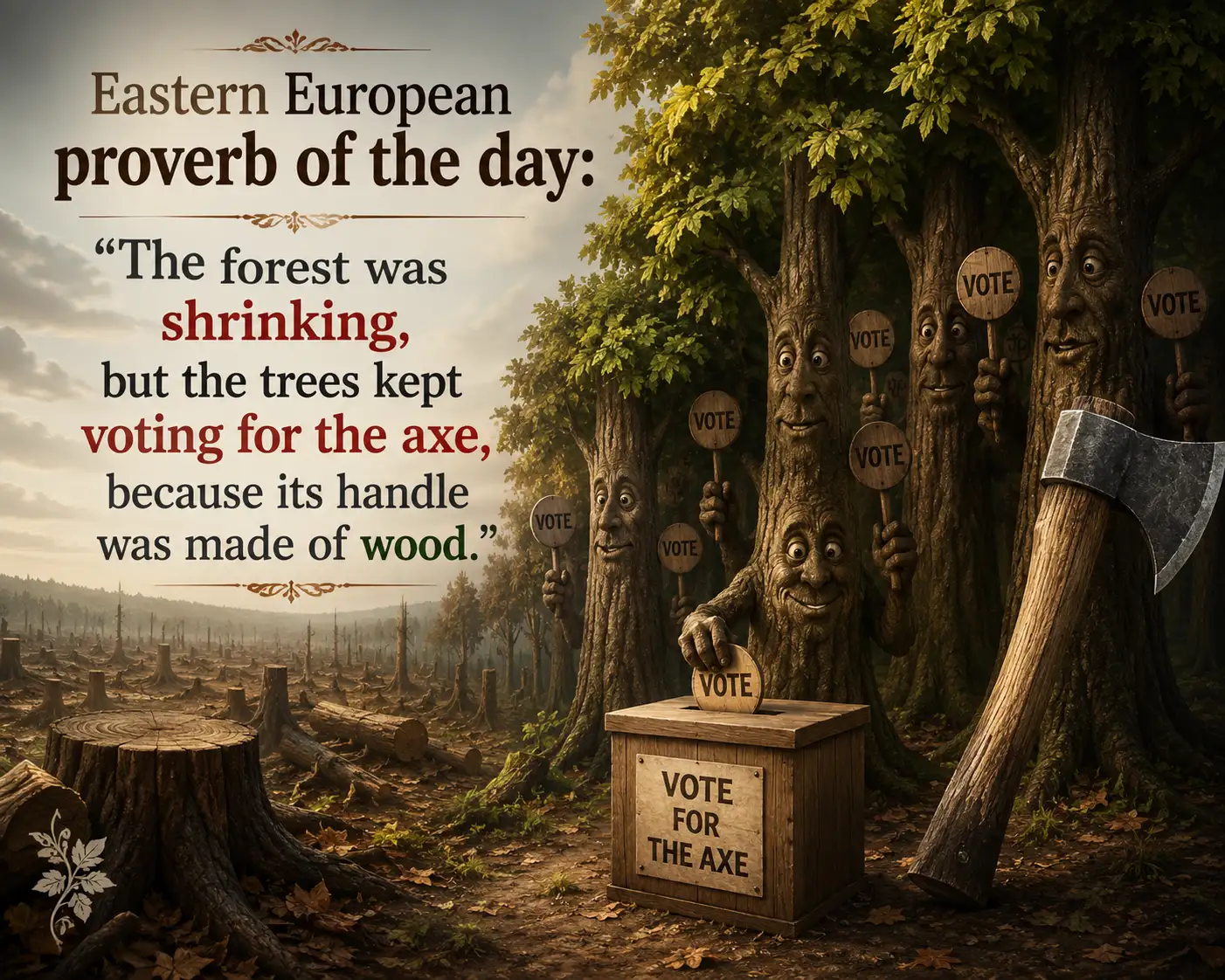
Best Proverb of the Day: “The Forest Was Shrinking, but the Trees Kept Voting for the Axe, Because Its Handle Was Made of Wood”
Some proverbs survive for centuries because they describe human nature more accurately than entire books. The old Eastern European proverb, “The forest was shrinking, but the trees kept voting for the axe, because its handle was made of wood,” belongs in that category. At first glance, it sounds like a simple observation about a forest. Yet beneath the image lies a profound lesson about trust, familiarity, influence, and self-deception.
The best proverb of the day feels remarkably relevant in modern life. Whether in politics, business, friendships, workplaces, or personal decisions, people often place trust in what feels familiar rather than what is genuinely beneficial. The proverb captures a psychological tendency that researchers continue to study today: our preference for the known over the unknown, even when evidence suggests the familiar choice may be harmful.
Why Does the Best Proverb of the Day Reveal a Universal Human Weakness?
The genius of the best proverb of the day lies in its simplicity. The trees support the axe because part of the axe appears to belong to them. Its handle is made of wood. It looks familiar. It seems connected. Yet the trees fail to recognize the part that matters most: the blade.
Modern psychology offers a fascinating explanation. Human beings naturally trust what feels familiar. Psychologists call this the familiarity bias. We often prefer ideas, people, habits, and beliefs that resemble what we already know. While familiarity can provide comfort, it can also cloud judgment.
History offers many examples. Entire societies have embraced harmful policies because they sounded reassuring. Businesses have ignored disruptive innovations because old methods felt safer. Individuals have remained in damaging relationships because the familiar seemed less frightening than change.
As the writer Mark Twain observed, “It ain't what you don't know that gets you into trouble. It's what you know for sure that just ain't so.” The best proverb of the day echoes this warning. The trees are not destroyed by ignorance alone. They are destroyed by misplaced confidence.
The lesson extends into everyday life. People sometimes stay in unfulfilling jobs because uncertainty feels risky. They delay important decisions because familiar routines provide temporary comfort. The forest shrinks slowly, often without anyone noticing until significant damage has already occurred.
What Can Modern Psychology Teach Us About the Forest and the Axe?
The best proverb of the day aligns closely with what psychologists call cognitive shortcuts. These mental shortcuts help people process information quickly. However, they can also lead to poor decisions.
One powerful shortcut is identity-based trust. People tend to trust those who appear similar to them. Shared backgrounds, shared language, shared experiences, or shared beliefs often create a sense of safety. Yet appearances can be misleading.
Consider some of history's greatest business failures. Many successful companies dismissed new competitors because they looked too small to matter. The familiar industry leaders assumed their position was secure. By the time they recognized the threat, the market had changed.
The proverb teaches that wise judgment requires looking beyond appearances. The trees focus on the wooden handle. They fail to evaluate the purpose of the axe. In real life, people often focus on labels, symbols, personalities, or first impressions while overlooking actions and outcomes.
This is why the best proverb of the day remains so powerful. It reminds readers to ask a simple but transformative question: What does this choice actually do?
That question can improve careers, relationships, finances, leadership decisions, and personal growth. Successful people often distinguish themselves not by intelligence alone but by their willingness to examine consequences instead of appearances.
The ancient philosopher Epictetus once noted that people are disturbed not by things themselves but by the views they take of them. The forest sees friendship. Reality sees a blade.
How Can the Best Proverb of the Day Help You Make Better Decisions?
The greatest proverbs are practical tools for everyday life. The best proverb of the day offers a framework for critical thinking in a world filled with persuasion, marketing, social pressure, and constant information.
Before making an important decision, it encourages people to pause and evaluate outcomes rather than impressions. Does a choice genuinely serve your goals? Does a relationship help you grow? Does an opportunity align with your values? These questions reveal the blade hidden behind the handle.
The proverb also offers hope. Awareness changes everything. Once the trees recognize the axe for what it is, they gain the ability to protect the forest. Likewise, people who learn to separate familiarity from wisdom become more resilient and more independent thinkers.
Many timeless sayings express similar truths.
“Not all that glitters is gold.”
“A wolf may lose its teeth but never its nature.”
“Fine words butter no parsnips.”
“The smoothest road is not always the safest.”
“The mask does not change the face.”
“Comfort is often the enemy of growth.”
“A borrowed opinion cannot guide your future.”
“The loudest voice is not always the wisest.”
“What is easy to accept is not always true.”
“Judge the path by where it leads, not by where it begins.”
Together, these sayings remind us that wisdom begins when appearances stop being enough.
The best proverb of the day endures because it captures a truth that remains relevant across generations. People often trust what feels familiar. Yet growth, wisdom, and success depend on looking deeper. The forest chose the axe because it recognized the handle. The lesson for modern readers is to recognize the blade before it is too late.
When understood fully, this proverb becomes more than a clever saying. It becomes a lifelong guide for judgment, courage, and clear thinking. And perhaps that is why the oldest wisdom often feels the newest.