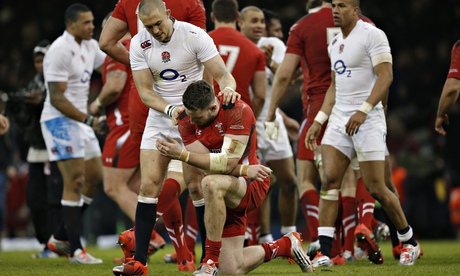
England have been playing Wales at rugby union since 1881 but never has there been expectation like this. Even the sides’ last Rugby World Cup fixture, in the 2003 quarter-finals, came freighted with less significance. As well as being England’s biggest game under Stuart Lancaster, the outcome could influence what happens on both sides of the Severn bridge for the next decade.
If that sounds ludicrously overblown, just consider – from the host nation’s perspective – the consequences of an English defeat on home soil at their own World Cup. In the short term it would leave them staring into the black hole of non-qualification from Pool A, at the mercy of a lip-smacking Australia next week. Fail to make the knockout stages and their worst nightmare will become depressingly real. Everything may unravel, from their coaching team to the Rugby Football Union’s desire to end the boom-and-bust cycle in which the national team has been trapped since 2003.
This is before Twickenham officials even begin to quantify the scale of the potential missed legacy opportunity in terms of inspiring future generations of English kids, never mind the unsold white shirts and associated replica trinkets. In theory this is just another sizeable game of rugby. In truth it is nothing of the sort.
The RFU, as one of its senior figures stressed on Friday, is “not planning for failure”. But neither are Warren Gatland’s Wales. Just imagine what a victory would do for Welsh rugby. The outbreak of scarlet fever would make their 30-3 win at the Millennium Stadium in 2013 feel like a pre-season friendly. There would still be the small matter of beating Fiji but Pool A qualification would be assured if the Wallabies also beat England. People love to imagine rousing pre-match team-talks but Wales need no further motivation on days like these.
It makes for a different feel from a Six Nations game. Traditionally what motivates both these countries most is not the sweet scent of success but the unspeakable horror of losing. Who can forget the one and only Frank Keating’s timeless quote from Mervyn ‘Merv the Swerve’ Davies: “Every Welshman’s nightly prayer is ‘Lord, if we’ve got to get beat, let it not ever be by England’.”
This weekend it is English supporters who are offering up the silent prayers of supplication – because this could be the absolute best of times for Lancaster’s squad or the most miserable experience of their lives. The backdrop will be wonderful, the occasion throbbing confirmation of the grandest World Cup yet. No one, though, can guarantee the outcome. England may have won their past eight home games, most recently against Fiji, but not even their most loyal supporters would accuse them of big-match consistency.
Nor does it count for much that England have beaten Wales on three of their last four visits to London. As this tournament has already shown, past reputation is not the reassurance it once was. What if England’s front five cannot gain the advantage they have enjoyed at scrum-time in the past? Or if Jérôme Garcès, who refereed South Africa versus Japan last Saturday, finds less fault with Gethin Jenkins’ scrummaging than has done previously?
If Wales are smart – and in the biggest games most teams coached by Gatland generally are – they will certainly attempt the odd chip through or over England’s midfield early on; Sam Burgess is capable of making a sizeable impact but Wales will want to examine his speed on the turn. Hassle the Youngs brothers, ask Dan Lydiate to chop down Billy Vunipola repeatedly, smash England’s reshuffled midfield: if Gatland’s men can do all three – roared on by an anticipated 20,000 of their own fans – they will consider they have every chance.
The onus, then, is on England to get an early grip at set piece and breakdown. Struggle – or lose their discipline – in both areas and a long, dark night of the soul will ensue. For whatever reason – form, nerves, opposition – the scrum has not been its customary area of strength. The breakdown, similarly, will be critical; Chris Robshaw may be about to outdo Martin Johnson by captaining England for the 40th time but it is getting the better of Sam Warburton that matters more.
That is certainly the view of the ever-combative Mike Brown, more of a key figure than ever given England’s relative lack of midfield pace and kicking options. “To stamp our authority on the game we need to start with our physicality,” he said. “It all starts there for us. Physicality is not just about one-out runners, it’s about being physical at the breakdown to give us quick ball to play the fast-paced game we know we can play.”
Brown was also a prickly presence at Cardiff in February during the tunnel stand-off that set the tone for a defiant England success. He is slightly embarrassed by the memory – “Chris was coming under a bit of heat and I was just trying to back him up, being the gobby so-and-so I am” – but will not be backing down on any front against England’s noisiest neighbours. “We seem to have a lot of grudge matches but they definitely seem to enjoy beating us. We’ve all grown up with it … in my case from the age of five, watching on the television with my old man. I just know it’s going to be an incredible occasion and I feel very lucky to be part of it.”
He is not alone. While Brown insists England will also draw inspiration from their Millennium mauling two years ago – “the 2013 game is still deep inside me, it’s definitely a driving force for us as a team” – he knows it is the immediate future that counts. If Wales can establish a lead, they will take some stopping. England should win narrowly but it is not a sure thing.