Technology giants reign as America's best-run companies.
The companies earning the highest marks in this year's Management Top 250 ranking have capitalized on what is now a nearly two-year stretch of pandemic-driven economic upheaval that has changed the way people work and shop.
At the very top, Microsoft Corp. held on to its No. 1 spot in the annual ranking, which uses the principles of the late management guru Peter Drucker to identify the most effectively managed companies.
Microsoft ranks no lower than sixth in four of the five main components of the overall ranking compiled by researchers at Claremont Graduate University's Drucker Institute: employee engagement and development, innovation, social responsibility and financial strength. It is No. 261 in customer satisfaction among the 846 companies examined for this year's ranking.
Amazon.com Inc. ranks second overall this year, followed in order by Apple Inc. and International Business Machines Corp., with Intel Corp. rounding out the all-tech top five.
"They were well managed and they made the most of a pretty chaotic environment," says Zachary First, Drucker's executive director, of the top-ranked companies. "Last year was a good time for companies that know how to innovate and know the value of innovation."
The analysis captures data through the end of June, reflecting the impact of the pandemic as well as the first few months of the economic recovery.
Microsoft's overall score has increased more than any other company's since Drucker researchers began ranking the best-managed companies in 2017. The increase in its innovation score over that period also is the biggest of any company.
Chief executive Satya Nadella has pushed Microsoft to develop its cloud-computing business since taking over in 2014, a sector that has thrived the past few years.
"I think what's impressive about Microsoft is what Satya Nadella has done under his watch," says Willy Shih, a professor of management at Harvard Business School. "His willingness to let go of the old and move to the new and move to cloud-first, that was a key decision. A lot of organizations have trouble letting go."
"I think we were in the right place at the right time," says Chris Capossela, Microsoft's chief marketing officer, explaining the company's strength during the pandemic. "Our reinvention to the cloud has been a huge part of our success."
In November, Mr. Nadella reaped some of the benefit of the Microsoft's success, selling about half of his shares in the company.
In a filing with the U.S. Securities and Exchange Commission, the Redmond, Washington-based software company reported Mr. Nadella sold 838,584 shares over two days, out of holdings of close to 1.7 million shares.
The transaction yielded more than $285 million for Mr. Nadella. The company said he sold the stock for personal financial planning and diversification reasons.
Not all technology companies thrived in 2021. Some early-pandemic darlings cooled off in this year's rankings.

Zoom Video Communications Inc., ranked in the top 200 a year ago, fell out of the Top 250 after declining customer and employee satisfaction scores.
After nearly two years of working virtually during the pandemic for many people, there are clear signs of burnout in an era of nonstop video calls, though companies have said they expect flexible work arrangements to endure.
Zoom didn't respond to requests for comment for this article.
Google parent Alphabet Inc. fell eight spots from a year ago to No. 13 this year, in part because of a 17-point decline in its employee engagement and development score, as well as smaller declines in innovation and social responsibility.
A group of Google employees formed a union during the pandemic, the Alphabet Workers Union, to organize workers and give them the ability to speak out about the company.
This October, in an interview at The Wall Street Journal's Tech Live conference, Alphabet CEO Sundar Pichai said employee activism pushes companies to be more accountable. Google didn't comment for this article.
Warning signs
While every company has flaws, the Management Top 250 ranking aims to point out firms that are particularly good at balancing a wide range of what are often competing management priorities. For instance, the 34 metrics used to determine the rankings include employee pay compared with industry averages, patent applications and three-year average total shareholder return.
The researchers also use a "red flag" system to highlight companies with particularly weak scores in one or more dimension of Drucker's scorecard.
The red flags serve as a warning that a company -- even one that scores highly in every other aspect of the ranking -- needs to address an area of weakness before it has a broader effect on its business.
This year, 56 companies in the Management Top 250 in a wide range of industries were flagged, including Allstate Corp. and Walmart Inc. for low scores in employee engagement and development, Philip Morris International Inc. and Wells Fargo & Co. for customer satisfaction, Nasdaq Inc. for innovation, Tesla Inc. for social responsibility and Hilton Worldwide Holdings Inc. and Delta Air Lines Inc. for financial strength.
Facebook's parent company, Meta Platforms Inc., earned a red flag this year for its weak customer-satisfaction score.
Meta fell 19 spots in the overall ranking this year, to No. 31 from No. 12 last year, with its disproportionately low customer-satisfaction score coming amid continuing criticism of Facebook's alleged harm to some users and the company's handling of misinformation, among other issues.
The Drucker researchers say Meta's overall statistical profile bears a resemblance to those of big tobacco firms: high marks for financial strength but low scores for customer satisfaction.
A spokesman for Meta declined to comment.
Stalwarts and stumbles
Another prominent name, Procter & Gamble Co., the maker of Tide, Bounty and many other consumer products, remained in the top 10 thanks to high scores across the ranking's five dimensions of performance.
The company has benefited from consumer shifts spurred by the pandemic, but it also began making changes to its complex management structure that had sometimes put brand managers and country managers at odds.
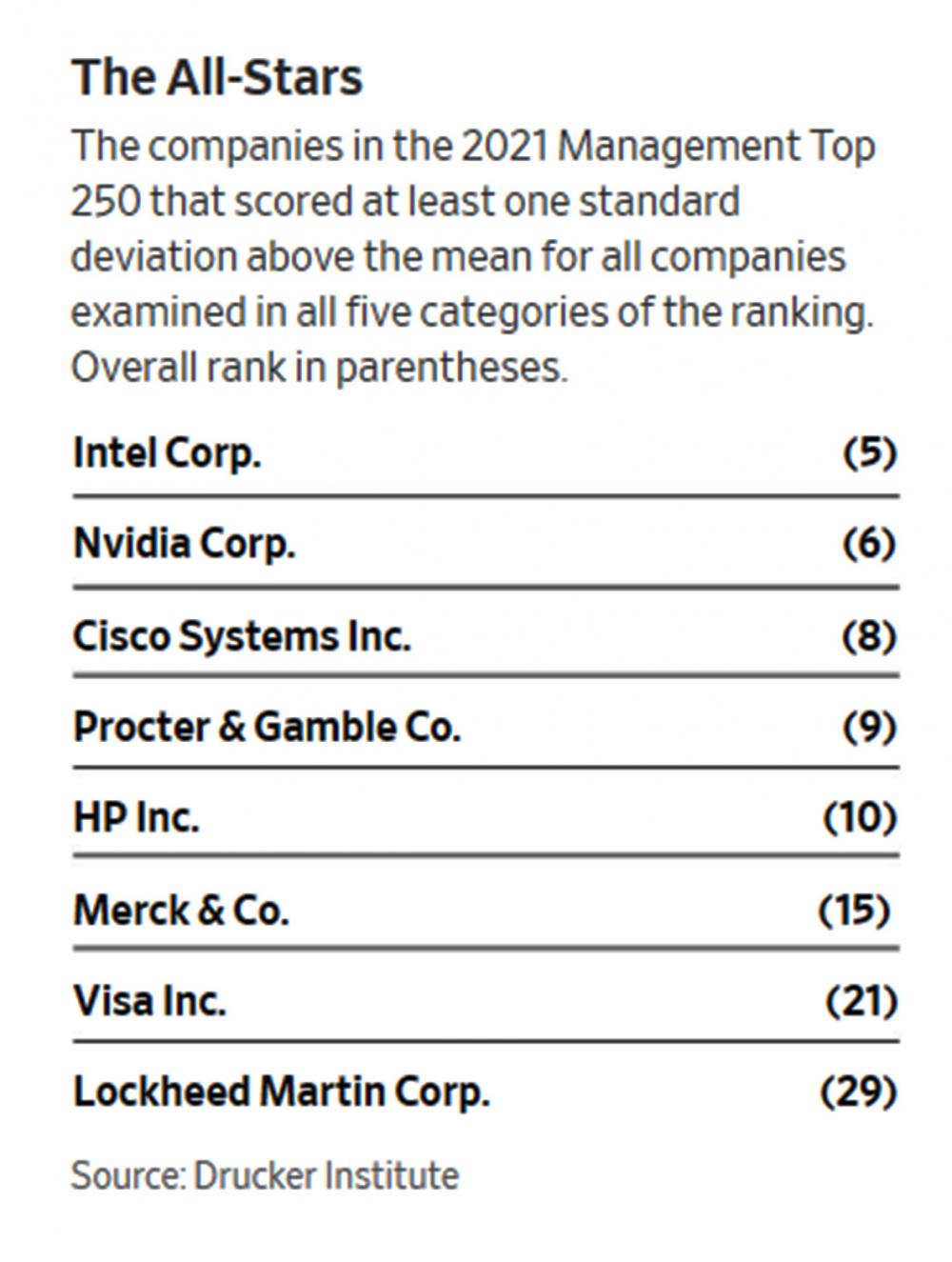
P&G is one of eight companies this year with particularly high scores across all five dimensions of the ranking. The others are Intel, Nvidia Corp., Cisco Systems Inc., HP Inc., Merck & Co., Visa Inc. and Lockheed Martin Corp.
AT&T Inc. fared worse, dropping 106 spots, to No. 166 this year from No. 60 last year -- despite a higher customer-satisfaction score this year -- due to declines in innovation, social responsibility, employee engagement and development, and especially financial performance.
Earlier this year, AT&T decided to unwind its big bet on entertainment by agreeing to combine WarnerMedia with Discovery Inc. in a new publicly traded company, completing AT&T's retreat from the media business.
"The data doesn't capture employee or customer response to the public announcement of the deal, but it does capture employee and customer response to the realities of a company struggling with what to own and what to divest," says Drucker's Mr. First.
An AT&T spokeswoman pointed to company CEO John Stankey's comments at the time of the merger announcement that it will help AT&T be one of the best-capitalized broadband companies, focused on investing in 5G.

It was also a down year for ExxonMobil Corp., which fell off the Top 250 list entirely this year -- from No. 177 last year -- after its financial-strength rating declined. In 2021, an activist investor successfully campaigned to win seats on the board of the oil giant.
The remade board of directors is debating whether to more forward with several major oil and gas projects as the company reconsiders its investment strategy in a fast-changing energy landscape.
An Exxon spokesman says the rankings capture one of the most challenging years in company history, and that in 2021 it made progress improving earnings and operating performance in a recovering market.
In October, Exxon reported quarterly earnings of $6.8 billion, its best quarterly performance since 2017. The industry is reaping the rewards of resurgent commodity prices as the economy emerges from pandemic-driven stagnation.
Exxon has fallen the farthest since the first Drucker ranking. Since 2017 the company has declined in all dimensions of the ranking except its social-responsibility score, which is based on various metrics that reflect environmental, social and corporate-governance issues, the researchers say.
Drucker's social-responsibility metric relies on various ESG rating services that reward companies for having policies in place for emission reduction or for not using forced labor in their supply chain, among other things.
But it doesn't measure if a company follows through on its pledges. For example, companies may earn higher marks for statements made in response to the murder of George Floyd last year, but whether or not they followed through on any diversity and inclusion efforts would be better represented in the ranking's employee-satisfaction score, the researchers say.
"This is an area in which you have to work with the data you have," says Mr. First. "Companies can do fairly well on these systems simply by disclosing and reporting certain things."