With growing awareness of the environmental and ethical consequences of mining for natural diamonds, lab grown diamonds are arguably a girl’s new best friend. Not only does mining cause habitat destruction, deforestation and chemical waste, but the human implications are equally severe, be it displacement, air pollution or poor working conditions.
The first diamonds were mined in India around 4BC, but the industry didn’t reach industrial scale until the 19th century when primary kimberlite pipes were discovered. These natural volcanic rock formations in the earth provided easier access to precious gems. It wasn’t long until jewellery heavyweights like DeBeers, Cartier, Tiffany & Co and Bulgari monopolised mining, making diamonds more accessible and no longer just for Royals and elites.
Driven by concerns like blood mining and land degradation, lab grown alternatives grew in the public consciousness at the turn of the century, with their popularity peaking in 2024. More affordable than buying the real deal, and the spitting image of a mined diamond, it’s no surprise that 78 per cent of engagement rings sold at Queensmith, a Hatton Garden jeweller specialising in diamonds, now feature lab grown diamonds, up from less than 1 per cent in 2019.
Whether it’s an engagement ring or an anniversary gift, buying vintage diamonds is an equally sustainable choice. But owing to their rarity, antique diamonds can cost a bomb (Taylor Swift’s rock reportedly costs between £500,000 to £4 million). Alternatively, lab grown diamonds will set you back 25-50 per cent less per carat compared to a mined diamond.
“The rise of lab grown diamonds has been one of the most transformative shifts our industry has seen in decades,” Brett Ashfar, founder of Queensmith, tells me. “The surge began around 2020 and has gathered pace ever since – it’s no coincidence that this growth has coincided with a period of economic uncertainty, when clients are more conscious of value for money than ever before.”
Jeremy Kazen, CEO and Co-Founder of The Diamond Store, argues this isn’t merely a trend, but a structural change in consumer values. “Customers are seeking transparency, value, and sustainable choices without compromising on visual brilliance or design.”
As with every industry, social media and celebrity culture have their part to play too. Taylor Swift’s aforementioned ring, Miley Cyrus’ cushion-cut style and Dua Lipa’s bold chunky stone have all created a demand for big, bold and beautiful rings. “Bigger diamonds are now seen as the standard rather than the exception,” Ashfar says. “As lab grown stones have become more accessible, they’ve reshaped the aesthetic benchmark for what an engagement ring “should” look like, and it’s now commonplace for our clients to be enquiring about 2 carat, 3 carat, even 4 carat diamonds on a daily basis.”
Whether you’re in the market for an engagement ring, a wedding anniversary gift, a special birthday or even a memorable Christmas gift, I’ve rounded up the best brands that sell lab-grown diamonds, from Pandora and Astrid & Miyu to Ernest Jones and H Samuel.
The best lab-grown diamond brands for 2025 are:
- Best trend-led lab grown diamond brand – Missoma: From £525, Missoma.com
- Best affordable lab-grown diamond brand – Pandora: From £199, Pandora.net
- Best lab-grown diamond engagement rings – Queensmith: From £995, Queensmith.co.uk
- Best lab-grown diamond brand for variety – Ernest Jones: From £1,500, Ernestjones.co.uk
Ernest Jones
Ernest Jones has grown from a small jewellers on Oxford Street in the mid 20th Century into one of the UK’s leading stores specialising in diamonds and watches. Having embraced the lab grown diamond movement, its new Bloom collection is fully traceable, responsibly sourced and Gemological Institute of America (GIA) certified. The diamonds are made using renewable energy and set in 14 carat white gold or 14 carat and 18 carat yellow gold. Starting from £500 for a 0.50 carat lab grown diamond bracelet, there are also studs, oval pendants, pearl cut bracelets and 2.50 carat rings costing upwards of £3,500.
H Samuel
H Samuel began in 1862, when Harriet Samuel transformed her family’s humble silversmith business into a mail-order company selling everything from jewellery to watches. Having always adapted to the times, its lab-grown collection continues the brand’s commitment to make luxury jewellery accessible to everyone. From a 0.25 carat lab grown diamond pendant necklace to a 0.50 carat eternity ring, and 0.50 carat oval and emerald cut hoop earrings, there’s plenty of choice for the lowest end of the budget.
Ottoman Hands
Ottoman Hand’s jewellery is instantly recognisable thanks to its signature eye motif. Inspired by Eastern and Western influences, each piece is hand-crafted by artisans and made from gold-plated recycled materials. Featuring in shows like House of the Dragon and Emily in Paris, its jewellery has been worn by the likes of Kate Winslet, Lily Collins and even Anne Hathaway in the new Devil Wears Prada. From striking earrings to pendant necklaces, the evil eye collection features handset precious stones, be it sapphires or lab-grown diamonds. Starting from £369 for a delicate diamond cluster bracelet, the solid gold evil eye diamond stacking ring would make a lovely anniversary gift.
886 by The Royal Mint

Launched in 2022, 886 by The Royal Mint is an evolution of His Majesty's Treasury-owned, The Royal Mint. Its name pays homage to the year the first unified coin was founded, under the reign of Alfred the Great. Despite remaining the UK’s official maker of British coins, our increasingly cashless society has forced the company to diversify its output.
Drawing on the artisan skills of coin makers and using sustainable sourcing methods, the jewellery brand recovers precious metals from electronic waste. Its first collection uses lab grown diamonds that are set in solid 18 carat gold. The bridal themed capsule includes bracelets, necklaces and earrings, ranging in price from £495 to £5,995. The company’s illustrious history only adds to their memorable appeal.
The Diamond Store
Founded in 1956, The Diamond Store is a London-based online jewellery that combines Hatton Garden craftsmanship with sustainable sourcing. It has long been a go-to for engagement rings and fine jewellery pieces, and its foray into lab grown diamonds now makes up a significant portion of its sales – particularly among younger customers. Be it a birthday gift or a wedding anniversary piece, its lab grown diamonds start from £109 for 00.5 carat and up to £5,335 for 2 carats.
Pandora
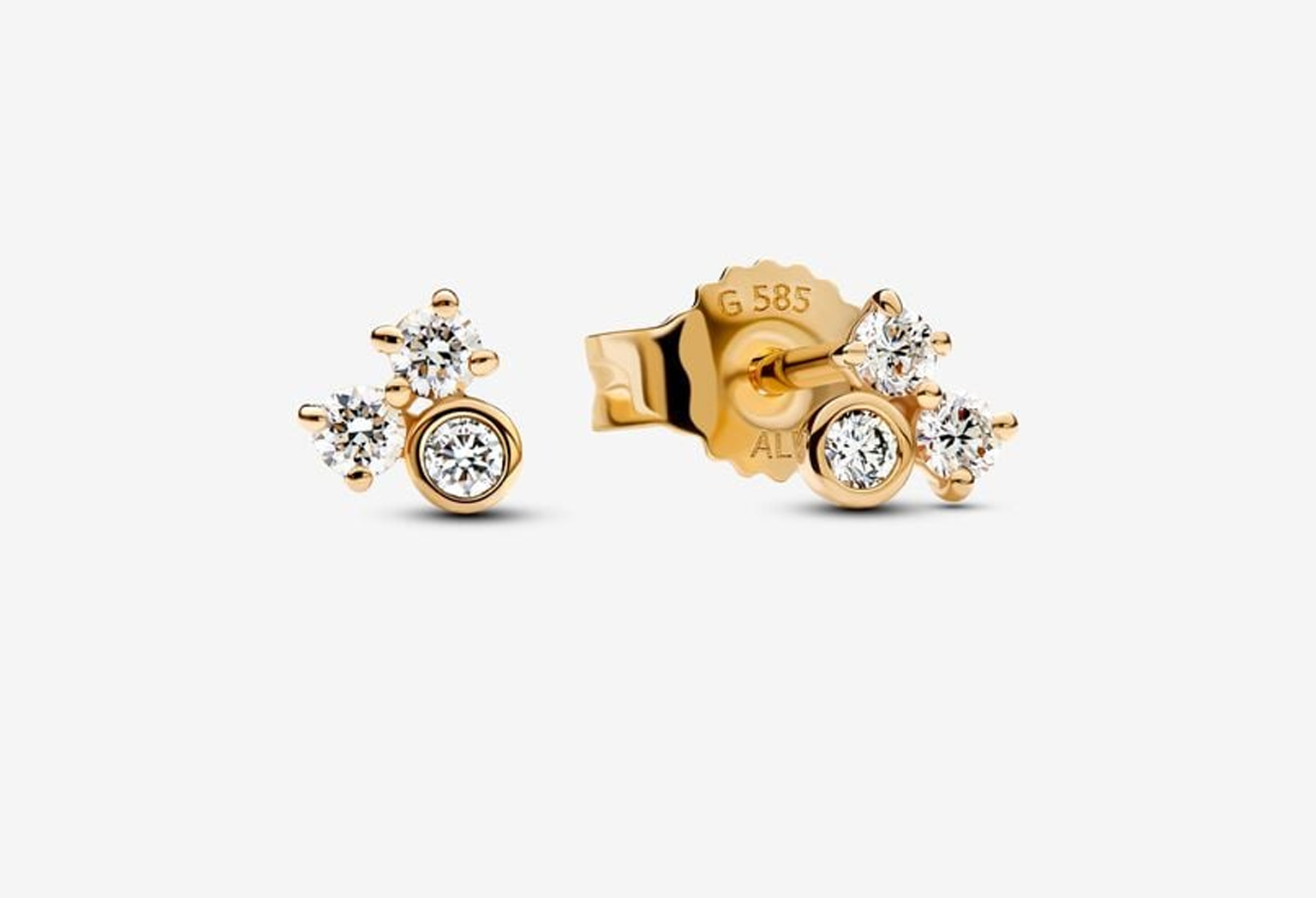
As part of its pledge to become entirely carbon neutral, Pandora says it uses 100 per cent renewable energy in its facilities when crafting diamonds, with each set in 100 per cent recycled silver or gold (this could come from recycled jewellery, silverware, coins or even electronics). According to the brand, the carbon footprint of a white Pandora lab-grown diamond is around 95 per cent lower than that of a mined diamond of the same size.
From dainty rings (£199, Pandora.net) and understated studs (£349, Pandora.net) to glitzy earrings (£349, Pandora.net) and gemstone necklaces (£689, Pandora.net), the pieces range from 0.03 to 1.00 carat, costing between £109 and £1,699. When I reviewed Pandora’s lab grown diamond collection, I wrote: “The timeless pavé pieces, delicate diamond clusters and minimalist gold bands and chains throughout Pandora’s new era collection put a contemporary spin on classic styles.”
Queensmith
Founded in London in 2016, Queensmith is a relatively new jeweller on the scene. Known for its ethical practices and skilled Hatton Garden craftsmanship, the label specialises in bespoke engagement and wedding rings. It offers both lab grown and natural diamonds in the same cuts and shapes. You can design every detail of your ring, from the ring metal to the band style. Each piece is made to order with free resizing available, making it one of the best shops for lab grown engagement rings – but Queensmith also sells oval lab grown diamond stud earrings, eternity rings and men’s wedding bands too.
Astrid & Miyu
Astrid & Miyu requires little introduction. Founded in 2012 with the aim of bridging the gap between luxury and the high street, its trend-led yet timeless fine jewellery appeals to every generation of women. The lab-grown diamond collection elevates it into the luxury market, from solid gold cluster rings (£850, Astridandmiyu.com) to diamond bracelets (£400, Astridandmiyu.com) and delicate huggies (£450, Astridandmiyu.com) – all at less than £850.
The lab-grown range contains some of the most affordable diamond pieces you can buy, without compromising on quality – it’s a great destination for memorable birthday and Christmas presents, or thoughtful anniversary gifts.
Kimaï
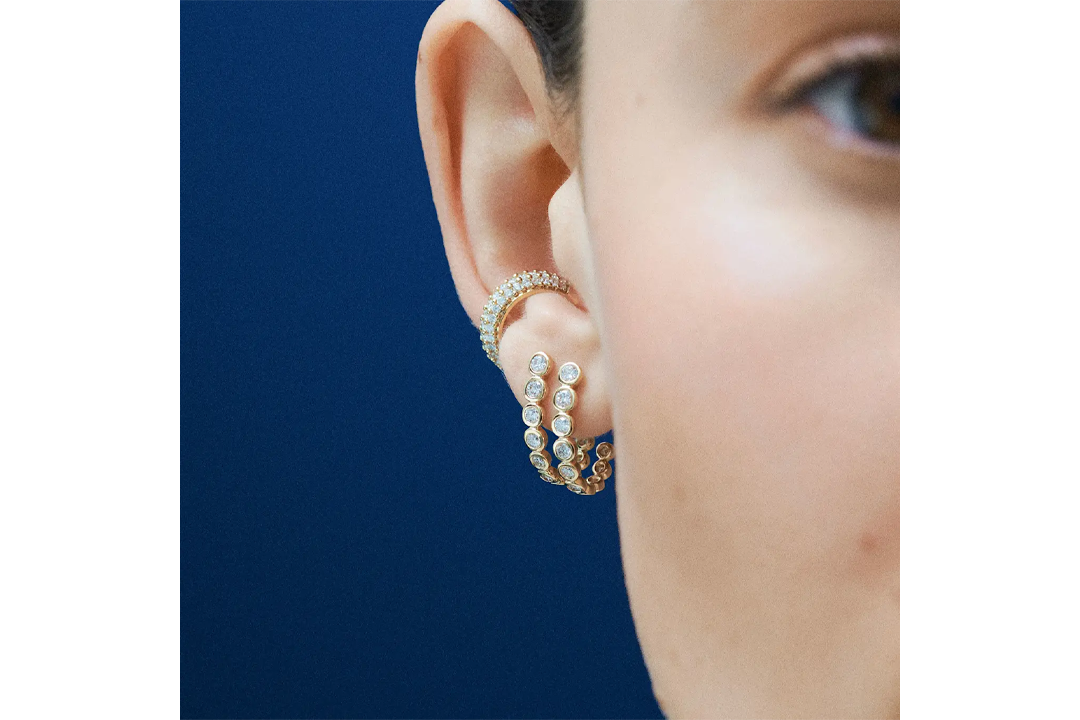
A specialist in the industry, Kimaï exclusively makes lab grown diamonds and uses recycled gold in its jewellery. Founded in 2018 with the pledge to cut out all the murky middlemen, the brand controls the entire process, from design to delivery. From fine jewellery pieces for special occasions to engagement rings and wedding bands, all its pieces are handmade to order and 18-carat gold plated to ensure durability, before being detailed with diamonds.
It’s acquired a loyal following that includes Meghan Markle, Emma Watson and Steven Bartlett, who invested a quarter of a million pounds into the brand on Dragon’s Den. My favourite pieces include the glow earrings (£225, Kimai.com), the Stella ring (£1,795, Kimai.com) and the Eva round ring (£1,645, Kimai.com).
Lily Arkwright
Manchester-based online jeweller Lily Arkwright has been leading the way in the UK for socially responsible engagement rings. Committed to affordable but well-crafted jewellery, the label produces lab-grown and moissanite diamonds – a sparkly and colorless lab-grown gem that’s cheaper than diamonds – that promise to rival the real deal. Its engagement rings can cost anywhere between £885 to £4,500, spanning classic solitaire styles to triple pave, vintage and halo designs.
When I reviewed the round lab diamond platinum solitaire ring (from £914.67, Lilyarkwright.com), I noted how it retained all the signatures of a traditional diamond – it’s near-impossible to tell the difference between its made-made centrestone and the real deal.
Missoma
Loved by the likes of The Princess of Wales and Bella Hadid, Missoma combines trend-inspired pieces with quality craftsmanship and attainable prices. The label’s lab-grown edit is fully traceable and excellent value – think £525 for a waved diamond stacking ring (Missoma.com), £575 for fine diamond mini hoop earrings (Missoma.com) and £765 for a diamond tennis eternity ring (Missoma.com). The 14 carat solid yellow gold pieces are more investment pieces, from the beautiful tennis necklace (£6,995, Missoma.com) to the matching bracelet (£3,195, Missoma.com).
Your questions about lab grown diamonds answered
Are lab grown diamonds real?
Offering the same reassurance as real diamond investments, labels selling lab grown gems offer certification that each stone is chemically and optically identical to mined diamonds. “Lab grown diamonds are genuine diamonds, made of pure carbon, with the same hardness, brilliance, and optical characteristics as those formed in the earth,” Kazen explains. “They are grown in a lab using cutting-edge technology that replicates natural geological conditions – even professional gemmologists need specialised equipment to tell them apart.”
Of course, there are slight differences. “Natural diamonds carry the weight of rarity and history: they’re finite and unique, and that sense of natural creation will always hold emotional power,” Ashfar says. “Lab grown diamonds, on the other hand, represent progress, innovation, and accessibility: they allow couples to choose a piece that’s often larger, flawless, and every bit as beautiful.”
Are lab grown diamonds worth it?
So, what about the investment value of rare, real diamonds? Industry experts argue that sustainability and transparency is now more important to buyers. “The modern buyer increasingly wants their purchase to reflect their personal values of ethical purchasing, sustainability and transparency, all integral to what luxury means today,” Ashfar says.
Owing to the lower initial price, Kazen also highlights how “customers can often go bigger or more bespoke for their budget.” In some cases, shoppers aren’t even decreasing their budget, but simply getting more bang for their buck. “The average engagement ring spend has stayed consistent at £5,750 year-on-year,” Ashfar explains. “Instead, people are expecting larger, better-quality diamonds for their money, which is entirely doable thanks to the ever-improving engineering of lab diamonds.”
The average lab-grown diamond that Queensmith sells today is around 1.70 carats compared with roughly 1.13 carats for mined diamonds. “People are realising they can have a larger or higher-quality diamond for the same spend, and that’s transforming what ‘value’ looks like in fine jewellery.”
For more inspiration, we’ve rounded up the best jewellery brands for every budget