Almost everyone who writes for a living now drafts with a machine somewhere in the process. The question stopped being whether to use AI writing tools and became which ones, and for what — a harder question than it sounds, because there are now hundreds of them and nearly every one claims to be among the best AI writing tools you can buy.
So instead of ranking by raw power, this guide sorts the leading tools by the writing task each one does best — drafting, research, paraphrasing, editing, marketing copy, and fiction — with honest notes on limits and cost. It is written for people who publish for readers who notice: reporters, editors, freelance writers, and communications teams who need work that is fast and trustworthy. We have left pure SEO platforms off the list on purpose. Where a figure could not be confirmed, we point you to the vendor's own page.
The best AI writing tools in 2026 combine large language models with workflows built for specific jobs: Eliten for an all-in-one text toolkit, Claude for research-heavy long-form work, ChatGPT for versatile drafting, QuillBot for paraphrasing and summarizing, Grammarly for editing, Jasper for marketing copy, and Sudowrite for fiction. The right pick depends on what you actually write.
The 7 best AI writing tools at a glance
|
# |
Tool |
Best for |
Starting price (see disclaimer) |
|
1 |
Eliten |
All-in-one text tools in one chat |
Freemium; paid tiers unlock more |
|
2 |
Claude |
Long-form reasoning and research |
Free tier; Pro from ~$20/mo |
|
3 |
ChatGPT |
Versatile, general-purpose drafting |
Free tier; Plus from ~$20/mo |
|
4 |
QuillBot |
Paraphrasing and summarizing |
Free plan; Premium from ~$8.33/mo annual |
|
5 |
Grammarly |
Editing and proofreading |
Free plan; Pro from ~$12/mo annual |
|
6 |
Jasper |
Marketing copy at scale |
Pro from ~$59/mo annual (no permanent free plan) |
|
7 |
Sudowrite |
Fiction and narrative |
From ~$10/mo annual (free trial only) |
All prices are accurate at the time of publication and change often. Check each vendor's site before subscribing.
1. Eliten — the all-in-one text workspace
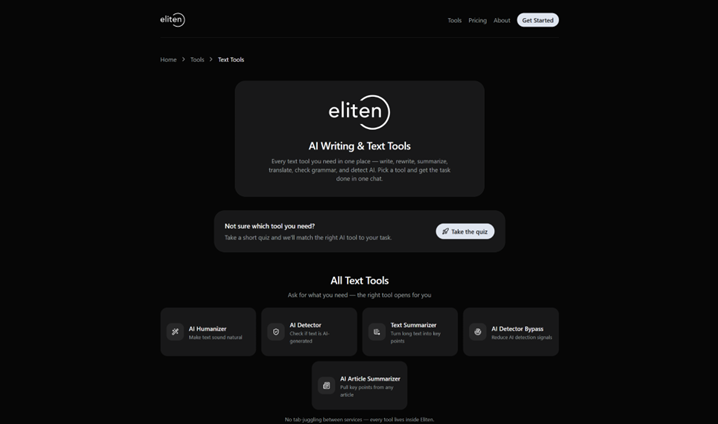
If your day means juggling a paraphraser in one tab, a summarizer in another, and a grammar checker somewhere else, Eliten's text tools collapse all of that into a single chat. You ask for what you need and the right tool opens: write from scratch, rewrite, summarize a long article, translate, check grammar, humanize AI-generated text, or detect whether something was written by AI. A short quiz even matches the right tool to your task if you are new to this.
That "one workspace, many tools" design is why it leads the list. For working writers, the friction is rarely a missing feature — it is the tab-juggling and copy-paste between five apps.
Best for: Writers, students, and non-native speakers who want humanizing, summarizing, paraphrasing, grammar checking, and AI detection in one place. Pricing: Freemium; check eliten.ai for current tiers and usage limits. Watch for: It is a focused text workspace, not a heavyweight book editor — pair it with a fiction tool for a full manuscript.
2. Claude — deep research and long-form reasoning
Claude, from Anthropic, is the tool serious long-form writers reach for first. Its strength is handling large amounts of context — long documents, dense source material, transcripts — and reasoning across them without losing the thread. For a reporter turning three reports into one explainer, that long context is the whole game, and its prose tends to need less heavy editing than most rivals.
Best for: Research-driven long-form work and any task where accuracy and nuance beat speed. Pricing: Free tier; Pro from ~$20/mo ($17/mo billed annually). Current at publication — confirm on the site. Watch for: Like every model, Claude can produce subtle factual errors in a confident voice. Treat it as a first-draft partner, not a fact-checker of record.
3. ChatGPT — the versatile generalist
ChatGPT remains the most versatile tool in the category and, for many, the on-ramp to AI writing. It drafts blog posts, reworks copy, brainstorms ideas, and handles short pieces with equal ease. If you want one general-purpose assistant that does a bit of everything competently, this is still the default.
Best for: General drafting, brainstorming, and quick rewrites before you commit to specialists. Pricing: Free tier (now ad-supported); Plus from ~$20/mo. Current at publication — check the site. Watch for: Its versatility is the catch. For editing precision use Grammarly; for narrative prose use Sudowrite. It is the Swiss Army knife, not the scalpel.
4. QuillBot — paraphrasing and summarizing
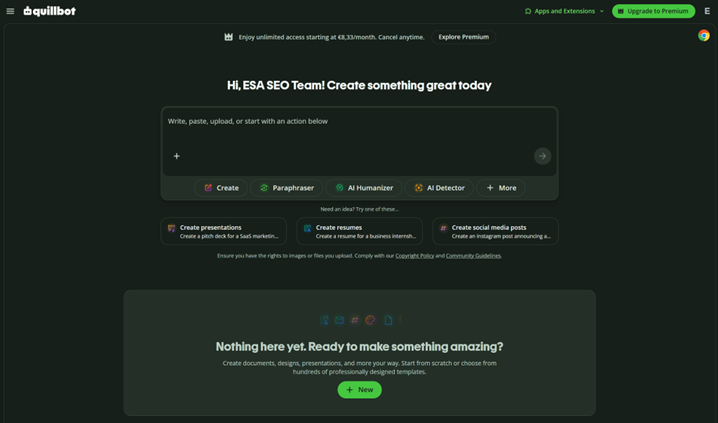
QuillBot earns its place for a job every writer does constantly: reshaping existing text. Its paraphraser cleans up clunky sentences, its summarizer compresses a long report into key points, and it bundles a grammar checker, plagiarism checker, citation generator, translator, and AI detector alongside. For a journalist digesting a 40-page filing, it is a genuinely useful companion — and a strong option for anyone on a budget.
Best for: Paraphrasing, summarizing, and cleaning up source-heavy drafts. Pricing: Free plan; Premium ~$19.95/mo monthly, dropping to about $8.33/mo on an annual plan (~$99.95/year). Figures vary by region — confirm on quillbot.com. Watch for: Paraphrasing reshapes text; it does not generate original thought. Use it to tighten your own writing, not to launder someone else's.
5. Grammarly — editing and proofreading
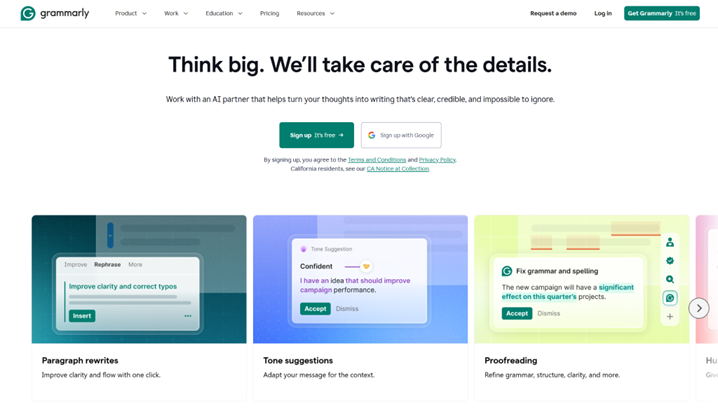
If the best grammar checker with AI features is what you need, Grammarly is still the name to beat. It catches the grammar, spelling, punctuation, tone, and clarity errors a tired editor misses, in real time across your browser, email, and documents. For anyone whose writing is read by clients or the public, it is the safety net you stop noticing until it saves you.
Best for: Editing, proofreading, and tone consistency — the last pass before you publish. Pricing: Free plan; Pro (formerly Premium) from ~$12/mo annual ($30/mo monthly), including 2,000 AI prompts. Current at publication — check the site. Watch for: Grammarly is an editor, not a ghostwriter. It sharpens what you wrote; it will not draft a full article from a one-line brief.
6. Jasper — marketing copy at scale

Jasper (formerly Jarvis) is what marketing teams reach for when the job is volume with consistency: blog posts, ad copy, social posts, and email that all need to sound like the same brand. Its standout feature is brand voice — train it on your own style and everything it generates carries a consistent, unique brand voice rather than generic output.
Best for: Marketing teams producing on-brand content at scale. Pricing: Pro from ~$59/mo annual ($69/mo monthly); custom Business tier; no permanent free plan, only a 7-day trial. Third-party lists still quote a Creator tier around $39–$49 — treat those as unconfirmed and check jasper.ai. Watch for: It is built for marketing. For journalism, academia, or fiction, a general model or a specialist usually serves you better.
7. Sudowrite — fiction and narrative
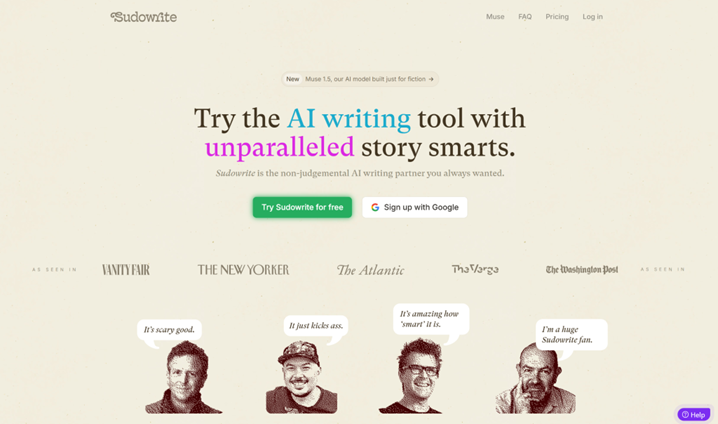
Sudowrite is the outlier, by design. It is built specifically for creative writing and fiction — not marketers, not bloggers. Its tools mirror how novelists actually work: describing a scene in sensory detail, exploring plot directions, and pushing through the blank page when a chapter stalls. Where most tools fight your voice, Sudowrite tries to find it.
Best for: Fiction writers and screenwriters who want an assistant tuned to prose. Pricing: Credit-based — Hobby & Student $19/mo ($10 annual), Professional $29/mo ($22 annual), Max $59/mo ($44 annual); free trial, no permanent free plan. Current at publication — check the site. Watch for: It is a specialist. For a business report or an article, this is the wrong tool.
How AI writing tools actually work
Nearly every tool here is a wrapper around one or more large language models — systems trained on billions of words that predict the most plausible next one. That is why most of them share a chat interface, and why they feel alike once you look past the branding: the real difference is the workflow built on top, not the model underneath. It also explains their biggest weakness. Because they optimize for plausible-sounding text, they can state something false with total confidence, so the human always owns the final call on what is true.
How to choose the right tool for your work
- Journalists and reporters: Claude to synthesize sources, QuillBot to summarize filings, Grammarly for the final proofread. Human verification stays non-negotiable.
- Editors: Grammarly as the anchor; Eliten's grammar and humanizing tools as a complement.
- Marketing teams: Jasper for on-brand volume, with ChatGPT as a general second seat.
- Fiction writers: Sudowrite, with a general model for research around the story.
- Students: QuillBot's paraphraser and citation tools, plus Claude for dense reading — and always cite your sources.
When a paid plan is worth it
Start with the free versions. Almost every tool here has a no-cost tier or trial good enough to tell you whether it fits before any money changes hands. Upgrade only when a specific limit — a word-count cap, the newest model, brand voice for a team, a plagiarism checker — starts costing you time. Most AI writing tools run between roughly $9 and $89 per month once you move past the free tier, so match the spend to the problem, not to the feature list. And remember the golden rule: never publish the first draft. AI gives you a start; a human still owns the facts, the cutting, and the voice.
Frequently asked questions
Is ChatGPT the best AI for writing? For general-purpose drafting, it is one of the strongest and a great starting point — but "best" depends on the job. Claude often edges it on long research pieces, Grammarly beats it for editing, and Sudowrite beats it for fiction. The most productive writers use it alongside specialists.
Is ChatGPT still the best AI? It is still among the best and the most widely used, but it no longer stands alone. Claude has closed the gap on long-context reasoning, and several tools now beat it on specific tasks. In 2026 the honest picture is a competitive field, not one clear champion.
What are the top 5 AI tools right now? For the writing jobs most people need done: Eliten for all-in-one text work, Claude for long-form and research, ChatGPT for versatile drafting, Grammarly for editing, and Jasper for marketing. Add QuillBot and Sudowrite and you cover nearly every use case.
Is it illegal to publish a book written by AI? No. In the United States, no law prohibits it, and major platforms allow it. Amazon's Kindle Direct Publishing permits AI-generated books but requires you to disclose AI-generated text, images, or translations through a private checkbox during publishing — a disclosure not shown to readers, and undisclosed AI content can lead to removal. Separately, the US Copyright Office generally will not register purely AI-generated work without meaningful human authorship, so the more you shape and rewrite, the stronger your position. Rules differ by country and platform and are still evolving, so confirm the current policy before you publish.
Can AI writing tools replace human writers? Not for anything that has to be true, original, or genuinely yours. These tools are excellent at accelerating drafts, beating the blank page, and handling repetitive tasks, but they have no judgment, no lived experience, and no accountability for the facts. The realistic future is partnership: AI carries the mechanical load while the human owns the ideas, the accuracy, and the voice.