CHANDIGARH: Although the recent repeated incidents of landslides in Himachal Pradesh might not have a direct link with the melting of glaciers and earthquakes in the fragile Himalayan region due to global warming, the authorities need to take these factors seriously.
A senior scientist in geophysics and seismology wing of the Wadia Institute of Himalayan Geology in Dehradun, Sushil Kumar Rohila says earthquakes are inevitable but we should be prepared to deal with even the worst situation. “We observe atleast three to four micro earthquakes every day in this part of the Himalayan region and these are heterogeneous,” he said. Since these micro-earthquakes are below magnitude of 3 on the Richter scale, people do not feel such earthquakes as these are coming at least 12 kilometres below the top layer of the earth and do not dislocate the surface, and only machines can record them.
Wadia Institute has installed 37 seismographs in north-west Himalayas, which covers Himachal Pradesh as well as Uttarakhand, which fall in seismic zones IV as well as V based on past incidents of earthquakes. Rohila says earthquakes are inevitable because some stress is accumulating 12 kilometres below the top layer of the earth and there is no such mechanism which can release the stress. He explains that during an earthquake in India, Indian tectonic plate collides with Eurasian tectonic plate in continent-to-continent collision and Indian plate gets below the Eurasian plate. In this process, the Indian plate is moving with a speed of 40-50 millimetres per year and it is not a static but dynamic process. “So pressure accumulates there which ultimately breaks weak zones and when it moves continuously, it results in fracture which is known as earthquake,” he added.
Two recent major earthquakes in Uttarakhand were recorded in 1991 and 1999. It was on October 20,1991, that an earthquake of 6.6 magnitude hit Uttarkashi in which over 760 people died and thousands of homes were devastated. On March 29,1999, another major earthquake occurred in Chamoli district in which over 100 persons lost their lives.
Early warning system needed
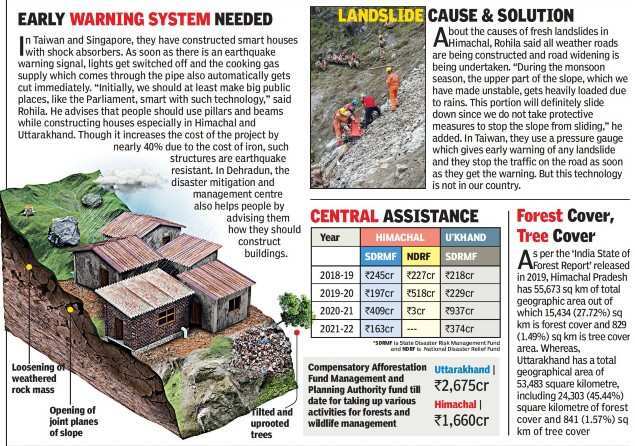
In Taiwan and Singapore, they have constructed smart houses with shock absorbers. As soon as there is an earthquake warning signal, lights get switched off and the cooking gas supply which comes through the pipe also automatically gets cut immediately. “Initially, we should at least make big public places, like the Parliament, smart with such technology,” said Rohila.
He advises that people should use pillars and beams while constructing houses especially in Himachal and Uttarakhand. Though it increases the cost of the project by nearly 40% due to the cost of iron, such structures are earthquake resistant. In Dehradun, the disaster mitigation and management centre also helps people by advising them how they should construct buildings.
Melting Glaciers
There are nearly 1,500 big and small glaciers in Uttarakhand and about 1,000 in Himachal. As per the latest Intergovernmental Panel on Climate Change (IPCC) report released last week, glaciers in HP’s Lahaul and Spiti district have been losing mass since the start of the 21st century. The report further says that if emissions do not fall, glaciers in the Hindu Kush Himalayan region would decline by two-thirds very soon.
Renu Lata, a scientist with the GB Pant National Institute of Himalayan Environment and Sustainable Development’s Himachal regional centre in Kullu, says for research on glaciers they have put up an instrument at a height of nearly 4,500 meters above sea level at Mantalai, which is the origin of river Parvati. “I am currently working on a project with a Bangalore team in the Beas basin of Kullu district to come up with an early warning system before any disaster happens,” she told TOI, adding since Himalayan mountains are young and very fragile, a clean environment should be the priority over development.
On February 7 this year, a glacier burst was reported from Joshimath in Chamoli district of Uttarakhand which had led to flash flood in the Dhauli Ganga river, causing destruction of two hydro projects. Bodies of over 80 people were recovered and over nearly 120 were declared missing. In another such incident near Joshimath on April 23 this year, at least 11 workers were killed in an avalanche near the Indo-China border after a part of a glacier collapsed on Sumna-Rimkhim road, where labourers were at work.
A recent study ‘Glaciers of the Himalayas’ released by the World Bank in June this year, says that glaciers in the Himalayas, Karakoram, and Hindu Kush (HKHK) mountain ranges are melting faster than the global average ice mass. “The HKHK glaciers are retreating at a rate of 0.3 meters per year in the west to 1.0 meter per year in the east. Field, satellite and weather records confirm that 9% of the ice area present in the early 1970s had disappeared by the early 2000s,” reads the study.
Damages due to hydrometeorological calamities
As per the data shared by the Union ministry of home affairs in the recently concluded monsoon session of Parliament, due to hydrometeorological calamities there was a loss of 429 human lives, 416 livestock, 5,886 houses and crops were damaged on 45,000 hectare area in Himachal in 2018-19. Whereas in 2019-20, 86 human lives were lost in the hill state besides 555 livestock and 2,940 houses were damaged. A total of 44 human lives were lost in 2020-21 till March 31 this year in Himachal, besides a loss of 84 livestock, damage to 1,307 houses and crops on 24,000 hectare area.
Similarly, in Uttarakhand, 103 human lives were lost in 2018-19, there was a loss of 770 livestock, 2,648 houses were damaged and there was damage to crops on 55,000 hectare. In 2019-20, besides loss of 80 human lives, 400 livestock were lost and 814 houses damaged. In 2020-21, Uttarakhand recorded loss of 68 human lives, 530 livestock and 1,031 houses.
Landslide Cause, Solution
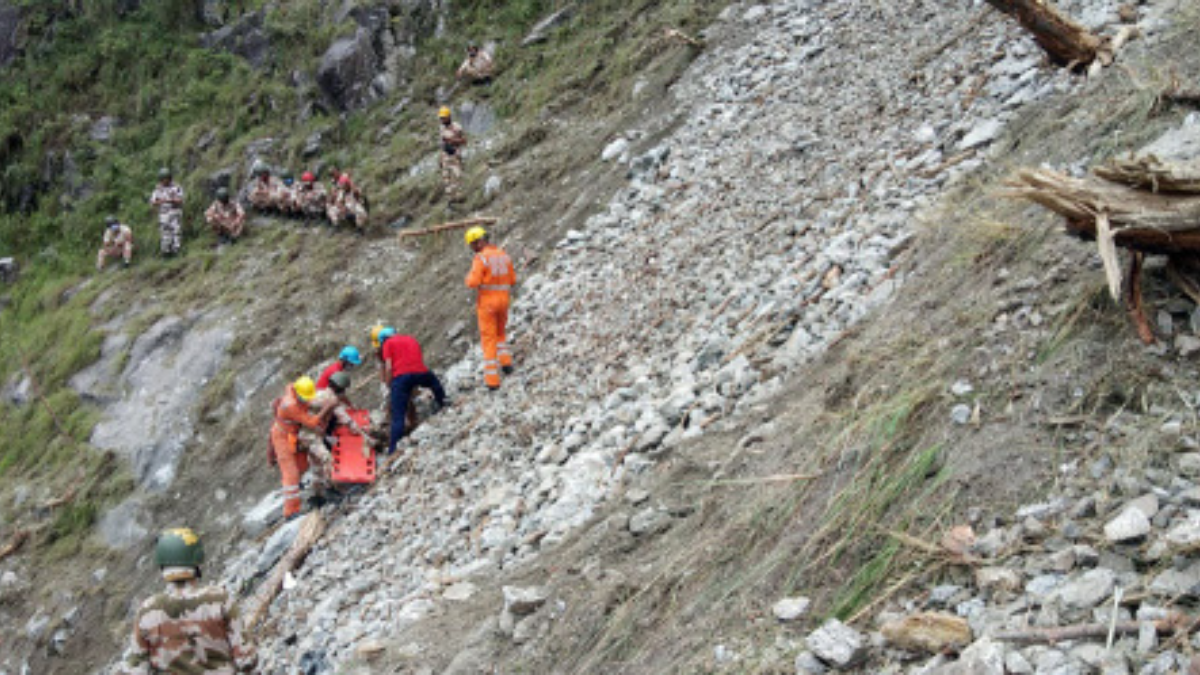
About the causes of fresh landslides in Himachal, Rohila said all weather roads are being constructed and road widening is being undertaken. “During the monsoon season, the upper part of the slope, which we have made unstable, gets heavily loaded due to rains. This portion will definitely slide down since we do not take protective measures to stop the slope from sliding,” he added.
In Taiwan, they use a pressure gauge which gives early warning of any landslide and they stop the traffic on the road as soon as they get the warning. But this technology is not in our country.
Central Govt Assistance
The central government has released its share of Rs 245 crore for 2018-19, Rs 197 crore for 2019-20, Rs 409 crore 2020-21 and Rs 163 crore for 2021-22 to Himachal under the State Disaster Risk Management Fund (SDRMF). Whereas under the National Disaster Relief Fund for all calamities, Himachal got Rs 227 crore in 2018-19, Rs 518 crore for 2019-20, nearly Rs 3 crore for 2020-21 from the central government.
Similarly, the neighbouring state of Uttarakhand received Rs 218 crore for 2018-19, Rs 229 crore for 2019-20, Rs 937 crore for 2020-21 and Rs 374 crore for 2021-22 as central government’s share of SDRMF.
The central government has also released Rs 2,675 crore to Uttarakhand and Rs 1,660 crore to Himachal under the Compensatory Afforestation Fund Management and Planning Authority fund till date for taking up various activities for forests and wildlife management.
Forest Cover, Tree Cover
As per the latest ‘India State of Forest Report’ released in 2019, Himachal Pradesh has 55,673 square kilometre of total geographic area out of which 15,434 (27.72%) square kilometre is forest cover and 829 (1.49%) square kilometre is tree cover area. Whereas, Uttarakhand has a total geographical area of 53,483 square kilometers, including 24,303 (45.44%) square kilometers of forest cover and 841 (1.57%) square kilometers of tree cover.