Italy's biggest media multinational MFE, formerly known as Mediaset, has stepped into the ongoing battle over the future of Warner Bros. Set up by the late former Italian Prime Minister Silvio Berlusconi, MFE said it favours Paramount's takeover bid over that of streaming giant Netflix.
After news of a deal between Netflix and Warner Bros in November, Paramount made a shock bid last week, announcing that it was going straight to Warner shareholders with an alternative takeover offer.
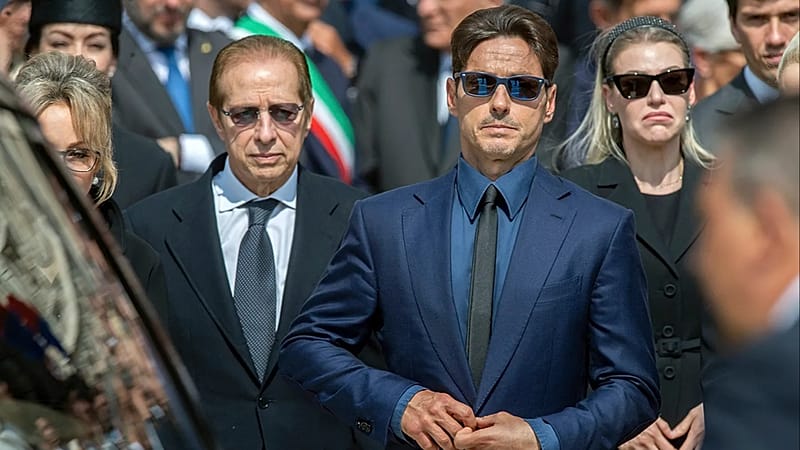
"It's a truly significant case," MFE CEO Pier Silvio Berlusconi said during a press conference at MFE's headquarters near Milan late on Wednesday evening.
"If I really had to go out on a limb, I'd prefer Paramount to win. But only because that way we wouldn't have three giants — Netflix, Amazon, and Disney — but four giants, including Paramount."
"It's a question of competition, not ideology," Berlusconi said of the bidding war. "A mathematical reasoning, not a political one. In any case, I see this operation as a very American thing, with little impact abroad."
Pier Silvio is the son of the former Italian prime minister and media tycoon Silvio Berlusconi. His mother is Carla Lucia Elvira Dall'Oglio.
What is MFE?
The senior Berlusconi founded Mediaset in the 1980s as the main private TV network, widely seen both as a hugely popular commercial broadcaster in Italy but also as a symbol of concentrated media and political power. Its outlets TGCom24 and Studio Aperto often promoted pro-Berlusconi politics and right-wing talking points.
In 2021, Mediaset was reorganised into MFE or Media for Europe, a Dutch-registered pan-European holding company that came out of the merger of its Italian and Spanish arms.
It currently owns leading channels in Italy, Spain, and Portugal, as well as German-speaking ones in Germany, Austria, and Switzerland through a 75.61% stake in ProSiebenSat.1.
Maintaining competition
Berlusconi highlighted the fact that in a market already dominated by Netflix, Amazon and Disney, the Paramount–WBD tie-up would create a fourth heavyweight to challenge the existing giants.
On the other hand, a Netflix–WBD merger would simply turbocharge the current number one by folding HBO and Max and the Warner Bros studio into its already vast subscriber base.
The stakes of the Warner Bros deal are particularly high for European broadcasters who are already squeezed by fragmented ad markets, younger audiences drifting to global streaming platforms or online viewing, and soaring rights costs.
A super-charged Netflix with WBD content would make European broadcasters even more dependent on a handful of US players. In turn, this would weaken their hand in licensing and co-production deals.
Figures behind the Paramount bid
Paramount Skydance has thrown the Warner Bros Discovery saga into a tailspin with an all-cash, $108.4bn (€92.3bn) hostile tender offer for the entire company, directly targeting WBD shareholders.
The bid, stemming from Larry Ellison’s family money, RedBird Capital, and a group of powerful Middle Eastern sovereign wealth funds plus Jared Kushner’s Affinity Partners, is being sold as a richer and cleaner alternative. It scoops up not just the studios and Max but also Warner's cable portfolio, including CNN and Discovery.
Netflix, by contrast, has already announced a $72bn (€61.3bn) cash-and-stock deal to buy WBD’s studios and streaming division only — folding Warner Bros, HBO and Max, DC, and the library into its own platform while WBD’s traditional TV networks are spun off as Discovery Global in 2026.
In Washington, Donald Trump has publicly questioned the Netflix deal.
"I think CNN should be sold, because I think the people that are running CNN right now are either corrupt or incompetent," Trump told reporters during a roundtable with business executives at the White House on Wednesday.
"I don't think they should be entrusted with running CNN any longer. So I think any deal should — it should be guaranteed and certain that CNN is part of it or sold separately," he added.