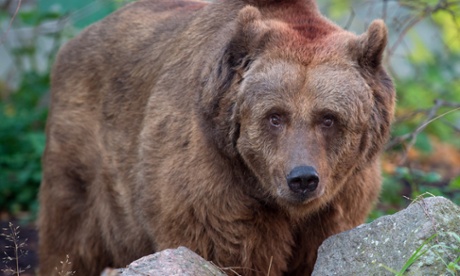
Berliners have been left to worry about the fate of their city’s last living mascot after an animal rights campaigner suggested that Schnute the bear may have to be put down due to her poor health.
The local newspaper BZ published excerpts from a leaked letter on Sunday in which the campaigner Stefan Klippstein, formerly of the Berliner Bärenbündnis, or Berlin Bear Alliance, called on the local veterinary authority to “assess whether it wouldn’t be in the interests of the animal to finally release it from its suffering and put it to sleep”.
After numerous papers reported that it had called for Schnute to be killed, the Bear Alliance said that Klippstein no longer represented the organisation, and added on its website: We believe that putting an animal to sleep only makes sense when it is suffering and any treatment of its suffering is impossible. That requires a specialised vet who would examine the animal on site.”
The 34-year-old brown bear is being kept in the Bärenzwinger, a compound in Köllnische park, near the town hall in central Berlin, where the “official” city bears have been kept as mascots since 1939. Schnute has been alone in the enclosure since the death of her daughter Maxi in August 2013, and according to Klippstein has been suffering increasingly poor health. “The animal has lost a lot of weight, can barely walk and seems downright apathetic,” Klippstein said.
Animals rights groups have protested against what they see as the Bärenzwinger’s inhumane conditions for decades, and in 2012-13 the newly founded allliance collected 23,000 signatures to have Schnute and Maxi moved to a larger park with better standards.
Maxi died during the campaign, and a conference of local council delegates decided in February 2014 that Schnute was too old to be transported safely. The alliance was “outraged” at the decision and repeated at the weekend that it was “still ready any time to take Schnute for free and give her a dignified end to her life in a humane enclosure”.
The Bärenzwinger, which opened close to the start of the second world war, originally contained five bears. Four were killed during the conflict and the compound was closed in 1945. It reopened in 1949 with two bears.
“For 14 hours a day the bears are kept in the inner enclosures of 8.5 by 11 square metres,” according to the alliance ’s website. “Only during the animal keepers’ working hours are they allowed on to two tiny concrete platforms surrounded by a wall mounted with giant iron thorns. Aluminium beer barrels, car tyres, and a kind of paddling pool are supposed to provide distraction.”
The alliance said both Schnute and Maxi had shown signs of psychological strain. According to bearlife.org, brown bears live for about 25 years in the wild and longer in captivity.
• This article was amended on 8 April 2015. An earlier version said that Stefan Klippstein represented the Berlin Bear Alliance. In fact he has left the organisation.