Afternoon summary
- John Bercow, the Commons speaker, has played down suggestions that the decision of peers to vote against tax credit cuts last night has created a constitutional crisis. There was “no procedural impropriety” in what happened, he told MPs. (See 1.05pm.) But the prime minister’s spokeswoman told journalists that Lady Stowell, the leader of the Lords, told the cabinet this morning that peers had broken a long-standing convention that they do not interfere with financial matters. David Cameron is launching a review into how that convention can be restored, and Downing Street are expected to release details of what it will involve later this afternoon.
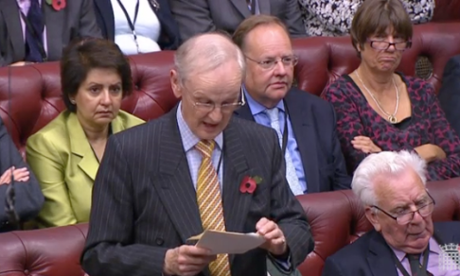
- Peers have started debating a motion to reject a government attempt to conclude the transition to individual electoral registration one year earlier than planned. (See 11.13am.) Labour and Lib Dem peers are both backing the “fatal” motion that would block the government’s plan and they believe they have a good chance of winning when the vote takes place later. Opening the debate, the Lib Dem peer Paul Tyler said the Electoral Commission was opposed to what the government was trying to do. He told peers:
Parliament has a special responsibility to listen to the Electoral Commission by law. They remind us that we have not just the right but we have a duty to oppose this order. Ministers should be ashamed of this unilateral attempt to undermine the IER [individual electoral registration] process, to skew the boundary review and in so doing to challenge the authority and integrity of the statutory independent commission set up precisely to advise us all on these issue.
The prime minister’s spokeswoman said the government wanted to bring in individual voter registration to tackle fraud and that, if the Tyler motion succeeded, the electoral roll in the Britain would “continue to contain a large number of entries who have either moved or are dead or who do not exist”. She also expressed concern at the Lords voting twice within two days to block government secondary legislation. This is only supposed to happen in “exceptional circumstances”, she said.
That’s all from me for today.
Thanks for the comments.
Updated
Robert Caro’s epic biography of the American president Lyndon Johnson is often (and rightly, in my view) described as the best political biography ever written. He has published four long volumes already, and only just started covering Johnson’s presidency, and another volume is on the way. People rave about them not just because the level of detail is extraordinary, but because they are written with all the narrative flair of a great novel.
So journalists were out in force to hear him being interviewed by Michael Gove at a press gallery event at lunchtime. Sadly I wasn’t there to to cover it (blame George Osborne), but here are some highlights.
(If you haven’t read any of the books, do. The second and the third are probably the best. You might think you won’t enjoy a book mostly devoted to a 1948 senatorial election but, trust me, you will.)
Michael Gove interviews great American biographer (Lyndon Johnson & Robert Moses) Robert Caro at Parlt press gallery pic.twitter.com/z66XFqxRoz
— Michael Crick (@MichaelLCrick) October 27, 2015
Robert Caro says Lyndon Johnson and Bobby Kennedy, great enemies, were essentially the same kind of characters
— Michael Crick (@MichaelLCrick) October 27, 2015
"If you want your writing to last, the writing has to be at the same level as a novel that endures," Robert Caro tells the Press Gallery.
— Robert Hutton (@RobDotHutton) October 27, 2015
"People want to know things in depth" Robert Caro's definitive argument for long form journalism at the press gallery lunch today
— Eleanor Doughty (@brushingboots) October 27, 2015
Caro says he studied Gibbon & Tolstoy's writing. Gove says he's a better historian than Gibbon and a better writer than Tolstoy. Applause.
— Robert Colvile (@rcolvile) October 27, 2015
Best bit of Caro's press gallery talk was the uncomfortable journalistic shuffling as he mentioned importance of double-sourcing every fact
— Sean Kemp (@Sean_Kemp) October 27, 2015
Caro key learnings: two sources for everything; supply silence to get people to talk; people do want to read big books...
— Robert Hutton (@RobDotHutton) October 27, 2015
Updated
Ministers have imposed new rules on universities intended to stop students being exposed to the views of extremists. In a speech to the Institute of Advanced Legal Studies today, Sir Vince Cable, the Lib Dem former business secretary, whose department was responsible for universities, said that he had blocked attempts to impose restrictions of this kind when he was in government. He said the rules would not stop extremism, and could even prove counter-productive.
It seems highly likely that university authorities in particular will be risk averse and will seek to avoid the danger of legal action from the authorities in respect of extremist speakers.
They will then also have to demonstrate impartiality by banning non-Muslim speakers whose reputation is also controversial - ie extreme - for different reasons.
Instead of intellectual challenge there will be a bland exchange of views which are inoffensive and politically correct.
This will not stop terrorism or terrorist recruitment and may even make the problem worse by driving underground those who are regarded as extreme but are currently non-violent.

FBU leaders to recommend that union re-affiliates to Labour
Leaders of the Fire Brigades Union are to recommend that the FBU re-affiliates to the Labour party, the Press Association reports.
The FBU left Labour in 2004 after a bitter pay dispute with the then government of Tony Blair. It was one of the first trade unions to come out in open support of Labour leader Jeremy Corbyn.
General secretary Matt Wrack said: “We have seen a remarkable turn of events during the summer, which we hope will change the political landscape to make for a fairer, more just Britain.
“The Labour leader is fully and unreservedly pro trade unions. Jeremy Corbyn and John McDonnell have supported the FBU for many years. In fact, more than a decade ago they co-founded the FBU’s parliamentary group, of which they are still both members.”
The conference will be held on November 27.
Here’s a Guardian video of George Osborne and John McDonnell at Treasury questions.
George Osborne is not short of advice today about how he could amend his plans for tax credit cuts. John McDonnell, the shadow chancellor, has offered his thoughts (see 1.05pm), and so has Frank Field, the Labour chair of the Commons work and pensions committee (see 1.42pm.) But the most substantial offering so far has probably come from Torsten Bell, the new head of the Resolution Foundation thinktank. He has written a detailed blog looking at some of Osborne’s options. But his figures show that even a substantial change to Osborne’s plans would still leave families losing a large amount of money.
Bell also points out that, on current forecasts, Osborne could cancel the cuts altogether and still get rid of the deficit by the end of this parliament.
Here’s an excerpt.
First, tone down the scale of the tax credit cuts. This is by far the most straightforward option because it permanently reduces the hit to families – getting to the core of the problem with these changes. Of course reducing the hit to family incomes means making less savings for the Exchequer, which would require money to be raised elsewhere, or for any good news on borrowing in the Autumn Statement to take the strain. But there is a long history of governments taking such action – from lone parent changes in the early Blair years to the decision in the last parliament to undo the damage of reduced in-work childcare support.
As an example, was the Chancellor minded to halve the savings to £2.2bn, he would reduce the average loss for families to below £700. Still significant but a major reduction. Indeed, on current forecasts, he could cancel the £4.4bn altogether and still meet his target of eliminating the overall deficit by the end of the parliament.
If this toning down option is being considered the priority should be to reduce the scale of the cut to the so called ‘income threshold’ (the point at which someone in work starts to lose tax credits). This cut not only hits poorer households harder, but also leads to a major reduction in the rewards to going out to work in the first place. Undoing some of that damage would allow George Osborne to say he was prioritising working households on the lowest incomes.
Newsnight’s Ed Brown has also presented Osborne’s dilemma in a handy graphic.
Worth rereading @TorstenBell blog on Osbo #taxcredits choice-I infographicised final para: https://t.co/XETAJdxUeu pic.twitter.com/Pkz0ziX4k1
— Ed Brown (@Edsbrown) October 27, 2015
Lord Lisvane, the former Commons clerk better known as Robert Rogers, was giving evidence to a Commons committee this morning about English votes for English laws. He said that talk of a constitutional crisis in the light of last night’s votes in the Lords was “entirely hyperbolic”.
Parly expert Lord Lisvane, ex Commons Clerk, tells MPs that talk of a crisis is `entirely hyperbolic'. #taxcredits pic.twitter.com/wIlfmhN5XP
— Kristiina Cooper (@KristiinaCooper) October 27, 2015
Boris Johnson has had more to say about tax credits, in an #askboris Q&A on Twitter.
tax credits must be reformed - massive subsidy for fat cat companies and poverty traps. but must protect poorest #askboris @chithecynic
— Boris Johnson (@MayorofLondon) October 27, 2015

Lord Forsyth, the Conservative former Scottish secretary, told the World at One that the government made a mistake when it decided to try introducing the tax credit cuts as secondary legislation, instead of as a money bill. If it were a money bill, the Lords would not have been able to block it, he said.
He said George Osborne decided to amend his plans, instead of choosing to try a second time to force them through the Lords in a different form, because “there is feeling in the House of Commons that there was need for movement on this matter”.
And he urged fellow Tories to stop talking about a constitutional crisis.
I would like to hear people stop talking about a constitutional crisis - you keep talking about a crisis, you create a crisis - and recognise that the Lords would probably agree to no longer having the power to vote down secondary legislation in return for the power to delay or amend it.
Talk of flooding the Lords with lots of new Conservative peers was “absolutely insane”, he said. The Lords was already too large. It needed to be smaller.
On the World at One Frank Field, the Labour MP who chairs the Commons work and pensions committee, mentioned at least three ways in which George Osborne could change his plans for tax credit cuts.
One would be cost-neutral, and would involve introducing a new threshold to allow the very lowest-paid to keep more money, at the expense of those earning more than £13,000. Field proposed this earlier this year himself, and he said he thought Lord Lawson was in favour. But he suggested in the interview that he was not so keen now.
Another would involve phasing in the changes, so that the full savings are not achieved until the end of the parliament, he said.
And another option would involve introducing the cuts for new claimants only from April, while allowing existing claimants to carry on getting their tax credits.
Field said one problem was that there was a lack of data explaining how much the various options would cost.
At the end of Treasury questions one MP asked George Osborne how much money would be saved by abolishing the House of Lords.
MP asks Osborne how much money abolishing the Lords would save. Osborne: "That sounds like a very decent proposal for the Autumn Statement"
— Michael Deacon (@MichaelPDeacon) October 27, 2015
Downing Street is expected to set out more details on the rapid review of the Lords later on Tuesday aimed at making the second chamber “respect” the will of the Commons on financial matters.
“To have measures go through that were voted on by elected MPs, and have been stopped, clearly the prime minister wants to look at how to address that,” Cameron’s official spokeswoman told journalists at the lobby briefing.
She could not confirm that letters setting out how much people will lose in tax credits will still go out before Christmas or if any changes will happen in April.
Asked whether Cameron still has full confidence in his chancellor, she said he “absolutely” did and stressed that the two have worked very closely throughout on the plans for tax credits.
Treasury questions - Summary
Here are the key points from Treasury questions.
- John Bercow, the Commons speaker, has dismissed suggestions that there was anything inappropriate about the way peers voted to delay the government’s planned tax credit cuts last night. Ministers have argued that this was unconstitutional, and Downing Street is launching a review of relations between the Lords and the Commons. But, in response to points of order about this from several MP, Bercow said that there was “no procedural impropriety”. (He sounded a bit John Profumo.) He told MPs.
The responsibility of the chair is for order. Nothing disorderly has occurred. There has been no procedural impropriety. That would not have been allowed. Whether people like what happened last night, the substance of the issue, or in terms of their views on constitutionality is a matter for each and every one of them. In terms of where matters rest, as I said last night from the chair, in response to a point of order from the shadow chancellor, this is now a matter for the government to take forward as it thinks fit ...
I do jealously guard the rights of this House. But I have to rest with what I’ve said, that nothing procedurally improper has taken place.
Earlier Wes Streeting, the Labour MP, accused the government of manufacturing “a phoney constitutional crisis” following last night’s defeats in the Lords.
- John McDonnell, the shadow chancellor, said Osborne should reverse the proposed tax credit cuts by relaxing his budget surplus rule, reversing tax cuts for corporations and abandoning the inheritance tax cuts. He told Osborne:
The chancellor has a choice before him. He can push on with the tax giveaways to multinational corporations. He can press on with tax cuts to the wealthiest few in inheritance tax that he announced in his summer budgets. Or he can reverse those tax breaks for the few and instead go for a less excessive surplus target in 2019-20 and be in a position to avoid penalising the 3m working families with these tax credit cuts, and stick to his self-imposed charter. Is he prepared to listen to reason on this matter? Is he willing, or is anyone on that side prepared to step up and show some leadership on this issue?
And Osborne replied:
Let’s remember, we inherited a tax system where city bankers were paying lower tax rates than the people who cleaned for them, and multinationals were paying no tax at all. We have introduced a new tax to make sure that multinationals do not divert their profits and we increased capital gains tax precisely to avoid that abuse of the tax rates. So we are not going to take lectures form the Labour party on a fair tax system.
And I would say this to him. He in a way reveals what he believes, which of course I completely respect, which is he says, ‘Abandon your surplus rule, run a deficit forever.’ I profoundly disagree with that central judgment. I think if you borrow forever, if you are not prepared to make difficult decisions on welfare, you are going to condemn this country to decline. And that means that as a result people are going to become unemployed and living standards are going to fall. That is not the Britain I want to see. We are going to go on taking those difficult decisions to deliver that lower welfare, lower tax and higher wage economy. And this elected House of Commons is going to go on promoting the economic plan that delivers that.
- Osborne confirmed he would introduce “transition” measures to help people who will lose out as the tax credit cuts are implemented. He said:
We will deliver the welfare savings that we were elected to deliver in this parliament. We will help people in the transition to that lower welfare, higher wage economy.
- McDonnell asked for an assurance that the new tax credit proposals would not result in any child living below the poverty line. In his first question to Osborne he said:
Can I remind the House, the 3m people out there, who have done everything asked of them, bringing up their children, going to work, this is not a constitutional matter. They will lose £1,300 a year. Given what happened in the other place last night, can I reassure the chancellor that if he brings forward proposals to reverse the cuts to tax credits fairly and in full, he will not be attacked by this side of the House. Indeed he will be applauded. But can he assure us that whatever proposals he brings forward, he will not support any that an independent assessment demonstrates will cause any child to be forced to live below the poverty line.
Osborne refused to give that assurance. He accused McDonnell of promoting “uncapped welfare and unlimited borrowing”. He told McDonnell:
I’m of course happy to [listen to] any proposals that he puts forward. But let me make this point; there is a difference between those who say ‘We want to make no savings to welfare at all, we want to abolish things like the benefits cap, we’re not prepared to make savings at all to the tax credit system’; and those who have said, ‘Yes, we do want to move to a lower welfare society, but we want help in the transition.’ Now, if he has proposals to help in the transition, of course I will listen to them. But if he is again promoting uncapped welfare and unlimited borrowing, then I’m afraid I don’t think the British people are going to listen to him.
- John Bercow refused an application from the SNP for an emergency debate on tax credits.
Updated
Several MPs are now making points of order about the Lords votes. Alex Salmond, the former Scottish first minister, is one. He asks if there is any precedent for a chancellor of the exchequer being outflanked by the House of Lords as a defender of the working class.
John Bercow, the Speaker, says he is not accepting the application.
Under the rule, he is not required to give reasons, he says. In fact, he is expected not to give his reasons.
But, in the interests of explaining things to people outside the Commons, he says that MPs have just discussed these issues in Treasury questions, and that they will debate them again in a debate on Thursday.
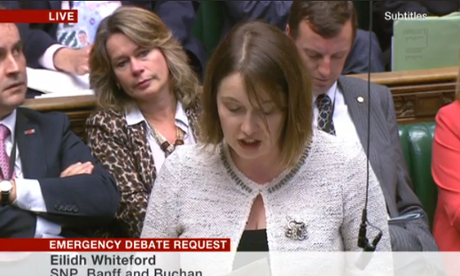
In the Commons Treasury questions is now over. Eilidh Whiteford, the SNP MP, is now making an application for an emergency debate on the tax credit cuts. She is applying for one under the standing order 24 rule.
A debate is necessary because millions of people do not know what will happen to their tax credits, she says.
Labour’s Bridget Phillipson asks Osborne if he will reflect on people who face losing thousands from his tax credit cuts.
Osborne says the people who lose the most when the economy fails are the poor. He says he will set out his transition plans for moving to a lower welfare economy in due course.
Rushanara Ali, the Labour MP, asks Osborne to confirm that he will not be writing to the 3m families facing tax credit cuts about his plans before Christmas.
Osborne says he will inform families once the changes he is making have become law.
Updated
They are now on topical questions at Treasury questions. Karl Turner, a Labour MP, asks George Osborne to drop his tax credit cuts. Osborne says he will introduce transition measures, but will move towards a lower welfare, higher wage economy.
Here is the key exchange between John McDonnell, the shadow chancellor, and George Osborne.
UPDATE: I’ve included this exchange now in the summary at 1.05pm.
Updated
Rob Marris, a shadow Treasury minister, says Labour does want to deal with the deficit. It just thinks Osborne is going about it in the wrong way. He asks what Osborne is doing to stop job losses in the solar industry.
Osborne says the costs have risen in the industry. That is why the government has cut subsidies.
My colleague Nicholas Watt says John McDonnell may have offered George Osborne a solution to his tax credits problem.
Looks like @johnmcdonnellMP identified how @George_Osborne will dig out of hole: go for less excessive surplus target, currently £10bn 1/2
— Nicholas Watt (@nicholaswatt) October 27, 2015
. George_Osborne wrongly says @johnmcdonnellMP wants him to abandon surplus. So GO use wriggle room Rupert Harrison sorted in target 2/2
— Nicholas Watt (@nicholaswatt) October 27, 2015
Caroline Flint, the Labour MP, asks Osborne for an assurance that he will publish an impact assessment for any revised plans he produces for the tax credit cuts.
Osborne says he has published an impact assessment and distributional analysis for his plans. Labour never used to do that, he says.
The opening exchanges are over. MPs are now on a question about funding for Scotland, being answered by Damian Hinds. The questions and answers about tax credits were relatively perfunctory, and we did not really hear anything new.
Updated
John McDonnell, the shadow chancellor, says for 3m people who will lose £1,300 a year this is not a constitutional matter. If Osborne reverses his plans, he will not be attacked by Labour, he says. Instead Osborne will be applauded. He asks for an assurance that his new plans will not force any child to live below the poverty line.
Osborne says he is happy to listen to any proposals. But there is a difference between those who say they want to make no savings at all (ie, Labour), and those who says they want to move to a low welfare society, but who want to introduce transitional arrangements too.
McDonnell says Osborne has a choice. He could reverse tax breaks for corporations, and he could change his plans to run a surplus. Is he prepared to step up and show leadership?
Osborne says under Labour bankers paid less tax than their cleaners. He says he won’t take lectures from Labour on this, he says. McDonnell wants the government to abandon the surplus rule, he says. But Osborne says that would be wrong. He will continue to take difficult decisions to move towards a low welfare, low tax, high wage economy.
Updated
Stewart Hosie, the SNP Treasury spokesman, says that Osborne’s hopes of becoming prime minister have gone up in a puff of smoke.
Osborne says the SNP just want to talk about party politics.
If Hosie wants, he can praise a Lords that he has spend his whole career trying to abolish.
Liam Fox, a Conservative, says the “debt tax” should be included on payslips to show how much the government has to spend on debt interest.
Osborne says tax statements now show how much the government is spending on debt interest.
Chris Leslie, the Labour former shadow chancellor, asks Osborne to read out the statement in the Conservative manifesto where he said he would be cutting tax credits.
Osborne says the manifesto is an excellent document. It says the Tories will make welfare savings worth £12bn.
Sir Edward Leigh, a Conservative, says unelected peers should not be deciding these matters.
Osborne says he agrees. In the last parliament the government did make changes to its plans after listening to concerns. But Britain cannot have an unlimited welfare budget, he says.
Andrew Tyrie, the Conservative chair of the Commons Treasury committee, says the Lords should only have the power of a “consultative assembly” on financial matters. It should not be voting on finance matters.
Osborne says he agrees. This matter has to be addressed, he says.
The SNP’s Kirsten Oswald says Osborne should drop the tax credit cuts altogether.
Osborne says the Commons has voted three times in favour of them.
We need a welfare system that works, he says.
Labour’s Wes Streeting says Osborne would not be in this mess if he had listened to the evidence. He says Osborne is manufacturing a “phoney constitutional crisis”. He needs to go back to the drawing board, he says.
Osborne says he will help people in the transition to a low welfare, high wage economy. He remembers when Labour used to believe in welfare into work.
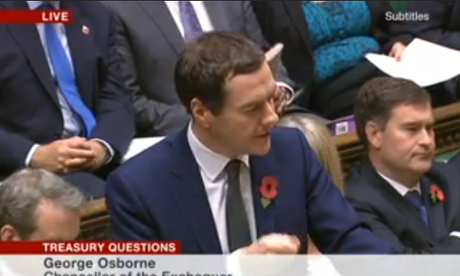
George Osborne says unelected Labour and Lib Dem peers voted down the government’s tax credit reforms. But he is determined Britain must live within its means. He will set out revised plans at the autumn statement.
Emma Lewell-Buck, a Labour MP, says one of her constituents said she might give up hope if tax credits are cut. Will Osborne shelve his cuts?
Osborne says he will support her constituents by delivering economic security. Unemployment has fallen by 44% in her constituency, he says.
George Osborne takes Treasury questions
George Osborne, the chancellor, is about to take Treasury questions.
The first question is about tax credits.
Lady Meacher was overshadowed in the Lords yesterday by Lady Hollis, the other peer who tabled an amendment to delay the implementation of the tax credit cuts and who gave the best speech of the night. But Meacher has become a hit on social media thanks to this clip, from a joint interview she was giving to Sky News with Michael Ellis, a Conservative.
It is not entirely clear whether she was trying to avoid being clobbered by his arms, or just expressing indignation about his argument that the Lords vote was a constitutional outrage.
The righteous indignation of Baroness Meacher on tax credits is well worth 9m of your time https://t.co/5WO8fk9LXx pic.twitter.com/0XcZdgQwEI
— Tara Mulholland (@tara_mulholland) October 26, 2015
Philip Cowley, the politics professor and a specialist in parliamentary revolts, has been tweeting his thoughts about last night’s tax credit defeats in the Lords.
1. We'll just about survive the 'constitutional crisis'. It'll be tough, but we'll manage.
— Philip Cowley (@philipjcowley) October 27, 2015
2. It's only a surprise or a shock to see the Lords standing up to the government if you know nothing about the Lords.
— Philip Cowley (@philipjcowley) October 27, 2015
3. For all the focus on the Lords, this is also about the Commons, and the gvt's wafer thin majority.
— Philip Cowley (@philipjcowley) October 27, 2015
4. This is a gvt with no majority in one House and a majority of just 12 in the other.
— Philip Cowley (@philipjcowley) October 27, 2015
5. It's a reminder of how much influence an organised cohesive Labour Party could achieve...
— Philip Cowley (@philipjcowley) October 27, 2015
6. Oh.
— Philip Cowley (@philipjcowley) October 27, 2015
7. And it'll have no impact on either Osborne's leadership prospects or the next election.
— Philip Cowley (@philipjcowley) October 27, 2015
And, potentially, there could be another government defeat in the Lords this afternoon.
The government is moving from a system of household electoral registration to individual electoral registration. Originally the change-over was supposed to last until the end of next year, but the government wants to terminate the process 12 months early. Up to 1.9m people on the household register who are not yet on the individual register face being struck off.
The issue is particularly important because the new register will form the basis for the boundary review that is going to start next year. The number of constituencies is due to be cut, and new boundaries will be determined on the basis of the number of people on the electoral register.
Labour and the Lib Dems are backing a fatal motion that would block the government’s order saying the transition period should end in December 2015, not 2016. It has been tabled by Lord Tyler, a Lib Dem peer, and he says the two opposition parties have quite a lot of support from crossbenchers. They are in a particularly strong position because the independent Electoral Commission has also said the government should abandon plans to terminate the transition period 12 months early. And Tyler said that, unlike last night, there is no dispute about whether or not the Lords has the power to block this change. In fact, the Electoral Registration and Administration Act 2013 makes it clear that the Lords can annul an order to end the transition period early.
This is a particularly important issue for Labour because Jeremy Corbyn has made getting more people to register to vote a key campaigning priority.
The vote is expected at some time after 4pm this afternoon.
Updated
According to James Kirkup at the Telegraph, ministers are now resigned to another defeat in the Lords this week. They expect Labour and the Lib Dems to win tomorrow when they try to amend the EU referendum bill to allow 16 and 17-year-olds to vote.
Boris Johnson says the Lords is 'pushing its luck'
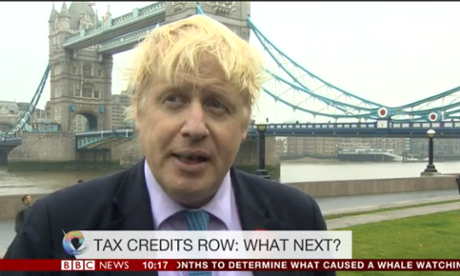
Boris Johnson, the Conservative mayor of London, has been speaking about the Lords defeats this morning. Johnson has been been saying publicly for several weeks now that the government should rethink its tax credit cuts, but in the clip he recorded for the BBC - filmed after he had participated in a tug-of-war outside City Hall - he avoided the temptation to say “I told you so” and instead stuck rigidly to the government script as set out by Chris Grayling this morning. (See 9.10am.) Johnson said:
I think the House of Lords is in grave danger of pushing its luck, frankly. This is not what they are there to do. They are a revising chamber. They are not there to throw out financial bills from the elected House of Commons. And I think the prime minister and the chancellor and right to feel pretty aggrieved about that.
George has said he is in listening mode and that is completely right. What everybody wants, what George wants, what we all want, is a way of reforming what is a grossly unfair system in a way that helps the poorest and the neediest.
But, if Johnson’s mouth managed to avoid saying that he had been right all along, his face could not disguise his true feelings. He would make a rotten poker player. George Osborne, of course, is Johnson’s rival for the Conservative leadership at some point in the future and in the clip the mayor seemed to be beaming with delight, looking as though he was thoroughly enjoying the chancellor’s setback.
Updated
Alex Johnstone, a Conservative MSP, told Good Morning Scotland today that Ruth Davidson, the Scottish Conservative leader, was one of the first people to alert George Osborne to how damaging the tax credit cuts could be to the party in Scotland. He told the programme:
She was concerned about that and she was the one who first raised the problem with the chancellor from a Scottish perspective. I think it’s important that we remember that we all need to work together the ensure that the policy applies appropriately across the country.
With a limited representation of Scottish members of parliament in Westminster, the chancellor perhaps didn’t have that opportunity as early as he could. But Ruth Davidson attends [political] cabinet meetings on a monthly basis, and she took the opportunity to make sure he knew.
Davidson spoke publicly about the need for the government to change its plans for tax credit cuts in an interview in the Mail on Sunday at the weekend. She said:
If we’re not the party of getting people into work and making it easier for them to get up the tree, then what are we there for? It’s not acceptable. The aim is sound, but we can’t have people suffering on the way. The idea that there’s a cliff edge in April before the uptake in wages comes in is a real practical human problem and the Government needs to look again at it.

How peers voted on tax credits last night - Full details
The House of Lords has its faults, but in one respect it is far superior to the House of Commons; on its website, it publishes the results of votes in a way that makes it easy for people to see how people voted by party, and who the “rebels” were.
Last night the government was defeated on two votes on the tax credits.
It lost the first vote, on Lady Meacher’s amendment, by 30 votes. The results are here. They show that:
- Three bishops joined Labour and the Lib Dems in voting against the government (the archbishop of York, and the bishops of Portsmouth and Chester).
- The crossbenchers were split. Some 41 voted against the government, but 51 voted with it.
- Four Labour peers voted with the government, including Lord Irvine, the former lord chancellor, Lord Robertson, the former defence secretary, and Lord Rooker, a former minister.
And then the government lost the vote on Lady Hollis’s rather tougher amendment, by 17 votes. The results are here. They show that.
- One bishop, the archbishop of York, voted with Labour and the Lib Dems against the government. One bishop, the bishop of Chester, voted with the government.
- The crossbenchers were again split, but 51 voted with the government, and 33 voted against the government.
- Lord Irvine was the only Labour peer who voted with the government on this amendment.
The government also won one vote, on a Lib Dem amendment that would have blocked the tax credit cuts for good. It won that vote by a majority of 211 because most Labour peers abstained. You can read the results here. They show that:
- Two bishops, the archbishop of York and the bishop of Chester, voted with the government.
- Seven Labour peers voted with the government. They were Lords Donoughue, Elder, Irvine, Lipsey, Robertson, Rooker and Williams of Elvel. And four voted with the Lib Dems. They were Lords Cashman and Parekh, Lady Adams of Craigielea and Lady Quin.
- One Lib Dem voted with the government, Lady Nicholson (Emma Nicholson).
- No crossbenchers voted with the Lib Dems, and 74 voted against.
- 83 Lib Dem peers voted for the amendment, out of a total contingent of 112.
Updated
Last night ministers responded to the double defeat in the House of Lords over tax credits with, effectively a double announcement; the Treasury will water down its plans to cut tax credits, but the government will also review the power of the Lords (because ministers think they acted in a way that was unconstitutional). But there was no detail about what either of these two initiatives would involve.
This morning Chris Grayling, the leader of the Commons, has been giving interviews. He has not shed a huge amount of light on what might happen next, but we had some insight into the government’s thinking. Here are the main points.
- Grayling claimed that Labour and the Lib Dems voted against the government last night out of revenge because they lost the election. He made the point when it was put to him that the government could have avoided defeat by introducing the tax credit cuts in the form of a bill, rather than as a statutory instrument (a piece of secondary legislation). He said:
I don’t think for a moment that the Lords would have done something different yesterday if it had been an amendment to a bill, or a bill, rather than a statutory instrument ... I think this is all about Labour and Liberal Democrat peers in the Lords who are unhappy that they lost the election, the Liberal Democrats, who have eight MPs and 100 peers, deciding they want to wreck the government’s programme.
Grayling’s answer is potentially misleading. If the tax credit changes had been in a bill designated as a non-money bill, the Lords could still have voted them down. But if the government had put them in a finance bill, the Lords would have had no power to alter them.
- Grayling played down the prospect of any hasty constitutional response to the defeat. Number 10 says it wants a review of how the convention that the Lords does not overturn budget measures operates. But Grayling said this would not be rushed.
The first thing not to do is to react on the hoof to this. We have to take a measured look at what the Lords have done, what the constitutional arrangements have been, what they need to be. There will have to be change of course, there will have to be change. The prime minister has said he wants to set up a review of the way these conventions work. That’s the right thing to do and we will be working on the detail of that in the next few hours. But we shouldn’t rush through change. We need to respond to this in a measured way.
This marks a change of tone from last night, when Number 10 said it wanted “a rapid review”.
- He played down the prospect of the government creating 100-plus new Conservative peers to get their business through the Lords. Asked if this was an option, he replied:
I don’t think we are ruling anything in or out at this stage. We haven’t really started the work. My view is I would be reluctant to see us do really dramatic changes, but it’s really a matter to sort out the relationship between the Commons and the Lords.
- He claimed that the power of the Lords needed to be contained because it was getting increasingly assertive.
Last week they threw out a measure on the energy bill that was in our manifesto. That’s the first time I believe that that has happened. This time they have taken the step of throwing out a statutory instrument on a financial measure for the first time in 100 years. They have set about trying to dismantle the financial plans that we said we would have to go through when we fought the election and won the election in May ... I don’t want to judge the scale of the changes that are needed, but I don’t really see how after yesterday we can say that no change is needed.
- He said Osborne would look at “transitional arrangements” to protect those who will lose from the tax credit cuts.
Osborne is taking questions in the Commons later and he is bound to have more to say on this issue. It is quite possible that there may be a statement or an urgent question too, although nothing has been announced yet.
I will be focusing on the reaction to the tax credits defeats, but here is the agenda for the day.
9.30am: Growth figures for the third quarter of 2015 are published.
10.15am: The Serious Fraud Office gives evidence to the Commons culture committee about Fifa.
11.30am: Sir Nicholas Houghton, chief of the defence staff, gives evidence to the Commons defence committee on potential future threats.
11.30am: George Osborne, the chancellor, takes questions in the Commons.
1pm: Robert Caro, the biographer of Lyndon Johnson, is interviewed by Michael Gove, the justice secretary, at a press gallery event.
As usual, I will also be covering breaking political news as it happens, as well as bringing you the best reaction, comment and analysis from the web. I will post a summary at lunchtime and another in the afternoon.
If you want to follow me or contact me on Twitter, I’m on@AndrewSparrow.

Updated