BENGALURU: At a time when Covid-19 is seen as being on its way out, the sudden rise in positivity rate in Bengaluru Rural has left many confused. With just nine positive cases this month, the district reported an incongruous positivity rate of 3.3% — the highest in Karnataka as on May 25.
But health officials on the ground attributed this to an error at the time of entering testing data. “The number does not reflect the ground reality and it is indeed a data entry problem,” said a senior official from Bengaluru Rural. “In some of the testing centres in Ramanagara and Kanakapura, the staffers enter the cases into the Bengaluru Rural log rather than adding them to the right district — Ramanagara. On a daily basis, we transfer several of them out while verifying the data.”
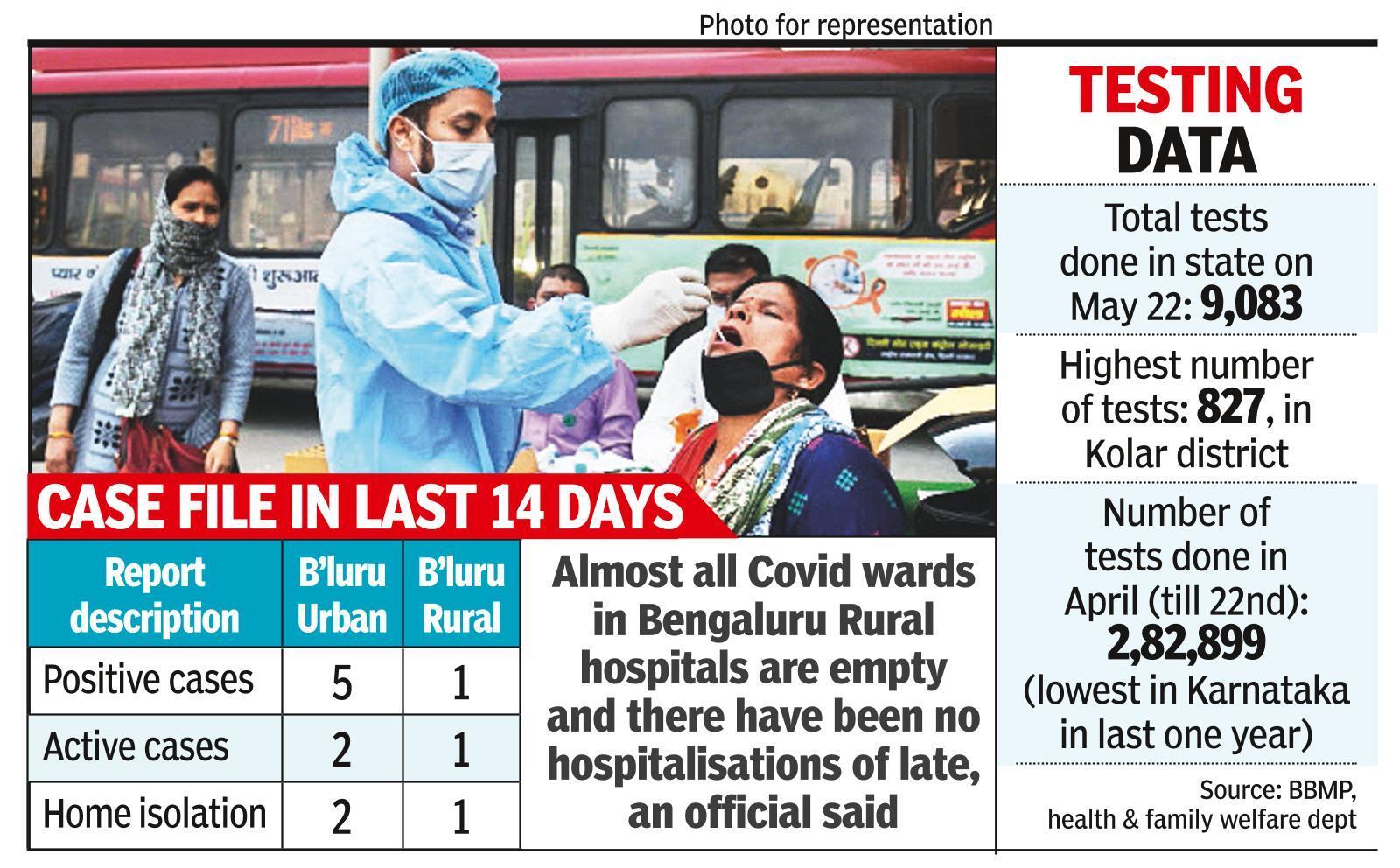
A surveillance officer in Bengaluru Rural said, “The district had only four Covid-19 cases in April and this month we have nine. Almost all Covid wards in hospitals are empty and there have been no hospitalisations of late. Had the positivity rate really been 3%, this would not have been the case in the district and the entire health department would have camped here.” The officer also explained that their last target was to collect 300 swabs a day, which has now been increased to 900. “Considering that we reported only nine positive cases for this entire month, our positivity rate should have been less than 1%,” he said.
Officials complained that a similar false high positivity rate was also in the spotlight during the first and second waves, despite a low number of positive cases. “We had flagged this problem with BBMP in the past,” one official said.
‘Testing numbers are low’
But Bengaluru Urban officials passed the buck, saying the problem is not due to an error at the data entry level but because of low testing. “If you test only five people and four of them turn out to be positive, obviously the positivity rate will be high. Also, the truth is that those four people may be the only ones positive even among 100 people, but it can be determined only if the number of tests is ramped up,” an official said. Shortage of lab technicians in those districts is also said to be one potential reason for low testing.
A senior health official told TOI that the positivity rate alone does not make sense and one must look at the number of positive cases and number of tests done to get the actual picture. D Randeep, commissioner, health and family welfare, said: “Till two days ago, the average testing done was 35% of the target and the positivity rate was 3.5%. However, in the last two days, it has reduced to 1.5% with the same level of target and average testing. We will soon be revising the test target as recommended by the technical advisory committee.”