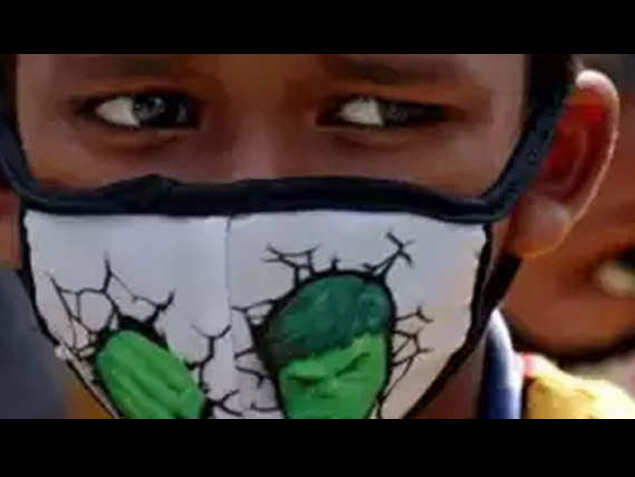
BENGALURU: When six-year-old Keerti was in a virtual class, her teacher briefed students on precautions they must take when on an outing. While the teacher told students to stay close to parents, not speak with strangers and not accept eatables from them, Keerti and her classmates added important safety measures the teacher had left out: “Wear masks and use sanitisers.”
For children between the ages of five and 12, the understanding of vacations, outings and even indoor games has changed drastically.
Rajeswari PN, a homemaker, says her five-year-old son was shocked when he saw photos of his parents in the Maldives and Sri Lanka without masks on. “He could not fathom how it was possible for us to travel without masks. He kept asking us if there were no policemen around when we clicked the photos,” Rajeswari said.
She says fear of the police helped their son develop a habit of wearing a mask. “We did tell him that the virus would enter his body through his nose and make him ill. But somehow, fear of the police worked better than the fear of illness,” she said.
Several parents like Rajeswari, in chats and messages on social media groups, say they have observed the shift in the way their kids perceive normal things like a vacation. One parent shared a photograph of his child-placing a mask on a doll, while another parent wrote about how kitchen games at home involve long sessions of hand-sanitising.
Akhil K, a project manager, says when the pandemic first hit, his five-year-old daughter had several questions and he and his wife tried to answer everything honestly. “We speak to her with the assumption that she understands everything, and it has worked till now. Now, even before we open the door for anyone, she runs to hand us a mask and never lets me enter the house without sanitising my hands,” he said.
Akhil, however, is worried these experiences will be embedded in his daughter’s psyche. “Her understanding of normal is completely different from ours,” he said.
Survival skill
Dr Poorva Ranade, a Bengaluru-based consultant psychologist, said parents must tell kids that wearing masks and hand sanitising is for their own safety and survival and are not permanent chores.
“Children must not be given false promises or a timeframe that this will end in a month or two but must honestly be told that nobody knows how long this will last. They must be told safety precautions are important,” Dr Ranade said. “It is crucial children don’t follow instructions blindly. They must know why they are doing it.”
Dr Ranade said children must be taught about the pandemic without making a big deal of it. “There is nothing worrisome about children accepting these behaviours. This shows children can learn to adapt to changing situations. It is required for survival and safety,” she said.