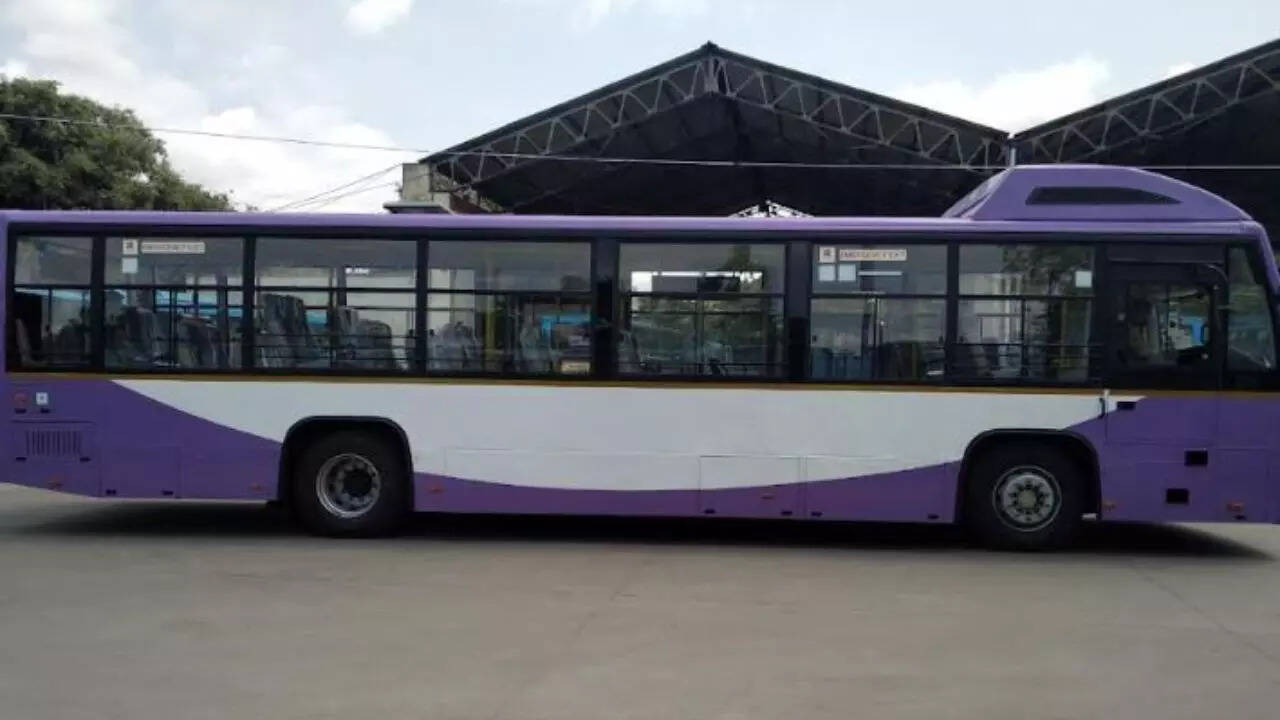
BENGALURU: You could soon travel by electric buses on long-distance routes from Bengaluru to places such as Bidadi, Hoskote and Attibele.
Bangalore Metropolitan Transport Corporation (BMTC) has identified 14 routes for 300 non-AC electric buses. All are expected to be rolled out by October.
The routes are: 226M KR Market-Bidadi, 226N Kempegowda Bus Station (KBS)-Bidadi, 276 KBS-Vidyaranyapura, 290E Shivajinagar-Yelahanka, 328H Attibele-Hoskote, KBS3A KBS-Attibele, 360K KBS-Attibele, 401K Yelahanka-Kengeri, 402B/402D KBS-Yelahanka Satellite Town, 401M Yeshwantpur-Kengeri, 500D Hebbal-Central Silk Board, 500DH Attibele-Hebbal, 501C Hebbal-Kengeri, and 600F Banashankari-Attibele.
In September 2021, Ashok Leyland emerged as the lowest bidder in the 300 e-bus tender under the Centre’s FAME II scheme after it quoted Rs 48.95 per km. BMTC officials said Switch Mobility Ltd, a subsidiary of Ashok Leyland, will supply and operate all 300 12m non-AC e-buses.
“We have received 12 buses from the manufacturer so far. By August first week, 100 buses will be inducted. All 300 buses will ply on city roads by October. The 41-seater (including driver) buses will run 150km on single charge. We are planning to run these buses on long-distance routes. They will run another 75km after opportunity charging (charging the battery for a short time whenever convenient) for 45 minutes. This means each bus could cover 225km,” a BMTC official said.
Officials said these e-buses will be operated from three depots — Yelahanka, Bidadi, and Attibele — through peripheral roads. “We are planning to run these e-buses from Yelahanka depot first. The e-buses are differently abled-friendly with facilities such as wheelchair lifting,” said an official.
Opportunity charging stations for 300 e-buses will be set up in depots at KBS, Kengeri, Yeshwantpur, and Central Silk Board bus station.
90 e-buses on nine routes
At present, 90 non-AC midi e-buses are operating from Yeshwantpur, KR Puram and Kengeri depots, mainly on Metro feeder (MF) bus routes.
Thirty buses are operational from Yeshwantpur depot: MF-258CB Yeshwantpur-Nelamangala (10 buses), MF-401 Yeshwantpur-Yelahanka (10), MF-410 FA Yeshwantpur-Banashankari (4), and MF-401RH Hebbal-Vijayanagar (6).
Similarly, there are 30 buses from KR Puram: MF-300E Shivajinagar-KR Puram (8), MF-304K Tin Factory-Channasandra (11), and MF-500L Tin Factory-Banashankari (11). “All routes except MF-300E (Shivajinagar-KR Puram) are Metro-connecting ones. But this route will also help passengers once the Kalena Agrahara (Gottigere)-Nagawara section (Pink Line) opens,” a BMTC official said.
Cost factor
According to the contract, BMTC has to pay Rs 51 per km per e-bus to NTPC, a PSU under the Union power ministry, and original equipment manufacturer partner JBM to run 90 e-buses. For these 90 e-buses, the average earning per km now is Rs 30. This means the utility is suffering an average loss of Rs 20 per km. However, e-buses are cheaper than diesel ones. The earnings per km for a non-AC diesel bus is Rs 47.08, while the cost is Rs 78.29. This translates to a loss of Rs 31.2 per km.
“The cost of operating diesel buses is increasing, mainly due to soaring diesel prices. E-buses will work out cheaper in the long run,” said a BMTC official.