Trends in benchmark land values in 2021 are marked by regional differences -- with some areas beginning to show signs of bottoming out, while downtown areas and tourist spots that were dependent on foreign visitors continue to see large declines.
Also, there has been a noticeable rise in land values in "company towns" that are supported by the manufacturing industry and of regional cities where redevelopment has been promoted during the second year of the coronavirus pandemic.
The future of land values will rest on whether economic activities can be normalized now that the government plans to ease restrictions on business activities.
--'1st time since war'
"In the 400-year history of Dotonbori, I think this is the first time that so many people have not returned to the area since it was burned to the ground in the war," said Minoru Kitatsuji, secretary general of the Dotonbori retailer association.
The Dotonbori district in Osaka had the nation's largest decline in basic commercial land values in terms of the benchmark land value.
The benchmark is the assessed value per square meter of land in major residential, commercial and industrial areas as of July 1 of each year. The benchmark value is used as a guide when buying and selling land.
With the disappearance of the millions of foreign visitors who used to visit the area each year, restaurants and other stores have seen their sales plummet.
By the end of August, 16 of the association's approximately 100 member shops had gone out of business. Most of the spaces they once occupied remained vacant.
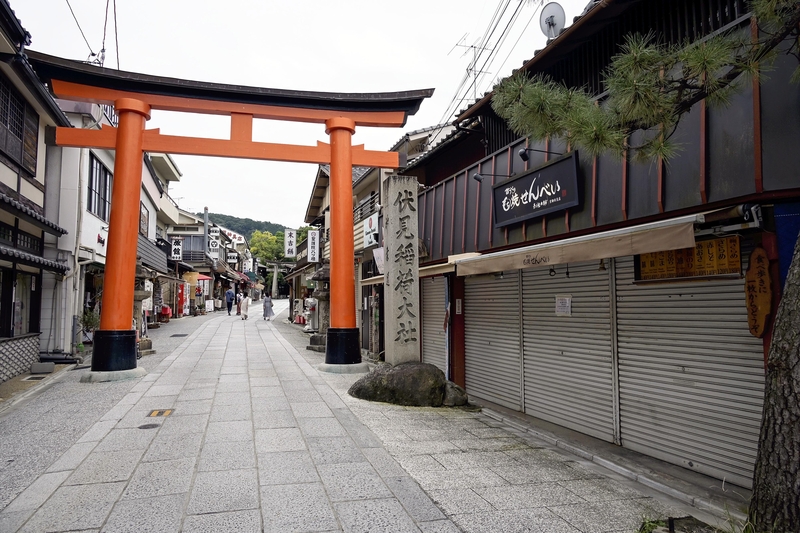
The area around Fushimi Inari Taisha shrine in Kyoto, which had been booming with foreign visitors to Japan, saw the fifth worst rate of decline in standard land values. Sales at nearby stores were down by nearly 70% for a while.
The Ginza district in Tokyo is no exception, with shuttered restaurants conspicuous along its back streets.
"While there are streets where luxury brands strongly want to open stores, the streets centered on restaurants are facing difficulties," said Masashi Okumura, senior director of CBRE, a major real estate service provider. "There is a polarization going on in Ginza."
-- Company town
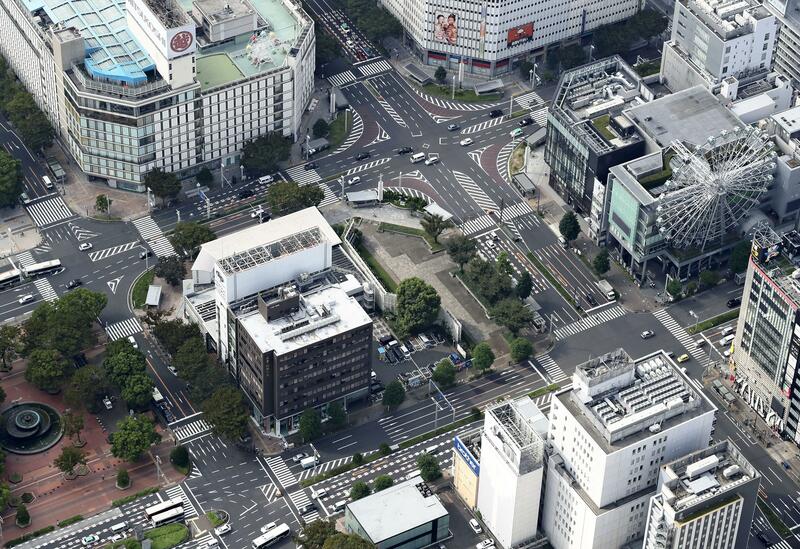
Meanwhile, the Nagoya area offers a stark contrast. The strong performance of Toyota Motor Corp. and other manufacturers has supported the local economy, pushing up both residential and commercial land prices.
In the early days of the coronavirus pandemic, the manufacturing industry was hit hard, and the number of contracts for houses for sale in Aichi Prefecture in March last year plummeted by 40% from the previous month.
With the recovery of the manufacturing industry, the number of contracts in the area has been picking up.
"Competition for residential areas has intensified," Koichi Koma, director of TSON Co. in Nagoya, said.
Ongoing redevelopment of hotels and other facilities in the city center in anticipation of the aftermath of the virus disaster has also contributed to rising land prices.
In Fukuoka, two major redevelopment projects are underway in the city center, as a result of which the city and its suburbs account for eight of the nation's 10 areas with the highest increases in commercial land prices.
-- Effect of monetary easing
The decline in land prices since the start of the novel coronavirus pandemic has been slower than the price falls that followed the bursting of the bubble economy in the early 1990s and after the collapse of U.S. investment bank Lehman Brothers in 2008.
The slow decline is attributed to money supplied by monetary easing by central banks around the world.
Amid the coronavirus disaster, the real gross domestic product for fiscal 2020 fell sharply, down 4.4% from the previous year.
However, Hideo Omizo, a fellow in the real estate consulting department at Mitsubishi UFJ Trust and Banking Corp., said, "Even though companies with deteriorating business conditions continue to sell off their real estate, foreign real estate funds with a strong appetite for investing in Japan are purchasing those properties."
Foreign investors with abundant funds in the era of low interest rates are believed to be investing in properties and REITs (real estate investment trusts). Such investors are attracted by the facts that infection rates are lower in Japan than in the United States, Europe and other major countries, and properties are relatively cheap.
The total amount of commercial real estate investment in Japan in 2020 was 4.57 trillion yen, down 4% from the previous year, according to real estate services firm Jones Lang LaSalle IP, Inc. The decline was modest compared to the 28% drop for the entire world.
Read more from The Japan News at https://japannews.yomiuri.co.jp/