A remarkable day at the Britannia Stadium and Lord’s. Up in the Potteries, Stoke City hit six against Liverpool; in St John’s Wood, Ben Stokes kept hitting sixes against New Zealand.
For once the exploits of the cricketer may be of more significance than those of footballers at the end of their season. Mark Hughes and his team can go on holiday with a smile. But now at the start of a cricket season laden with pitfalls and polarisation, Stokes has allowed the cricketing fraternity to dream again. The summer of 2015 may not be viewed with such constant trepidation after all.
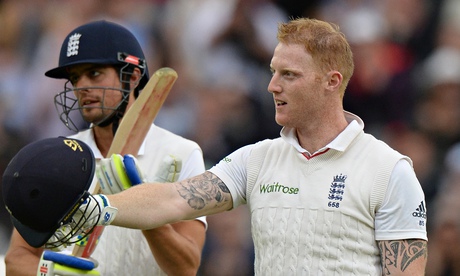
Here Stokes cracked the fastest ever Test century at Lord’s. It took him 85 balls, two fewer than the angry century by Mohammad Azharuddin against England in 1990. Stokes’ knock was mesmerising and in less than two hours it changed the balance of the match. All the while his captain, Alastair Cook, looked on from the other end admiringly – and gratefully. Eighty yards away the England balcony was crammed full; even the pros had their eyes popping.
When Stokes scampered the run which took him to his century, there was Joe Root, smiling broadly and delivering his mischievous military salute, a reference to Marlon Samuels bidding Stokes farewell after his ugly dismissal in Grenada a month ago. Stokes himself celebrated with some verve – he had, after all, missed out on three figures by an agonising eight runs in the first innings.
But he batted with even more verve. Upon his arrival the match was tottering. England were 232 for four, a lead of 98, a far better situation than the one that greeted Stokes in the first innings (30 for four) but precarious nonetheless. It did not take long to establish how Stokes was going to play – the same way as on Thursday: if the ball was there to hit, he was going to hit it. Thus he produced an “I was still there” innings.
After his 92 from 94 balls in the first innings Stokes recalled what the caretaker coach, Paul Farbrace, had said to him beforehand: “Do what you do and everyone backs you; don’t change anything just because you’re wearing the three lions.”
Farbrace, wisely, was giving Stokes the freedom to play his own way. It can be more or less guaranteed that Peter Moores would have said something similar to Stokes during the previous 15 months. But maybe Farbrace’s more avuncular manner struck a chord. Sometimes it ain’t what you say; it’s the way that you say it – there’s a promising lyric there somewhere.
Stokes was given licence. Yet there was also a purity about the way he batted. As in the first innings there was no hesitation in attacking the full-length deliveries. McCullum being McCullum left plenty of holes in the field; the slip cordon was packed and with textbook orthodoxy yet extraordinary power. Stokes hit through the line and through those gaps.
Once he squeezed the ball to the boundary. Trent Boult propelled a near perfect yorker; Stokes dug down on it just in time and still the ball sped from the bottom of his bat to the pavilion somehow gaining pace all the while like a treacherous Augusta putt. It’s not great for the bowlers’ morale when the good balls are going for four.
The advent of the new ball sent Stokes into overdrive. The harder the ball, the faster it can fly, as Tim Southee rediscovered. He bowled six overs with that new ball, in a period of the game that all the sages deemed to be critical.
He bowled one maiden. The other five overs went for 53. Stokes riles bowlers just as Stokes, the bowler, can be easily riled by batsmen. So, with the encouragement of McCullum, Southee chose to twist rather than stick. He stationed two men on the leg-side boundary – a third would join them before long – and he proceeded to use the middle of the pitch. Stokes was not in a mood to watch the balls sail by.
The first bouncer was swatted way over long leg for six; the second just cleared deep square leg for another six; the third – for McCullum and Southee would not be easily deterred from their plan – was top-edged down to fine leg for four.
Twenty runs had come from the over; the floodgates were open. New Zealand were as defenceless as Messrs Gerrard, Skrtel, Mignolet etc.
Soon after reaching three figures Stokes was caught at slip heaving away at an off-break from Mark Craig. It was not the greatest of shots but only a fool, and a brave one at that, would have taken him to task.
For certain, Farbrace would have given him a smiling pat on the back. For the second time in four days Stokes had transformed the Test match. Now, if only someone can catch off his bowling.