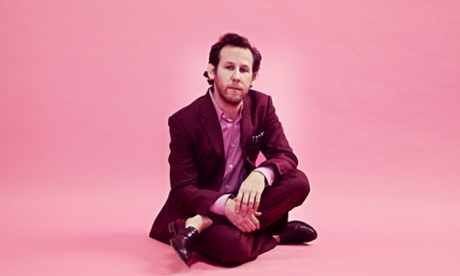
The day before Ben Lee calls, I hear his perennial anthem, We’re All In This Together, wafting from the television in another room. Even on the release of his new album, Love Is The Great Rebellion, Lee’s biggest hits are still simmering in the collective unconscious.
He laughs generously at this quirk of fate. “They’re still keeping food on the table!” he says of that song and Catch My Disease, both lifted from 2005’s multi-Aria-winning, Awake Is The New Sleep. “Literally, financially, they have absolved me of a certain amount of pressure; otherwise, I might have had to make very different decisions. I have a lot of gratitude in those moments.”
Lee, who lives in Los Angeles with wife Ione Skye and their daughter Goldie, has made some different decisions anyway, chiefly 2013’s experimental Ayahuasca: Welcome to the Work, a meditative exploration of the effects of the psychoactive South American healing drug. Perhaps unsurprisingly, then, his catchy new album has been heralded as a “return to form”. Certainly, if you compare it to the free-wheeling experimental quality of Ayahuasca, Love feels like vintage Ben Lee.
“I thought it was going to be a natural progression from the Ayahuasca album,” he says. “I thought it was going to be something very obtuse and abstract and meditative but suddenly these pop songs started coming out.” Always willing to adjust his comfort zone, he says, he went with it. “And as I started exploring, I realised I still feel some degree of unfinished business with what the pop song can do, creatively. I don’t feel entirely tapped out of the medium.”
Reflecting Lee’s personal journey, Love brings with it a variety of meaty themes, from spiritual enlightenment and forgiveness to a growing acceptance of death, all delivered by way of Lee’s particular knack for a melody.
Does he see pop as the gateway drug through which he can communicate bigger ideas to the listener? “Pop music or dance music speaks to the sensual mind of the human being, in that it speaks to the part of us that connects immediately in a visceral way,” he responds.
“For me, I like the idea of the immediacy and the graspability of it: little kids can get it, and older people can get it. A good melody cuts across age and gender and socio-economic boundaries. And at the same time, you can always try to insert grains of something profound for people.”

I ask whether this is the “dignified rebellion” Lee has referred to in the promotional lead-up to Love’s release; whether he is, in a sense, rebelling by injecting breezy pop songs with deeper spiritual and philosophical themes. He takes a typically tortuous route to his answer.
“I’m very interested in alchemy, and if you look at that, it was always based on working with the raw materials you have right now, not idealism,” he says.
“Look, I’m not, technically, the greatest musician in the world. I have a lot of limitations and a lot of flaws, but for me, starting from where I actually am includes what my audience wants from me. Instead of looking at that as some sort of huge limitation, saying: ‘Let me try and work within that framework, and still create something that aspires towards transcendence’. That is a fun challenge.”
A pause. “So, that’s the ‘dignified’ part.” He laughs, the little Yoda-ish giggle he occasionally punctuates sentences with.
“My interest is what it’s always been, and that is the liberation of consciousness. The Buddhists call it the Final Illumination, or enlightenment, or God, or whatever phrase you want to use ... there was a mystic who said: ‘Loving God has so thoroughly ruined my life’– it’s that type of experience I’m interested in.”
Of course, the pursuit of the liberation of consciousness is, in the context of today’s music market, not a populist theme. Rebellion is still the lifeblood of the mainstream; even the biggest hits of the past year pushed as “subversive” (like Meghan Trainor’s All About That Bass) have a scent of focus-group about them.
And while Lee he may have slipped from the charts in the years between his last big hits, there’s still a collective idea of what his name represents – not least from the singer himself.
“That’s what Gamble Everything For Love was about, the willingness to let go of what we think we know,” he says. “That’s risky material! In pop and rock music, people are okay with rebellion if it comes in a form that is traditional: singing about drugs or sleeping around. The reality is, those behaviours aren’t really rebellious, because they have an incredibly predictable outcome.”
There is a sense, throughout the album, that Lee is dismantling some of the expectations that have trailed him. In I’m Changing My Mind, he sings about letting go of anger. I wonder aloud whether he’s jettisoning the “angry young man” mantle that made his work in the late 1990s so compelling.
“Yeah, the ‘angst’?” He laughs again at the reminder of his 1998 persona. “When I wrote that, it was a mixture of the ego in general and [saying]: ‘You know what? I don’t actually want to look at the world like that, or be that person. That’s not convenient for my growth anymore’. But also ... maintaining the right to contradict yourself. You can change! And you can hold yourself to a higher standard than you held yourself to yesterday.”
Surely it’s a little more difficult to maintain the right to contradict yourself within the constraints of the music industry? “Certainly if you want to be a hero of the masses, there are rules, I guess,” he says.
“I’m interested in a different type of reward. I can’t say I don’t want my music to get across to as many people as possible, because I do wish success for it, but my real loyalty is to a process that’s unfolding in me. From what I understood, that’s the point of art.”
- Love Is The Great Rebellion is out now on Warner. Ben Lee plays the Black Bear Lodge, Brisbane on 5 June, Newtown Social Club, Sydney on 6 June and Northcote Social Club, Melbourne on 7 June