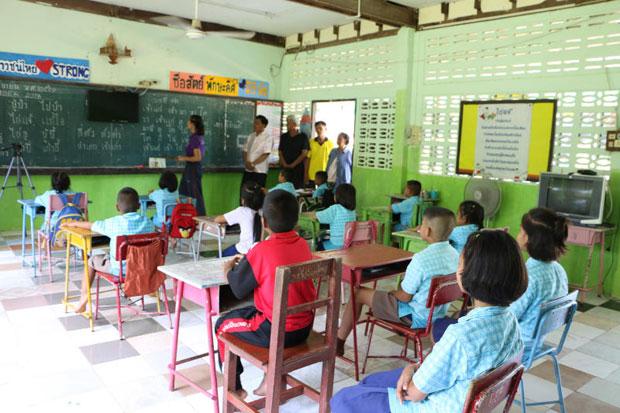
Twelve small schools in five provinces will be merged into larger ones before the start of the new semester later this month to improve the quality of education in rural areas, the Office of Basic Education Commission (Obec) said.
Parents have been notified of the move, it said.
Each of the schools to be merged had 60 students or fewer enrolled.
Obec chairman Ekkachai Kisukphan said the measure is in line with the Ministry of Education's goal of raising educational standards outside big towns and cities.
"These schools don't have enough teaching staff, which means when a teacher is present in one class, other classes have to go without," he said, adding schools should not have more than 20 students per teacher.
"Some only have one teacher to cover all subjects for students from Grades 1 to 6, because the number of students is less than 20," he added.
The schools to be shuttered are: Nikom Bangrakum 8 School, Watngiwngarm School, Nikom Ban Krang School and Wat Phothiyan School in Phitsanulok; Ban Rainuae School, Ban Lam Pa Sak Moon School, Ban Lhung School, Ban Tungkae School and Ban Na School in Phetchabun; Ban La-ong School in Ranong; Ban Pak Han School in Surathani; and Ban Aow Yang School in Prachuap Khiri Khan.
Mr Ekkachai said the number of students in Thailand dropped from 9.5 million in 1997 to 7.4 million last year. It is expected to fall by another 2 million over the next six years.
"The number of schools must be reduced to match the number of students, if we are to see improvements in the allocation of resources in the basic education sector," he said.
A recent study by the World Bank indicated Thailand now has one of the smallest class sizes in the world at the primary level -- one teacher for every 14 students.
In theory, this should benefit students. However, the report found that students in rural areas are often a year or more behind their peers at bigger schools in the sciences.
In terms of reading proficiency, the rural-urban gap is even wider.
More than half of all children who attend small schools in rural areas are functionally illiterate and struggle to understand the meaning of what they read, according to the January report.
"You can't expect a good outcome from students who study in schools that only have one or two teachers covering the subjects," Mr Ekkachai said.
Obec has also communicated the news to local communities, explaining why the move should prove beneficial in the long term, he added.
According to a survey it conducted, of the 30,816 Obec schools nationwide, some 15,577 are now considered small with fewer than 120 students enrolled.
Almost 11,000 of them have fewer than 60 pupils, the survey showed.
According to its plan, Obec will focus on merging those with less than 60 pupils.
About 2,700 of these small schools are considered untouchable, mainly because of their location, such as on islands or in mountainous areas. They will remain open even though their student enrollments are low, because traveling to other schools would be too burdensome on students.