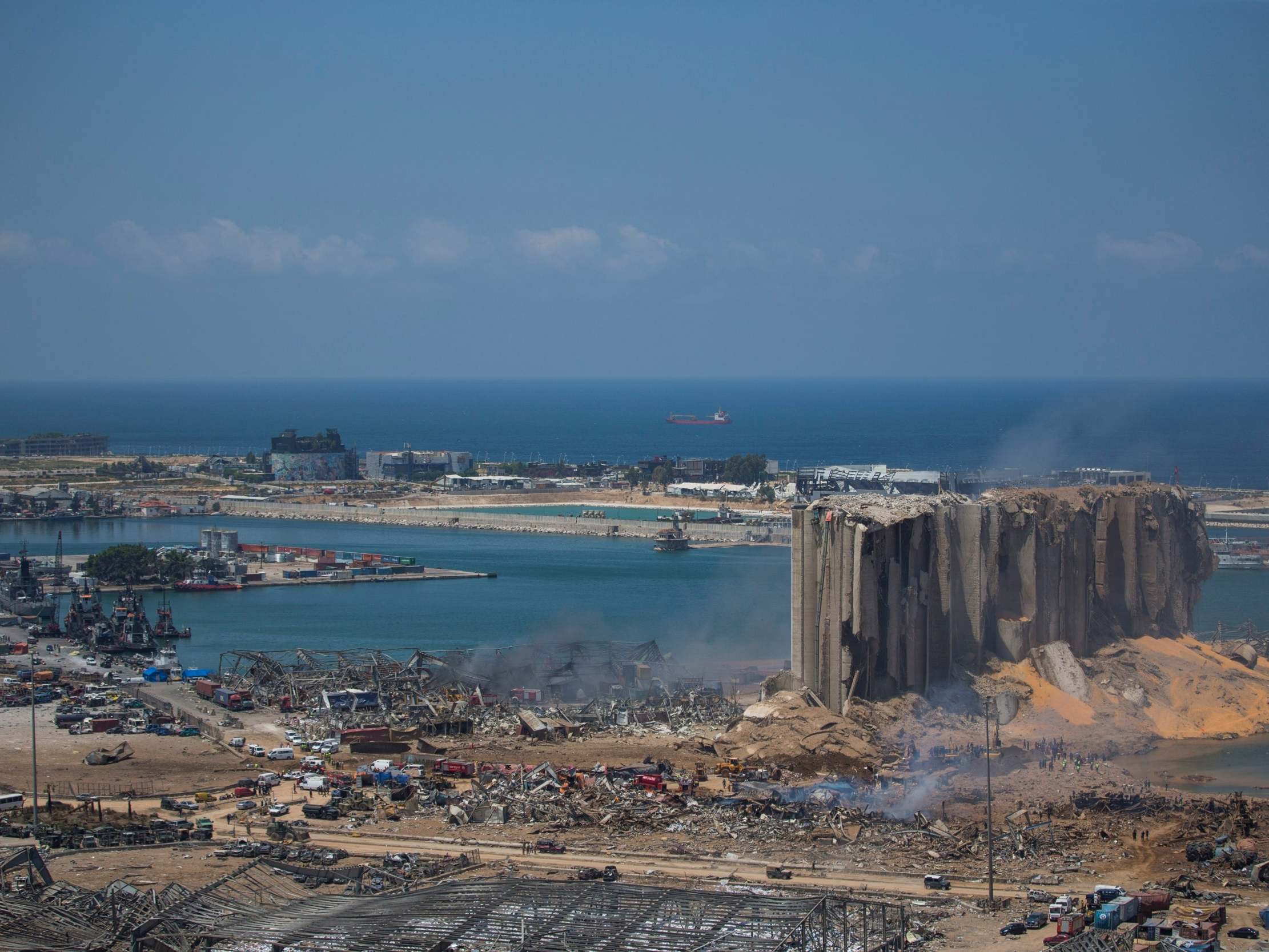
Residents of Beirut have awoken to devastation after huge explosions at the city’s port sent shock waves across the Lebanese capital on Tuesday, killing at least 100 people and injuring thousands.
President Michel Aoun called for an emergency cabinet meeting on Wednesday and said the cause of the blasts was 2,750 tonnes of ammonium nitrate, used in fertilisers and bombs, which had been stored for six years at the port without safety measures. Three days of mourning have been declared.
It came as documents unearthed by Al Jazeera showed custom officials had warned of the “serious danger” posed by the ammonium nitrate stockpile at the port years before the explosion on Tuesday.
Please allow the live blog a moment to load...
Photos show extent of damage to Beirut
Beirut is reeling from the damage caused by Tuesday's massive explosion.
Photographs show the pain of those injured in the blast as well as the extensive destruction of buildings in the city.
Our reporter, Kate Ng, has this article on some images from the Lebanese capital:

Beirut port’s general manager has said the facility had warehoused highly-explosive material, which has been blamed for the explosion, six years ago based on a court order, local broadcaster OTV has reported.
The broadcaster quoted Hassan Koraytem as saying that the customs department and state security had asked authorities for the material to be exported or removed, but that “nothing happened”.
Australia has said it will donate 2 million Australian dollars (£1.1m) in humanitarian support to Lebanon to help Beirut recover.
Marise Payne, Australia’s foreign minister, said in a statement that the money would go to the World Food Programme and the Red Cross to help ensure food, medical care and essential items are provided to those affected.
She said Australia and Lebanon had a strong relationship built on extensive community ties, with more than 230,000 Australians having Lebanese heritage.
An Australian was killed and the Australian Embassy in Lebanon was damaged in the explosion.
French president Emmanuel Macron will travel to Lebanon on Thursday to offer support for the country following the devastating explosion in Beirut.
Mr Macron’s office said he would meet with Lebanese political leaders but did not provide further details on his plans.
Lebanon is a former French protectorate and the countries retain close political and economic ties.
France is also sending several tons of aid and emergency workers after the explosion, which has killed at least 100 people and wounded thousands.
Tuesday’s explosion came as a shock to many Beirut residents but for the crew of a Russian-owned vessel abandoned in the docks in late 2013, it likely came as less of a surprise.
Our Moscow correspondent, Oliver Carroll, has explained below how the dangerous cargo ended up in the Lebanese city’s port:

The European Union has activated its civil protection system to bring together emergency workers and equipment from across the 27-nation bloc to help Beirut.
The EU commission said on Wednesday that the plan was to urgently dispatch more than 100 firefighters with vehicles, sniffer dogs and equipment designed to find people trapped in urban areas.
France, Germany, the Czech Republic, Greece, Poland and the Netherlands are taking part in the scheme and other countries are expected to join.
Janez Lenarcic, the EU’s crisis management commissioner, said the EU shared “the shock and sadness” of Beirut residents over the destruction and stood ready to provide extra help.
Lebanon’s president has said there will be an investigation into the explosion on Tuesday to reveal the circumstances of what happened as soon as possible and the results will be revealed transparently.
In a televised speech at the start of a cabinet meeting, Michel Aoun appealed to other nations to speed up their assistance to the country, which is already struggling with an economic crisis.
It is still unclear exactly what sparked the explosions in Beirut yesterday but multiple sources have pointed to a stockpile of ammonium nitrate at the city’s port as a possible cause.
But what is ammonium nitrate? And how was it able to cause such a powerful and devastating blast?
Our science reporter, Andrew Griffin, has the full story below:

Initial investigations into the Beirut explosions have indicated years of inaction and negligence over the storage of highly explosive material caused the blast, an official source has told Reuters.
“It is negligence,” the source said, adding that the storage safety issue had been before several committees and judges and “nothing was done” to issue an order to remove or dispose of the highly combustible material.
The source's comments came after the prime minister and president said on Tuesday that 2,750 tonnes of ammonium nitrate, used in fertilisers and bombs, had been stored for six years at the port without safety measures
Badri Daher, director-general of Lebanese Customs, told broadcaster LBCI on Wednesday that customs had sent six documents to the judiciary warning that the material posed a danger.
“We requested that it be re-exported but that did not happen. We leave it to the experts and those concerned to determine why,” Mr Daher said.
Another source close to a port employee said a team that inspected the ammonium nitrate six months ago warned that if it was not moved it would “blow up all of Beirut”.
The full scale of the devastation in Beirut has been captured by drone footage as rescue workers continue operations to search for survivors today.
The blasts, which struck at 6pm local time, hit the Lebanese capital with the force of a 3.5-magnitude earthquake and have left thousands injured.
Our reporter, Emily Goddard, has the full story below:

International troops serving in the UN’s Interim Force in Lebanon are among those injured by the massive explosion at Beirut’s port yesterday.
Bangladesh’s military said at least 21 Bangladesh Navy members of the multinational force in Beirut had been injured, with one of those injured in critical condition at the American University of Beirut Medical Centre.
Bangladesh Navy members have been working in Lebanon with the UN force since 2010 to prevent entry of illegal arms and ammunition.
Separately, Lorenzo Guerini, Italy’s defence minister, said one soldier assigned to Italy's contingent in Lebanon was injured.
You can find their conversation below:
Custom officials warned of the “serious danger” posed by the ammonium nitrate stockpile at Beirut’s port years before yesterday’s explosion, documents unearthed by Al Jazeera have shown.
Lebanese officials have pointed to the chemicals as a possible cause of the blast, which has killed at least 100 people and injured thousands.
The cargo of ammonium nitrate is understood to have arrived in Lebanon in 2013 and custom officials sent at least five letters to judges between 2014 and 2017 asking for guidance on what to do with the chemicals.
A letter from 2016 reported by Al Jazeera today said there had been no reply to the requests for help.
“In view of the serious danger of keeping these goods in the hangar in unsuitable climatic conditions, we reaffirm our request to please request the marine agency to re-export these goods immediately to preserve the safety of the port and those working in it, or to look into agreeing to sell this amount,” the letter said, as reported by Al Jazeera.
There were reportedly three options suggested for dealing with the cargo - exporting it, giving it to the Lebanese Army or selling it to the privately-owned Lebanese Explosives Company.

Pope Francis has offered prayers for Lebanon and the victims in Beirut today as the death toll from the explosions on Tuesday stands at more than 100 people.
The pontiff appealed that '”through the dedication of all the social, political and religious elements,” Lebanon “might face this extremely tragic and painful moment and, with the help of the international community, overcome the grave crisis they are experiencing.”
His words came as international aid headed to the city, with countries such as France, Poland and Russia sending medical workers and supplies.
Turkey’s Humanitarian Relief Foundation (IHH) is helping in the search for survivors in Beirut following Tuesday’s explosions, with Ankara offering to build a field hospital and send help as needed.
“We've relayed our offer to help” (including immediate work on the hospital) and “we are expecting a response from the Lebanese side,” a senior Turkish official told Reuters.
Mustafa Ozbek, an Istanbul-based official from the group, said members of the IHH group were digging through debris to look for people and recover bodies on Wednesday, and the group had also mobilised a
kitchen at a Palestinian refugee camp to deliver food to those in need.
“We are providing assistance with one ambulance to transfer patients. We may provide help according to the needs of the hospital,” he said.

Russia's emergency officials have said the country will send five planeloads of aid to Beirut to help with the aftermath of the explosions on Tuesday.
The Russian Ministry for Emergency Situations will send rescuers, medical workers, a makeshift hospital and a lab for coronavirus testing to Lebanon.