
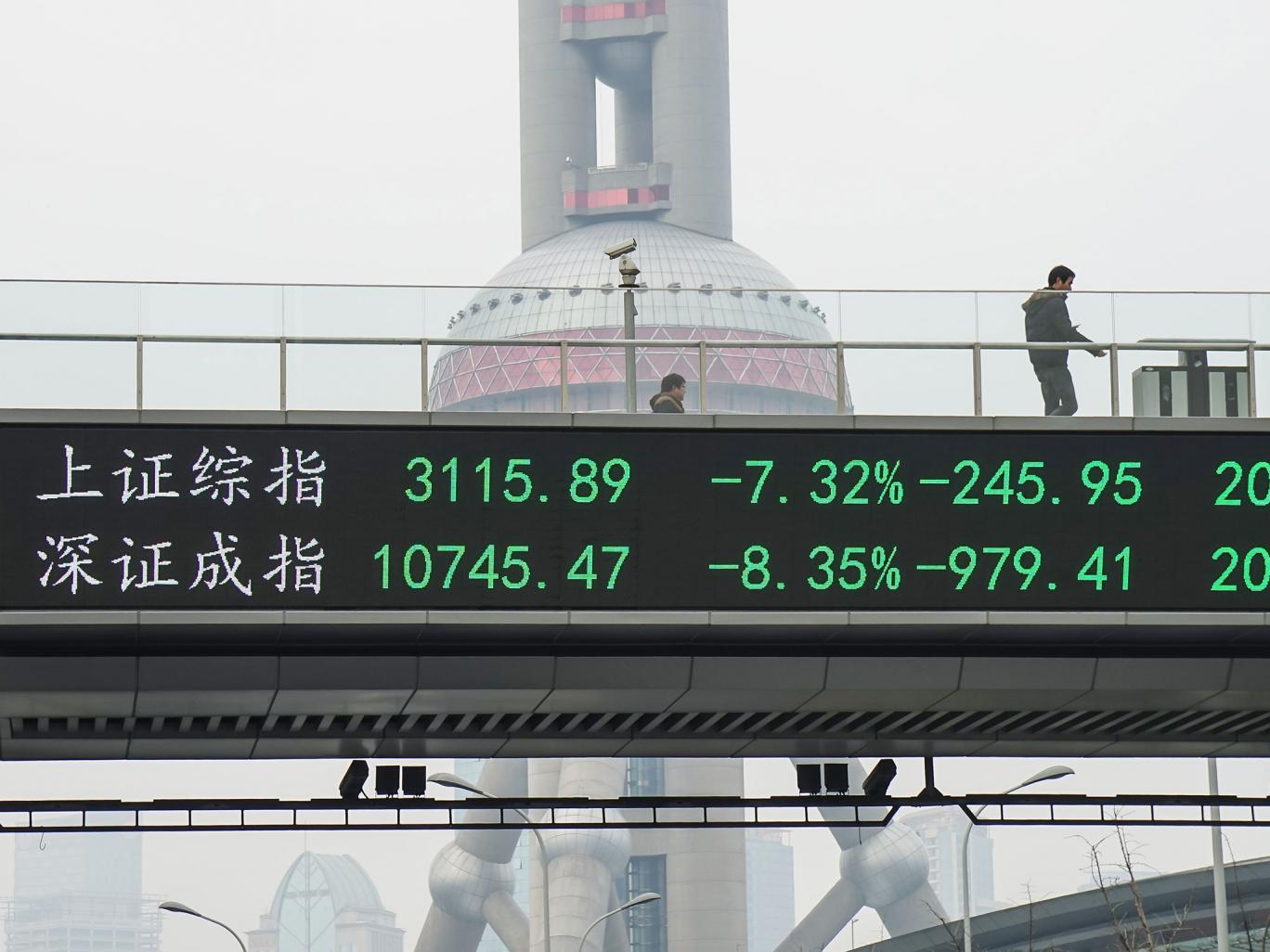
The Chinese stock market’s brand new “circuit breakers”, which have been blamed for bringing chaos to equity trading in the world’s second-largest economy this week, are to be suspended, Beijing’s market regulator said yesterday.
The circuit breakers automatically suspend share trading when the CSI 300 index of large Chinese companies moves more than 7 per cent in a single day – and have been activated twice since they were introduced on Monday. Yesterday trading was suspended within half an hour of the market opening.
Stockbrokers claim the circuit breakers have actually exacerbated the market volatility and price falls they were designed to prevent, by encouraging herd trading among small investors, who are panicked into offloading stock before trading is halted. Some argue that they are badly designed and kick in for excessively low movements.
In a sign Beijing accepts that criticism, the China Securities Regulatory Commission announced the suspension of the circuit breakers last night via its microblog.
The latest market sell-off appears to have been triggered by concern about currency depreciation, after Beijing yesterday allowed the biggest fall in the yuan against the dollar in five months.
Traders were shocked when the People’s Bank of China set the official mid-point of the yuan 0.5 per cent weaker at 6.5646 per dollar, the lowest level since March 2011. “It was a panicked response to the forex market,” said Wang Jun of China Securities in Beijing. “Accelerating exchange-rate depreciation could lead to liquidity problems. Valuations can’t help but take a pounding”.
Analysts are divided over China’s currency strategy, with disagreement on whether Beijing is trying to squeeze speculators by allowing the yuan to fall in value, or attempting to give its ailing export sector a fillip.
It was a surprise official depreciation of the yuan in August that set off the “Black Monday” panic, as fears spread around the world about the underlying health of the Chinese economy.
“Risks and uncertainties with regard to the [yuan] and its ripple effects are substantial,” said Louis Kuijs of the forecasting organisation Oxford Economics.
Market volatility earlier this week was also blamed on the imminent expiry of a six-month ban on large stock sales. The Beijing authorities yesterday moved to ease that concern with new limits on the amount of stock that big shareholders can offload.
The Chinese central bank also revealed that the country’s foreign exchange reserves fell by $108bn (£74bn) in December to $3.33trn, in a sign that the country has also been spending to prop up the value of the domestic currency.
The price of a barrel of US crude oil dipped $1.40 to $32.57, the lowest in more than a decade. The gold price rose above $1,100 an ounce for the first time since November –an indication that investors are seeking safety.
The billionaire investor George Soros said that China had a “major adjustment problem” and added that the current febrile state of markets reminded him of the global crisis eight years ago.
“When I look at the financial markets, there is a serious challenge which reminds me of the crisis we had in 2008,” he told an economic forum in Sri Lanka.




.png?w=600)








