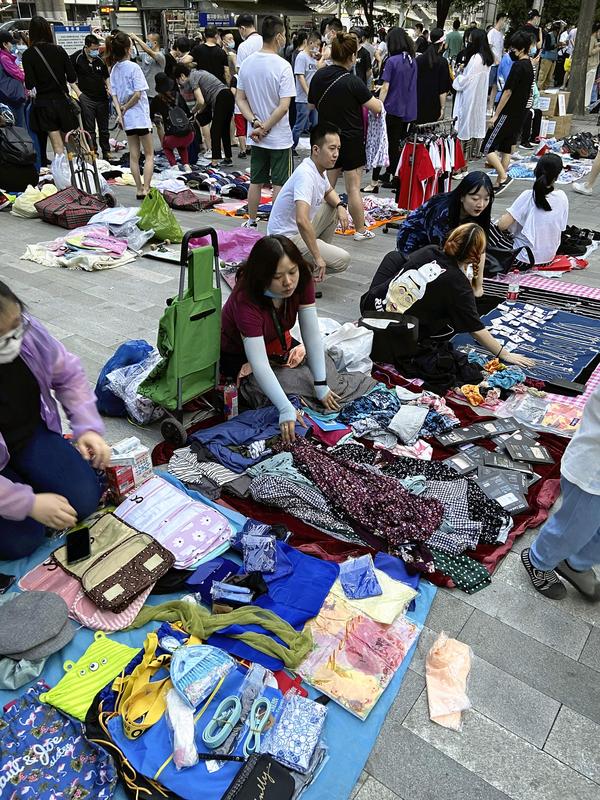
Recently in Beijing I saw something I haven't seen in a long time, it was a street vendor pulling a cart, selling fruit. Bright-eyed local housewives and other passersby gathered around. Cherries were being sold at 30 yuan (or about 450 yen) per 500 grams, less than half the supermarket price. And they were very fresh, too.
Street vendors are popular among locals, but in recent years they have rarely been seen, due to strict control by local authorities. I was worried that the vendor might be running a risk by violating regulations, so I asked her if selling fruits in this way was OK. The woman, who said she came from Hebei Province, calmly explained: "Premier Li Keqiang said it's OK. We have to earn cash income."
During a press conference in May, Li said approvingly that after the ban on street vending was lifted in Chengdu, the capital of Sichuan Province, earlier than any other cities in the nation, "A hundred thousand jobs were created overnight." As Li ranks No. 2 in the administration of Chinese President Xi Jinping, his remarks were seen as a "high official stamp of approval," prompting major cities, including Shanghai, to swiftly lifted the ban as well. In fact, "stall economy" quickly became a buzzword.
As the Chinese economy has deteriorated due to impact of the new coronavirus, restaurants and small and medium-sized companies have gone out of business one after another. The government has unexpectedly started placing importance on street vendors -- the very sight of whom it had previously loathed for spoiling the cityscape and disturbing public order -- as the key to quickly creating jobs. Such a change is nothing but the "declaration of the state of emergency, saying that people must live on by their own efforts," as a source related to the Communist Party of China has put it.
Confusion is also spreading over the abrupt change in the government's policy. In Dalian, Liaoning Province, a rush of roadside stall openings caused traffic congestion and left rubbish scattered along streets. In Beijing, there are also those who oppose street vending, saying it does not befit the capital.
Incoherent responses are not limited to street vending.
At a press conference where he spoke in recommendation of street vendors, Li pointed out that some 600 million Chinese, out of the 1.4 billion population, earn a monthly income of only about 1,000 yuan (or about 15,000 yen). While the Xi administration pushes, as its official pledge, achieving the "elimination of poverty" and the realization of a "moderately prosperous" within this year, a perception has spread that Li brought to light the dire current reality in which more than 40% remain low-income earners.
As a matter of fact, based on criteria set by the administration, the 600 million people Li pointed out do not fall into the category of "poverty." This is because the administration considers that the nation will be "out of poverty" if people earn an annual average income of 4,000 yuan (or about 60,000 yen) or more, or a monthly income of 333 yuan (or 5,000 yen) or more.
Even so, it would be impossible for a person to live a decent life with a monthly income of only 1,000 yuan, though it is three times more than the standard for bringing people "out of poverty." As Li did not neglect to mention at the press conference, "It is difficult [for those with a monthly income of 1,000 yuan] even to rent a room in a medium-sized city."
While Li's remarks have created a stir, Xi, the administration's top official, made an inspection visit to the Ningxia Hui Autonomous Region in the northwest of the country, a typical impoverished region, and called once again for the realization of the elimination of poverty.
It isn't clear whether confusion over the pros and cons of lifting the ban on street vending, or the definition of poverty, reflects the discord within the administration. Yet one thing is certain: Whether people will be able to realize a "life of comfort" will surely have an impact on the future of this country.
Read more from The Japan News at https://japannews.yomiuri.co.jp/