As the number of children in need of a certain kind of regular medical care, such as the administering of ventilators, is increasing, ensuring day care centers and kindergartens that can accommodate such children is becoming a pressing issue.
The government policy of offering early childhood education and kindergarten free of charge also includes provisions to help such facilities accept more children who need medical care. However, a shortage of nurses capable of providing such care has become an obstacle and has led to many parents and other guardians failing to secure places for their children.
Suction machine in staff room
In many cases, children requiring regular medical care need various kinds of assistance on a daily basis. Four-year-old Kosuke Onishi has a serious heart disease and other health problems. He attends the city-run Minami day care center in Yonago, Tottori Prefecture. Twice a day, Kosuke goes to the staff room, where a nurse uses a suction machine to remove phlegm that has built up in his respiratory system.
Kosuke has already undergone 15 operations. A tube has been inserted into his windpipe that makes it easier for him to breathe. The regular removal of phlegm to keep his airway clear is essential for his health. When Kosuke takes a nap at the center, his heart rate is monitored. If his oxygen blood level drops, he must be given oxygen.
Kosuke energetically moves around and he loves making his friends laugh by pulling funny faces. His mother, Hiroko, who teaches at a special needs school, has been impressed with Kosuke's development. "Since he started coming to this day care center, his appetite has increased and he has become physically stronger," said Hiroko, 39.
Children requiring such regular medical care refers to those who continue to have such regular treatments as use of ventilators, removal of phlegm with a suction machine and tube feeding, even after receiving hospital treatment for congenital diseases and other conditions. Some of these children may be bedridden.
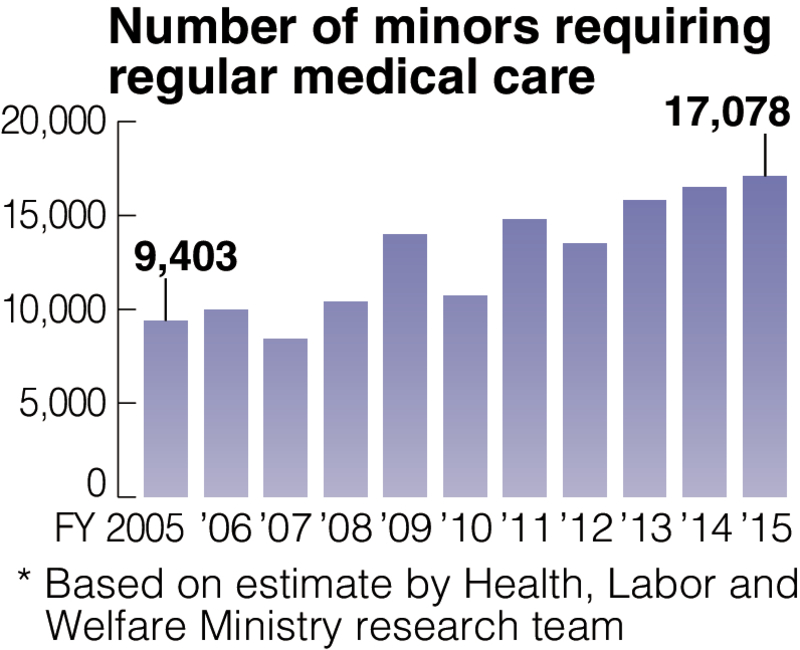
A research team of the Health, Labor and Welfare Ministry estimates that about 17,000 children aged 19 or younger across the nation required regular medical care in fiscal 2015 -- almost double the number of such children 10 years earlier.
One of the reasons for the increase is recent medical advances that have saved more children who would previously have been unable to survive.
Moms forced to quit jobs
In stark contrast to this situation, regional efforts to support children requiring medical care have been slow off the mark. While the number of women in the workplace has been increasing for various reasons, ensuring a sufficient number of day care centers that accept children needing medical care has not caught up with the increase.
In 2016, the health ministry surveyed about 1,300 parents and guardians of children requiring regular medical care. According to the survey, it was mothers who predominantly provided care for these children. Although 70 percent of these mothers did not work outside of the home, almost half of them wanted to find employment. "I want more day care centers that my child can attend made available," many survey respondents commented.
Kosuke started attending his day care center in the autumn of 2016 after what had been a difficult process. The city government had struggled to find a full-time nurse to provide the care Kosuke required. Hiroko spent 3-1/2 years on child care and nursing care leave while she waited for the green light. "My company was very understanding and allowed me to return to work, but many mothers have no option but to quit their jobs," she said.
A 30-year-old Tokyo mother who had been a regular employee at a pharmaceutical company had to quit her job three years ago because she was unable to find a day care center for her 4-year-old oldest daughter, who has a severe disability.
She repeatedly sought help from her local ward office and tried about 30 nearby day care centers, but was turned down every time. "We can't offer the services of a nurse who can provide constant care of your daughter," she was told. After quitting her job, her family income was slashed by half. "It's really tough having to provide around-the-clock care for my child. I want to be a part of society," the woman said.
Kids rejected at day care centers
The Yomiuri Shimbun surveyed 115 prefectural governments, ordinance-designated major cities and core cities between November and January. In fiscal 2016, at least 36 children requiring regular medical care were rejected from day care facilities across 18 local governments, according to the survey. "We don't have nurses able to provide the required medical care or child care workers that have received the necessary training," was the most common reason for the refusal among the local governments -- 86 percent of which gave this response.
When asked which conditions were important for accepting children requiring regular medical care, 92 percent of local governments said, "Having more nurses stationed at the facility," followed by, "Having more child care workers stationed at the facility" (36 percent) and, "Providing better medical care training to child care workers" (27 percent). Respondents could provide multiple answers to this question.
Children with disabilities who have yet to enroll in elementary school can receive support from about 5,000 day care facilities across the nation. However, only about 25 percent of these facilities provide medical care. Moreover, such facilities tend to be for children with severe disabilities, and may not be suitable for children with less-severe disabilities. This has prompted strong calls for day care centers to accept more children with less serious disabilities.
"Many parents and guardians just give up without even speaking up about this problem," said Shukutoku University Prof. Reiho Kashiwame, an expert on child and family welfare. "Local governments must first examine these families' needs and then put systems in place to help them, such as stationing nurses where necessary and giving day care center workers more training."
More nurses needed
The central government and local governments are gradually addressing this issue.
In December 2017, the central government hammered out a policy to make early childhood education and kindergartens free of charge. In line with this, children requiring regular medical care when they attend day care and kindergartens, day care centers for children with disabilities and other facilities are expected to be covered by the plan. Furthermore, the Child Welfare Law, which was revised in 2016, obligates local governments to make efforts to support these children.
The Hachioji city government in Tokyo started accepting children requiring medical care at four locations, including the Uchikoshi Day Care Center, from fiscal 2018. Three nurses at the center look after 18 children with disabilities, including three who require regular medical care. A nearby nursing center for children with disabilities helps train staff at the center, such as in how to help the children eat meals. "With nurses stationed here, as well as support systems in place in case of emergencies, accepting these children hasn't been difficult," said Seiji Mitsumune, head of the Uchikoshi Day Care Center.
Since fiscal 2016, the Kawasaki city government has assigned one nurse to each public day care center in the city's seven wards. More nurses will be provided if needed. These nurses are restricted to providing three types of care, such as tube feeding, and six children used their services in fiscal 2017.
However, some areas are suffering from a nurse shortage. Given that more parents will inevitably want to place children requiring regular medical care at day care centers and other facilities as early childhood education becomes free of charge, training nurses able to take care of these children has become an urgent task.
(From The Yomiuri Shimbun, April 19, 2018)
Read more from The Japan News at https://japannews.yomiuri.co.jp/