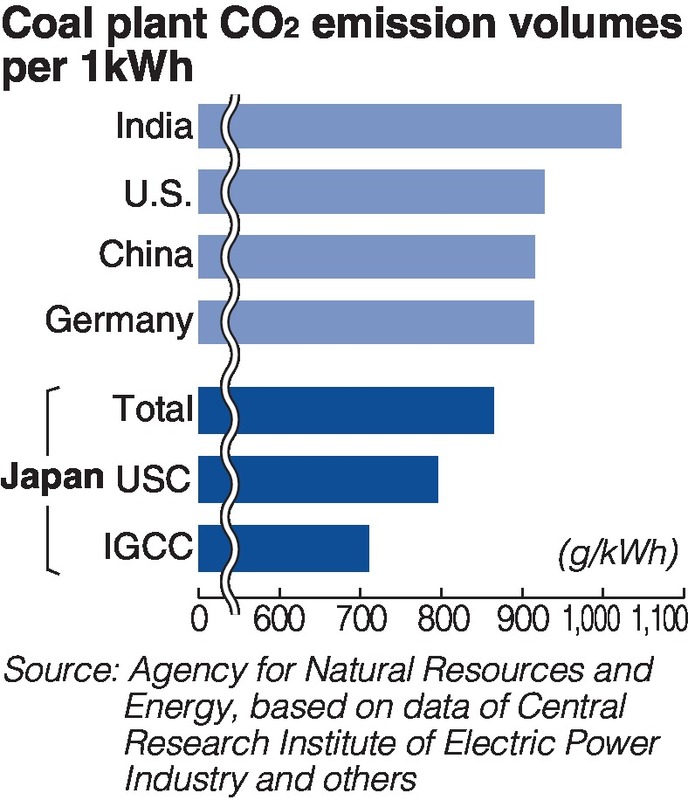
Driven by the desire to mitigate climate change, the backlash against coal-fired power generation and its heavy carbon dioxide emissions is gaining momentum. A move to end investment in coal-related industries is also taking hold around the world. With coal-fired power remaining a key source of electricity for Japan, how can the country best tackle this situation?
Norges Bank is one of the world's largest sovereign wealth funds and manages the Norwegian government's pension fund. Since 2016, under its new guidelines, Norges Bank has removed companies involved in coal from its list for investing. The bank decides to exclude companies based on their earnings structure -- whether the company gains 30 percent or more of its total earnings from the coal business -- and other factors.
Some of Japan's energy companies were notified in 2017 that they have been placed under observation for possible exclusion. Hokkaido Electric Power and J-Power, which are among the top Japanese power companies, have been excluded. In 2018, Japan's megabanks announced their policy to stop offering loans for inefficient coal-fired power plants.

Japanese companies have risen to the forefront of the development of high-efficiency coal-fired power generation technology. Ultra-supercritical (USC) power plants generate power by burning coal to create steam at extremely high temperatures and pressure, and turn turbines with that steam.
State-of-the-art integrated gasification combined cycle (IGCC) technology further increases efficiency and reduces CO2 emissions by using high-temperature gasified coal to generate power. After development as a public-private venture from the 1980s, IGCC began to be put into commercial use in 2013 in Iwaki, Fukushima Prefecture.
Nevertheless, plans for coal-fired power plants are being reconsidered in Japan. In April 2018, J-Power announced the abandonment of its plan to replace a coal-fired power plant in Hyogo Prefecture. A joint project for the construction of a coal-fired power plant involving Chugoku Electric Power has also switched over to liquefied natural gas-fired power.
Since the Great East Japan Earthquake of 2011, the delayed resumption of operations at nuclear power plants has led to the emergence of coal-fired power generation as an effective means of reducing the cost of fuel and keeping electricity rates under control.
Coal-fired power plants can be put into service for around 40 years, during which time they will repay any investment. However, if regulations in Japan and abroad were to be tightened, any such facility "could become a 'beached asset,'" like a ship that has run aground and become unable to move, making the investment unrecoverable, said one executive from a major bank.
In fiscal 2017, Japan relied on coal-fired power for 32 percent of its electricity. As a relatively inexpensive resource, coal is easy to procure and delivers lower power-generation costs. The Japanese government considers coal to rank alongside nuclear as a key power source. In its Strategic Energy Plan, the government forecasts that coal will still account for 26 percent of power generation in fiscal 2030.
Japan currently relies on imports for the majority of its resource needs, with its energy self-sufficiency rate coming in at the extremely low figure of 9 percent. As a result, "it is not practical to discard coal as an option," said one top official from the Agency for Natural Resources and Energy. Even Germany, which has put much of its weight behind renewable energy, depends on coal for 40 percent of its electricity. Concerns about supply stability and issues of employment preclude any realistic possibility of abandoning coal.
As the world approaches coal-fired power generation with increasing caution, what should Japan do to maintain a stable energy supply?
One solution has emerged from Poland, which in December hosted the 24th Conference of the Parties (COP24) to the United Nations Framework Convention on Climate Change.
Poland, a "coal giant" that relies on coal for 80 percent of its electricity needs, has settled on a policy of refusing any climate change strategy that imposes an excessive burden on the quality of life of its residents, such as by placing significant constraints on economic growth or coal mining-related employment. In its coal-fired power plants, the country will employ cutting-edge technology to limit CO2 emissions.
At the same time, it is also attempting to overcome its environmental challenges through the widespread adoption of electric vehicles and the use of nuclear power, which does not produce CO2.
To sustain its climate change mitigation efforts and its economic growth, Japan needs not only state-of-the-art coal-fired power generation, but also the reactivation of its nuclear power plants that have been verified as safe.
The continued use of coal-fired power will necessitate further technological development. A top official of the Economy, Trade and Industry Ministry said, "It will be necessary to find methods to reduce emissions by researching ways to reuse CO2 generated by coal-fired power plants, such as by sequestering it and using it to synthesize chemicals."
As a country with limited resources, Japan has many challenges to overcome.
Shozo Kaneko, a research advisor at the University of Tokyo's Institute of Industrial Science, sees the use of coal-fired power as essential in terms of maintaining the country's energy security.
"Japan relies on other countries for the fuels that are used for power generation, such as natural gas and coal. Even though natural gas has low CO2 emissions, relying just on that would be dangerous," he said.
Read more from The Japan News at https://japannews.yomiuri.co.jp/