At the recently finished annual session of the National People's Congress, Chinese President Xi Jinping reiterated that the "reform and opening up" program that had shaped China since it was launched in 1978 by Deng Xiaoping would continue.
However, the fundamentals of this 40-year-old program have changed completely. The words used might be the same, but what they mean is another thing entirely.
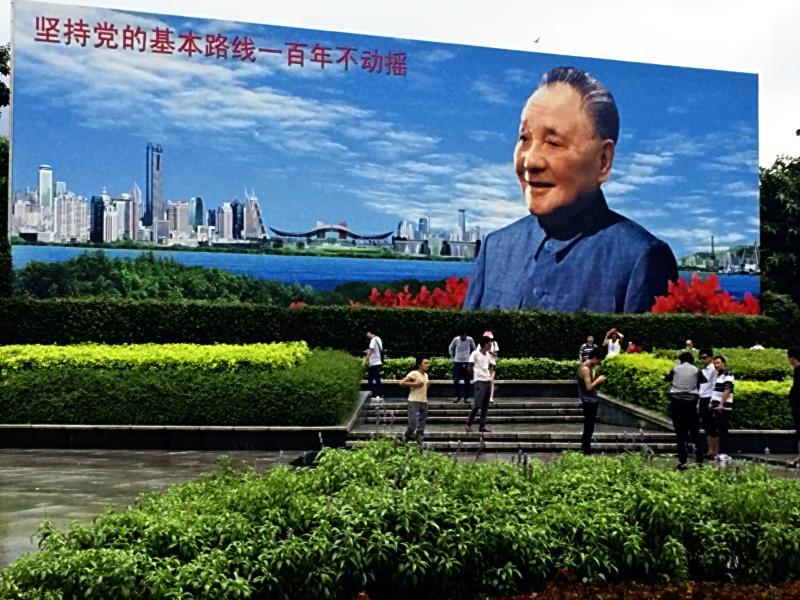
The expression linking the basic words "reform" and "opening up" originally was not a generic term for individual economic policies. This was the basic path Deng spelled out to rebuild the nation, which was devastated during the final years of Mao Zedong, China's leader when the People's Republic of China was established. The objective of "reform and opening up" was economic development.
Deng destroyed the Mao era political setup to achieve this goal. Deng denied the autocratic rule of Mao that had led to tens of millions of deaths from starvation and persecution during the "Great Leap Forward" and the Cultural Revolution, crafting a collective leadership system that could prevent an individual leader from running out of control, and also opening the door to a retirement system for national leaders.
Deng repeatedly trumpeted the importance of these changes following the Tiananmen Square Incident (see below), over which Chinese Communist Party leaders were split and the collective leadership system tipped into crisis.
On the economic front, "reform and opening up" freed people who had been constrained by common ownership under socialism, and ushered in reforms that allowed people to make money.
Deng's nominated successors as president, Jiang Zemin and Hu Jintao, both carried on these policies while they were in power.
Throughout the history of the People's Republic of China, party governance has flipped between "centralizing power and tightening" and "decentralization and loosening."
The centralization of power and tightening the grip on authority reached its zenith under the Mao autocracy, but Deng quickly loosened this control through the "reform and opening up" program.
However, during the latest session of the National People's Congress -- China's parliament, which ended on March 20 -- the constitutional provision limiting the presidency to two terms totaling 10 years was abolished. This means Xi, who is general secretary of the CCP, could stay in power indefinitely.
Xi's political thought for "a new era" -- a theory bearing his name -- has been enshrined in China's Constitution. Reform of state institutions and personnel selected to leadership positions have strengthened Xi's leadership of a party that is now overwhelmingly dominated by one man.
China's direction has clearly done a U-turn. Once again, China has embarked on a path of emphatically centralizing power and tightening control. This is a historic change of direction.
Chinese Premier Li Keqiang said that China "will endeavor to make new breakthroughs in reform" during the "crucial juncture" of 40 years after the "reform and opening up" program began. Li added that China "will open its door even wider to the world."
The mayor of Shenzhen, a city in Guangdong Province, which has developed as a special economic zone that was a poster child of the "reform and opening up" program, said the 40th anniversary of the reforms would be a "new starting point."
This "juncture" and "starting point" are essentially a turning point toward a "new era" in which Xi, who has seized enormous authority, can steer national politics. This is not a direct continuation of the past "reform and opening up" program.
'One core'
The nature of the "reform and opening up" program could be neatly summed up as revolving around "one core."
Under this line of thinking, every policy was tailored to the "core" objective of economic development. This was based on Deng's realistic approach under which economic rejuvenation was more important than anything else in the drive to rebuild the nation.
Although giving development top priority created unwelcome side effects, including huge income disparities, widespread corruption and environmental destruction, China grew into the world's second-largest economic superpower.
Xi has stepped away from this "core." He has hammered out the concept of a "new normal" that puts growth quality ahead of the speed of economic growth, and emphasized an integrated plan that attached importance to all the five key policy pillars of economic, political, cultural, social and environmental advancement.
While this plan touted five pillars, the Xi administration has so far focused the most on -- and devoted most of its energy to -- the political element, especially maneuvers concentrating power in Xi's hands.
Xi also said he opposes the "rule of men," in which politics can be influenced by individual people.
After hearing Xi say this at the congress, a chorus of praise erupted from his aides. "We will protect Xi's central position," one said, while another added, "Xi is the people's leader."
It seems Xi himself is now the "core" of the Chinese Communist Party.
Standing apart from West
One more phrase defining the "reform and opening up" program is "the liberation of thought." This was a command from Deng to smash the shell of the old socialist ideology for the sake of economic development and boldly carry out the reform plans more in keeping with reality.
Under the unheard-of coined phrase "socialist market economy," private companies and operators that had been knocked down during the Mao era as enemies of the working class started to grow. Freedom, human rights and other values and cultures championed by Japan, the United States and Europe began to filter into Chinese society.
However, the Xi administration has turned its back on these values and systems of the West. On the economic front, China claims to uphold a free trade system, but it appears greater emphasis is given to maintaining control by the party rather than by market principles.
Under the surface, there is growing concern about this approach. "Doing it this way will make attaining sustainable growth difficult," a party official said.
Li's plan for cultural policies contains a slew of expressions that are at the opposite end of the spectrum from "liberation of thought," such as "revolutionary culture," "socialism's advanced culture," "socialism's central values" and "spiritual civilization for the masses."
When the Xi administration speaks of "reform and opening up," it is mainly limited to individual economic policies. It does not touch political actions that could definitively sway the direction of the economy. Can this really be called "reform and opening up"?
A noted researcher of ideology carefully chose his words as he said, "'Reform and opening up' has also entered a new stage in Xi's 'new era.'"
(From The Yomiuri Shimbun, March 22, 2018)
--Tiananmen Square Incident
In June 1989, the administration under the Chinese Communist Party used force to crush a massive pro-democracy demonstration led by students in the area near Tiananmen Square in Beijing. The crackdown killed and injured many people. Deng Xiaoping sacked Zhao Ziyang, the party's general secretary, who sympathized with the demonstrators. Deng nominated Jiang Zemin as Zhao's successor to sustain the administration in a whole-party approach.
Read more from The Japan News at https://japannews.yomiuri.co.jp/