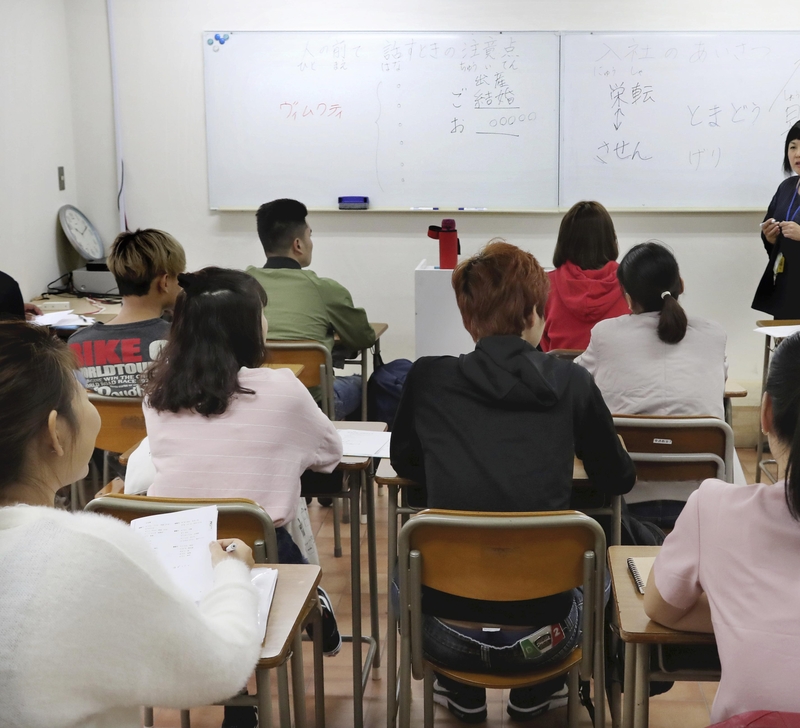
A survey conducted by The Yomiuri Shimbun has found vocational schools -- facilities licensed to provide training in practical professions for young Japanese based on the School Education Law -- throughout the nation where most of the students are foreign nationals. The reasons behind this include an increase in the number of foreign students coming to Japan apparently to work and an inadequate system for checking the quality of educational institutions.
Mass expulsions
"We admit so many Japanese language school graduates and just pack them into classrooms. It would be better if lots of students left the school. It's not like we have to return their course fees or anything," admitted a person close to the Japan-China College of Culture and Arts in Tennoji Ward, Osaka. The vocational school admitted foreign students far in excess of their admissions quota. Because of this, 109 students from countries like Vietnam were refused resident status by the Immigration Bureau this summer and had to leave the school.
Since the school first opened in 2015, a total of 400 foreign students have been expelled as punishment for absence, among other reasons. Investigation by the Osaka Prefecture found that actual lessons at the school deviated a great deal from the vocational training the school was supposed to provide.
The school was licensed by the prefecture to cultivate skills such as Chinese interpretation mainly among Japanese students. However, 90 percent or more of the students were found to be foreign nationals from countries including Vietnam and Nepal, who were being taught elementary Japanese language skills like reading and writing kanji.
The School Education Law stipulates that vocational schools "exclude schools that exclusively admit foreigners." After surveying about 2,400 schools in 46 prefectures, excluding Tokyo, where the tally is still incomplete, the number of vocational schools where foreign students accounted for 90 percent or more of the student body was at least 72. Of these, 35 schools had a student body made up entirely of foreign students.
What many of these schools have in common is that the Japanese language ability of their students is low. "They can't understand specialized classes, so we've oriented the school toward foreigners. It's an extension of a Japanese language school," one employee revealed.
'You can make money in Japan'
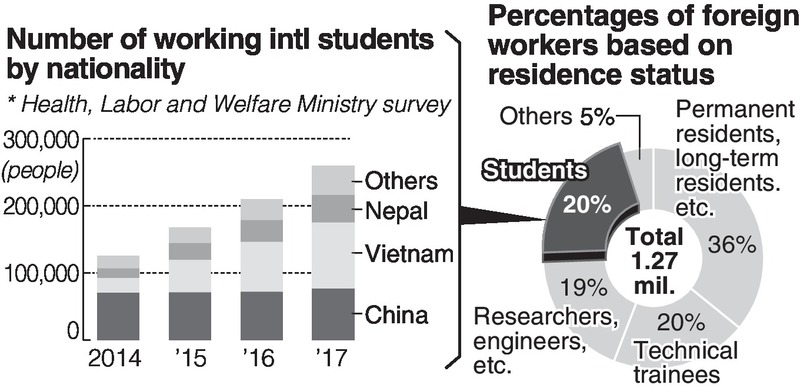
In 2008, the central government decided on the "300,000 international students plan." To attract more highly skilled foreign nationals, it relaxed the procedures for aquiring the status of residence and according to the Japan Student Services Organization (JASSO), ended up increasing the number of international students to 267,000 by 2017.
However, it is not universities but Japanese language schools and vocational schools that are helping to increase the number. About 78,000 international students were enrolled in Japanese language schools in 2017, or 3.2 times the level five years before. At vocational schools, the number was about 58,000, or 2.3 times more.
One reason for the increase is that international students are now allowed to work. They can work up to 28 hours per week in Japan, but other developed countries such as the United States have stricter rules, partly based on the idea that work can hinder their studies.
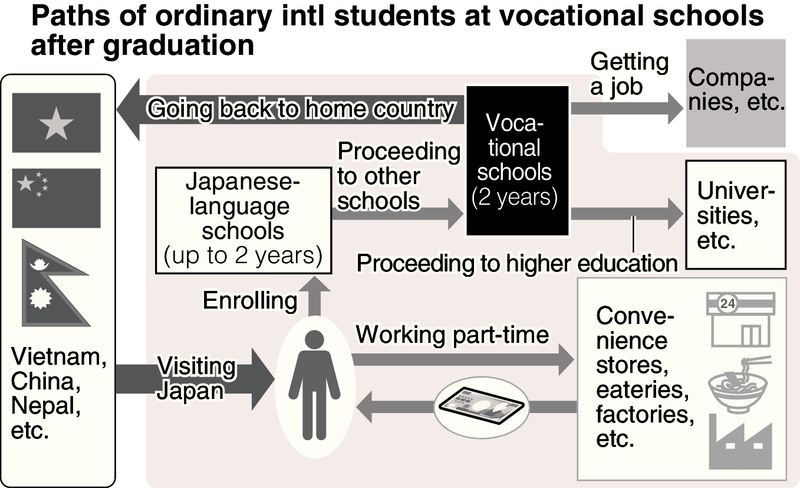
There has been a sharp increase in the number of intermediary companies in countries like Vietnam and Nepal that proclaim "if you go to a school in Japan, you can make money." A growing number of debt-ridden foreign nationals enroll in a Japanese language school and then spend all of their time working part-time jobs -- they are referred to sometimes as "migrant workers studying abroad."
Foreigners can be enrolled for up to two years at a Japanese language school, and after they graduate, they must choose between applying for higher education or going back home. Some vocational schools that have had trouble recruiting students due to declining birth rates have accepted students who can barely hold a conversation in Japanese.
The proprietor of one such school said: "It's not easy to find Japanese students no matter how much you spend on advertising. International students just keep coming."
Highly skilled migrants increasing
Needless to say, there are international students who study alongside Japanese students at ordinary vocational schools and later work for Japanese companies. The number of graduates who are permitted to reside in Japan as "highly skilled" workers is increasing and was about 5,000 last year.
However, there are also many who hope to work in Japan but return to their country without being able to acquire resident status because their expert knowledge is not up to par.
"Currently, we are close to having no system to keep educational quality in check," says Yuriko Sato, an associate professor of the Tokyo Institute of Technology and an expert in exchange student policies overseas. "It's imperative that we create a system to eliminate unsuitable schools and guarantee quality."
Sato referred to the Australian system as an example. Educational institutions there that accept international students must undergo inspection by the government to see if their classes meet certain standards. If they are not who they say they are, international students are entitled to request a refund of their tuition fees.
Managing director Toshihiro Menju, who specializes in policies regarding foreign nationals at the Japan Center for International Exchange, said, "Under these circumstancs, studying in Japan will become less attractive for eager international students and eventually, they will stop choosing Japan as their destination."
Shops depend on intl students
The fact that Japanese businesses beset by labor shortages are being supported by part-time work by international students is complicating the issue.
According to the Health, Labor and Welfare Ministry, out of 1.278 million foreign nationals working in Japan, 20 percent or 259,000 are international students. In an effort to expand the foreign workforce, the government is planning to grant resident status in 14 industries, including unskilled work in fields such as agriculture and fisheries. However, many industries fall outside this group of 14 and will likely still have to rely on help from international students.
The number of foreign workers at the three major convenience store chains has now exceeded 50,000. This workforce accounts for 6 percent of the total number of employees, and the majority of them are international students. A 67-year-old male owner of a convenience store in Kobe revealed that half of his employees were international students, saying, "I wouldn't be able to run my business without them."
As the competition for international students heats up, Lawson, Inc. has already opened a training center in Vietnam in 2016 for inbound students, looking to snap them up early.
(From The Yomiuri Shimbun, Nov. 10, 2018)
Read more from The Japan News at https://japannews.yomiuri.co.jp/