The Korean Peninsula situation has undergone a flurry of significant developments in recent weeks. North Korean leader Kim Jong Un has agreed to hold a summit meeting with South Korea's president at the end of April, and even indicated a willingness to denuclearize the peninsula.
But Pyongyang will likely continue its nuclear and missile development, so the North Korean military threat remains unchanged. For Japan, what "worst-case scenarios" could unfold on the Korean Peninsula?
Kim's real objective
After a meeting between Kim and a South Korean special delegation, the South Korean government announced on March 6 that both sides have agreed to hold a summit meeting at Panmunjom -- a village in the demilitarized zone separating the two Koreas -- in late April, and that Kim indicated a willingness to denuclearize the Korean Peninsula.
What is North Korea's objective?
"The most pressing issues for North Korea at the moment are avoiding a military conflict with the United States and concentrating on building its economy, which is a pillar of Kim's 'two-track policy' of nuclear and economic development," said Keio University Associate Prof. Atsuhito Isozaki, an expert on North Korean politics.
"Getting economic sanctions lifted is essential if North Korea wants to gain economic assistance from South Korea. To secure U.S. support for lifting these sanctions, North Korea firstly had to fulfill the preconditions needed for dialogue with Washington," Isozaki added.
"Denuclearization" was the key word in the preconditions for U.S.-North Korea talks. U.S. President Donald Trump swiftly indicated that he welcomed Kim's show of willingness to give up Pyongyang's nuclear program.
However, it is difficult to believe that North Korea will abandon the development of nuclear weapons it has worked so hard on for decades.
"'Denuclearization of the Korean Peninsula' doesn't just mean 'denuclearization of North Korea,''' Isozaki said. "It's a cliche trotted out by North Korea that includes demands to the United States and South Korea, such as the removal of U.S. military forces from South Korea."
Buying time?
This latest agreement has seen the mood of rapprochement spread even further. Be that as it may, the North Korean crisis has not been resolved. It is quite possible North Korea will dredge up some sort of excuse to again revert to a hard-line stance. Pyongyang's eagerness to hold dialogue is also aimed at buying time for further nuclear and missile development.
The United States and South Korea plan to soon conduct joint military exercises.
At a House of Councillors Budget Committee meeting on March 8, Foreign Minister Taro Kono said, "While there is the view that tensions are easing, there is also the view that North Korea could resort to further provocations out of resentment toward the military exercises or some other action."
Given all this, what would be the worst-case scenario Japan could conceivably face?
One would be a U.S.-North Korea military conflict triggered by a U.S. preemptive strike launched because Washington will not allow North Korea to possess intercontinental ballistic missiles that could carry nuclear warheads. It is assumed North Korea could also inflict tremendous damage on Japan in a counterstrike.
"The probability of the United States launching a preemptive strike on North Korea is about 15 percent," estimated Yukio Okamato, a foreign policy commentator.
According to public opinion polls in the United States, nearly 60 percent of respondents supported U.S. military action over concerns about an attack by a North Korean ICBM with a nuclear warhead.
"Trump is influenced somewhat by domestic opinion. If he decides that U.S. national security is hanging in the balance, he could use that as a reason to initiate a preemptive strike," Okamoto said. "I think if that time came, he would launch the attack believing that there would not be a massive retaliatory strike by North Korea."
Yoji Koda, a former commander in chief of the Maritime Self-Defense Fleet and a retired vice admiral, said, "There's a considerable chance of a U.S. military strike on North Korea in the next few months."
If the United States went ahead with a preemptive strike, minimizing any possible retaliation by North Korea would become a major task.
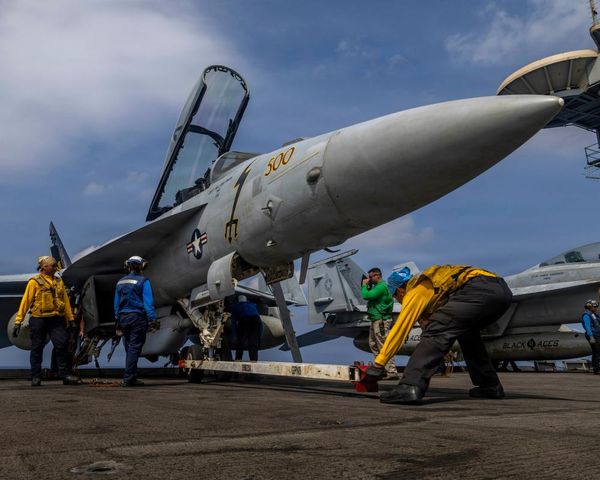
According to Koda, a U.S. attack would require sending in firepower, including more than 1,000 missiles, such as Tomahawk cruise missiles, about 300 to 400 aircraft such as F-16 fighter jets and FA-18 strike fighters and about 50 strategic bombers. Nuclear-powered aircraft carriers and nuclear-powered submarines would be deployed in waters near the peninsula, and U.S. bases in South Korea and Japan would also have vital roles to play in the attack.
But if North Korea continues to keep a lid on its military provocations, the United States will also struggle to come up with a pretext for launching an attack.
Fears of nuclear proliferation
Some observers anticipate North Korea-related issues will enter a more serious phase over the medium- and long-term.
"If North Korea possesses nuclear missiles, the U.S. nuclear deterrent would become extremely ineffective. This would be the worst-case scenario for Japan," said former Defense Minister Gen Nakatani, a Liberal Democratic Party lawmaker, at a symposium in Tokyo on March 6.
Also at the symposium, which was attended by ruling and opposition party lawmakers, Kibo no To (Party of Hope) leader Yuichiro Tamaki said, "The worst situation for our nation would be if the United States says it'll make a deal with North Korea provided it stops developing ICBMs."
Lawmakers expressed concerns felt domestically in Japan, namely that if Pyongyang completes a nuclear ICBM, Washington would hesitate to come to the defense of its allies due to fears of a nuclear attack on the United States, and that if the United States reaches a compromise with North Korea on the condition it freezes and abandons its nuclear ICBM development, the problem of Pyongyang's medium-range missiles that can reach Japan would be left behind.
If North Korea completes its nuclear capabilities, it could threaten Japan, South Korea and other nations in the region with its nuclear arsenal and repeatedly intimidate them to meet Pyongyang's demands in the military and economic spheres.
Furthermore, fears of nuclear proliferation could become a more realistic prospect if North Korea sells its nuclear weapons to third nations or terrorist groups for foreign currency.
"This would be the worst possible scenario for mankind," Koda said.
Overwhelming capability
The United States and Japan have maintained a stance of calling for North Korea's "complete, verifiable and irreversible" denuclearization.
The two countries intend to reinforce the international encirclement of Pyongyang and keep pressure at a maximum to complete its denuclearization. Cooperation with South Korea, China and other countries also remains vital.
However, applying pressure has its limits. Unless things change, Japan cannot help but face the reality that it exists in the same region with a North Korea that is threatening its neighboring countries with nuclear missiles.
What should Japan do?
Okamoto said it should consider possessing the capability of attacking enemy bases, saying the nation "has no choice but to acquire an overwhelming second-strike capability by teaming up with the United States."
Japan will be put to the test over the proper state of its diplomatic and defense arrangements.
(From The Yomiuri Shimbun, March 9, 2018)
Read more from The Japan News at https://japannews.yomiuri.co.jp/