The patterns we relied on in the past no longer serve us in an age of rapid change, where we are unable to see what is coming. These days, we must come up with the best response from one moment to the next. In order to foster the problem-solving abilities of students, elementary schools, junior high schools and high schools are feeling their way toward a shift from teacher-led learning to proactive, interactive and authentic learning (see below).
Various perspectives
"What's reconstruction?"
"Making things the same as they were originally."
"That's what I thought at first, but ..."
In December, a performance of a dialogue-based play was held at Futaba Future School, a high school located in Hirono, Fukushima Prefecture, that aims to nurture people who will work for reconstruction related to the 2011 Great East Japan Earthquake. The play forms a part of the so-called theater education that all first-year students undertake for 8 months as a central component of the education provided by the school.
Soon after starting the school, the students break up into groups of four or five. Their first task is to go and listen to the stories of local people. They speak to staff at government offices, shopkeepers or people working for Tokyo Electric Power Company Holdings, Inc. (TEPCO). Taking ideas from the stories they have heard, each group then decides on a theme and has discussions. They then create a script for the play, decide on the cast and perform the play on their own.
"I bought a house in the evacuation area."
"Are you going to abandon your hometown?"
Contradictions and dilemmas are highlighted during the process of developing the play as the students think from perspectives different from those of their classmates, teachers, and the roles they perform in the play. "The students came to be able to understand complex problems in all their complexity," explains playwright Oriza Hirata, who mentored the students.
When the students enter their second year at Futaba Future School, they undertake project-based learning that targets solutions for regional problems. "We want to foster the skills that will be required in the 21st century by having the students continue to engage in dialogue and collaboration, and have them come face to face with different standpoints and ways of thinking," Principal Junichi Tanno said.
Exchange with other countries
Project-based learning involves the students identifying and actively addressing real-world problems. But often the success of the project itself takes priority over the students' learning, and the project ends up being led by the teacher, with the students' self-directed learning falling by the wayside.
Consequently, the Education, Culture, Sports, Science and Technology Ministry; the Organization for Economic Cooperation and Development (OECD); the University of Tokyo; and other local researchers and government officials all collaborate in trying to come up with new teaching methods.
One such method is the Japan Innovative Schools Network, supported by OECD. It is an ensemble of project-based learning that extends beyond the school and local community. High school students from the Tohoku region, as well as those from as far away as Wakayama and Fukui prefectures, form into teams that comprise anything from a handful to several dozen students each.
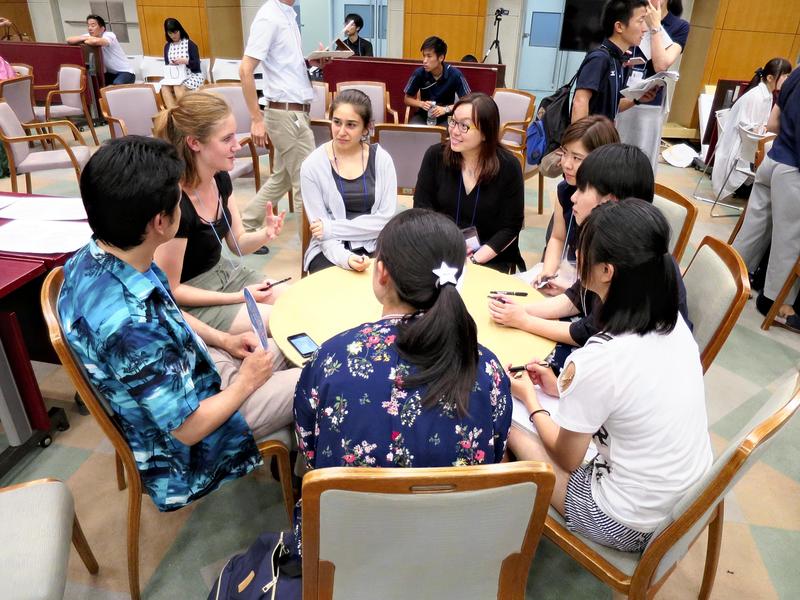
The students have discussions with other students in their region or who are based locally, in other parts of Japan or overseas, identifying problems in their local communities and coming up with solutions. In August last year, an international conference was held in Tokyo to announce the results of the first two years. About 350 people from nine countries, including the United States and Turkey, participated in the event.
"We used to think only about the tragedy of the atomic bomb, but now we reflect more widely, such as the reasons why the war broke out," said a member of a group from Hiroshima Prefecture who were interacting with local students from Hawaii.
A member of a group from Wakayama, who worked with students from Fukushima, said, "We don't have any nuclear reactors, but we may get tsunami. My awareness about disaster prevention has changed."
Meanwhile, teachers' comments included, "I got into the swing of things once I abandoned my sense of obligation to lead and decided to learn with them," and, "Interaction with others makes for highly effective learning."
The Tohoku team quantified student growth, adding external evaluations to self evaluations. The results were analyzed by Associate Professor Atsushi Sakamoto of Fukushima University, who commented that the highest level of development was in communication skills, with planning and execution skills, and reform-related knowledge following close behind. Comments from the teachers included, "Student grades improved," and, "Originality increased."
"Learning and growth come from encountering things that are different to ourselves," said co-leader of the Innovative School Network, Fukushima University Vice President Hiroki Miura. "Adults and children stimulated each other, and I feel that the teachers demonstrated how education can act as a catalyst."
University entrance rates
But there is one problem -- a lack of understanding about the efforts, including the understanding of fellow teachers and the students' parents. A high school teacher who looked after the project-based learning was asked by a colleague, "Can you take responsibility if students fail university entrance examinations?" Discussion of this issue is taking place amid the absence of methods for evaluating problem-solving abilities in Japanese university entrance examinations.
In 2020, a new unified university entrance test will replace the National Center Test for University Admissions. According to Sumiko Osugi, deputy director general of the National Center for University Entrance Examinations, it is possible to test problem-solving processes, to some extent. She said examinees' abilities to see problems and conceptualize solutions can be tested by tweaking and making improvements to multiple-choice questions and introducing question styles that require descriptive answers.
"However, there are limits to what can be tested in a limited amount of time in a written exam carried out en masse on a large scale. We also hope universities assess students' such abilities through individual selection processes," Osugi added.
Reforming entrance exams key for change
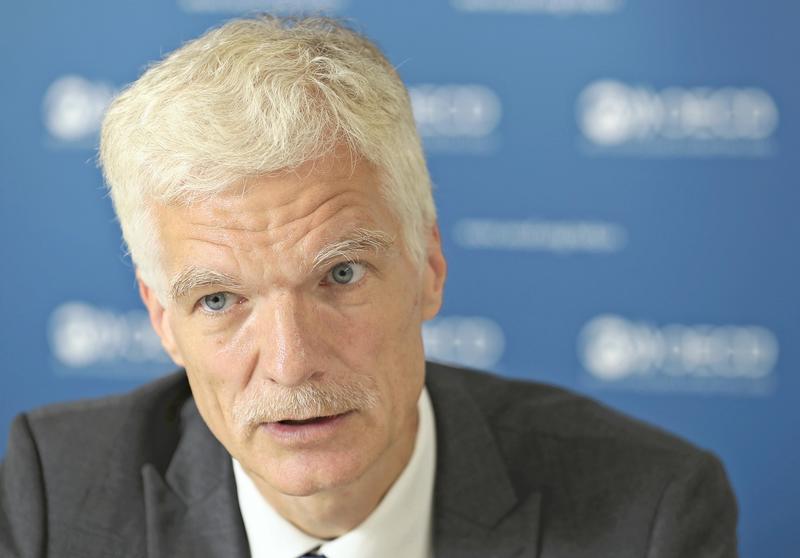
Is Japan's education system heading in the right direction? What challenges remain? Organization for Economic Cooperation and Development (OECD) Director for Education and Skills Andreas Schleicher, who has been nicknamed "Education Minister of the World," answered such questions in an exclusive interview with The Yomiuri Shimbun. The following is excerpted from the interview.
The Yomiuri Shimbun: The OECD's review of education in Japan was released recently. Let me ask you first about active learning, which the education ministry places at the core of the education reform. It is defined as proactive, interactive and authentic learning. How do you evaluate the education reform package? What will the role of teachers be like under the new education system?
Andreas Schleicher: Active learning is a shift from students being recipients of knowledge to become the creators of knowledge. It is to develop what we call "agency," the capacity to create, to innovate, to create intrinsic positive words, the capacity to manage tensions and dilemmas, to make judgments to take initiative, and finally to be able to mobilize our cognitive, social and emotional resources.
If you think about the time of artificial intelligence or digitalization, knowledge transmission is no longer the main role of teachers, because now, thanks to ICT [information and communications technology], there are many different ways how we learn these days. The role of a teacher in the active learning paradigm shift is to become a good coach, a good mentor, facilitator, good evaluator, a good designer of a learning environment.
Q: Isn't that easier said than done?
A: I believe that the Japanese curriculum actually provides significant space for project-based learning. The question is how to use that space effectively. I have seen many successful initiatives of project-based learning. But we often don't know exactly what makes them successful. And that makes it very difficult to spread success. I thought they included many good ideas, but again, the same idea replicated in another context and is not successful, so we are not able to scale and systematically spread that kind of success.
You need to have school leaders who are able to bring teachers together, help teachers develop a strong sense of self-efficacy, ownership of an instructional design. If you want the schools to be adaptive, to be responsive, to be resilient when there is change, I think that leadership dimension is very important. And that is something I don't think Japan is yet strong enough in. Your school leaders are still very much administrative leaders. The self-image of the school principals of Japan is not that of an instructional leader.
In Japan, you become a school leader at the end of your career as a teacher. That's not a good model necessarily. In Singapore, on the first day you enter your school as a teacher, they will ask you, "What do you want to do in your life?" You want to go until you become a specialized teacher, or you want to go to a leadership role, you want to go to assessment, you want to go to human resource development. They have many school principals in their 40s.
Not just objectivity
Q: What about entrance exam reform? Do you think it is possible to develop an entrance exam system to evaluate students' capacity fairly and equally?
A: We really see it as very important for Japan to redefine the gateways. The point we made in our report is that there is a discrepancy in Japan between the ambition of the curriculum -- active learning or project-based learning -- and the assessment culture -- the examination culture -- that is very much geared toward the reduction of content knowledge.
In education, we tend to overemphasize reliability, and underemphasize relevance. So we underemphasize validity, and then overemphasize efficiency. In education, in order to be fair, look fair, we go over to give you a very superficial test, and I can ask you 20 times the same question and you will give me 20 times the same answers, and they say, 'OK, they are reliable, the same answers.' I think we make our life too easy. As a policymaker, of course, you will get criticized when the test is not exactly objective. So that's why you are driven toward a kind of multiple-choice test that is kind of what we have in the university entrance exam.
If you apply to a company to get a job, the company will interview you, they will test your skills, maybe they will ask you to work for two weeks, and so on. And so there is a lot of inquiry about your skills and competencies. That's not objective necessarily. But it's getting to the heart of your knowledge and skills. It is much more advanced than the kind of things that we use for university entrance exams.
And, I think in education it is time to rebalance those kinds of traits that trade between reliability and relevance to make our assessment more relevant.
The strength of Japan
Q: In the OECD report, you pointed out the possibility that the holistic approach to education in Japan will be lost.
A: For us, the holistic approach should really be the objective of the reform. It's the big strength of education in Japan, I think, something which the whole world admires Japan for that. Actually teachers take care of students' development holistically. There is a strong sense of pastoral care of the teachers for students, a strong commitment that teachers have for social and moral development. If we tailorize the work of teachers so that individual specialists take only over some very specific functions, students are lost in the middle.
I think the involvement of communities in schools is a great strength in Japan. I can see enormous benefit in this, particularly if you want to educate students for the future. And the future is not necessarily in school. However, the involvement of communities should not be a goal in itself. Community involvement can also add to the workload of teachers if it is done wrongly. It should be done as a way to improve students learning, and to relieve teachers of things that they're not very well placed for.
--This interview was conducted by Hattori.
-- Proactive, interactive and authentic learning
School lessons where students anticipate what is coming and act of their own accord, where they have discussions with different people and think about issues, where they learn by identifying and researching real-world and real-life problems. In other words, it refers to active learning.
Read more from The Japan News at https://japannews.yomiuri.co.jp/