BUDAPEST -- The Hungarian center-right ruling coalition spearheaded by Prime Minister Viktor Orban, whose campaign centered exclusively on an anti-immigrant and anti-refugee platform, stormed to a crushing victory in the general election on April 8.
Why did the majority of Hungarians support the hard-line policies of the Orban administration, which controls the media and judiciary and has taken a hostile view of the European Union and the United Nations?
The answer boils down, it seems, to government propaganda that played on people's fears -- a typical form of populism.
Just after 11:30 p.m. on April 8, Orban gave a short victory speech as a spring night breeze blew over the Danube River. "The people have defended Hungary," Orban said. "This is a historic victory."
The result defied many predictions. The ruling coalition romped to victory and picked up 134 of the 199 seats in parliament -- more than two-thirds of the total [after 99 percent of votes had been counted]. Opposition parties had coordinated their candidates in nearly 30 percent of the constituencies, and it had been widely speculated that they would put up a good fight as voter turnout was high at 68 percent. This made their defeat all the more stunning.
Former Prime Minister Ferenc Gyurcsany, who leads the left-wing opposition party Democratic Coalition, could not conceal his disappointment after the election loss. "I thought we could return to being a normal country, one that has a European viewpoint. But a nightmare has unfolded before us," he tweeted.
Media fully mobilized
The Orban-led Fidesz party had consistently trumpeted a single issue -- its pledge to stop the influx of migrants.
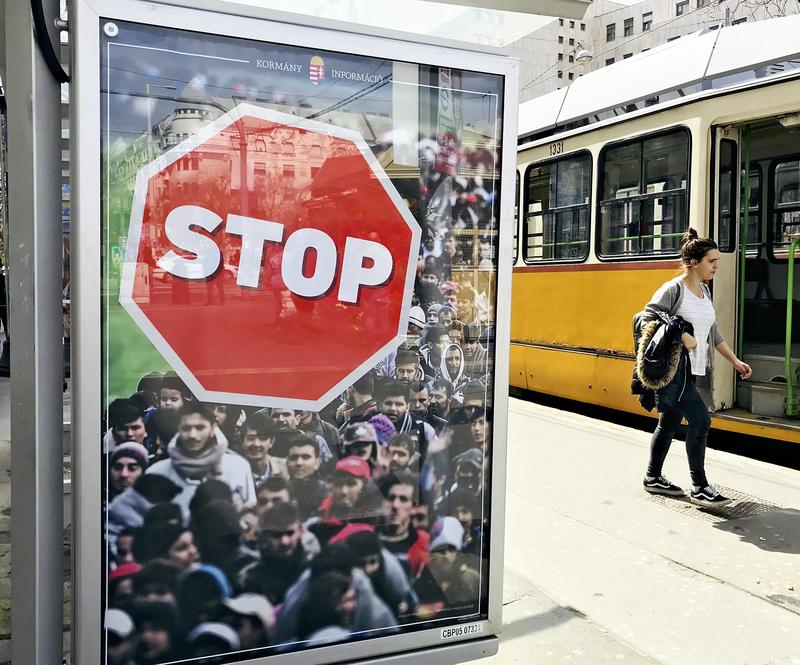
During the election campaign, a poster featuring a single photo was displayed at stations, along shopping streets and in other places across Hungary. The photo showed a long line of people who appear to be migrants, with a red sign saying "STOP," seemingly indicating that their advance will be blocked. This advertisement was repeatedly shown on TV, in newspapers and online, and was labeled "governmental public information."
During a speech, Orban said refugees were "like a rust that would slowly but steadily ruin Hungary." In an interview with a government-affiliated TV channel, he explained his reasons for keeping refugees out. "There is a struggle going on in Europe," Orban said, adding that the struggle will be defined by which countries "stay out of the global trend which creates immigrant countries taking in more and more mixed populations, cultures and people without roots. The question is whether Hungary, together with Poland, the Czech Republic, Slovakia, Croatia and perhaps Romania, will get to stay out of this and preserve Hungary as a Christian, national, Hungarian country."
Orban, who returned to power in 2010, has tightened his grip on the media. Officials related to the government and the ruling party have taken over the management of many national and local newspapers, and the public TV broadcaster has become state-run.
Krisztian Szabados, director at Political Capital, a think-tank in Budapest that is critical of the government, explained a method the government used to assert control over the media.
"Full-page ads calling for refugees to be booted out are printed almost daily in government-affiliated newspapers. This provided revenue for the newspapers that were struggling. Newspapers that opposed these ads were sidelined," said Szabados.
Indeed, the newspaper Magyar Nemzet, which had criticized the government and called for a change in power, announced on April 9 -- the day after the election -- it would be shutting down. The major daily cited "financial difficulties" as the reason.
Numbers tell another story
"Basic salaries in the country are less than half of what people earn in neighboring Austria," Szabados said. "We have a unique language and it's hard for foreigners to settle here. Even though we don't see a serious 'migrant problem' in Hungary any more, the Orban administration kept going on about only the fears and danger of migrants. The election was carried out completely over propaganda and fake news."
In fact, Hungary's current migrant situation is rather surprising. Andras Kovatz, a representative of Menedek, a Budapest-based nongovernmental organization that has been supporting migrants for more than 20 years, points out that there is no imminent migrant problem in Hungary now. "In 2017, almost 5,000 people applied for refugee status here. But only a few hundred were actually recognized as refugees," Kovatz said.
Kovatz said there were two main reasons for this. "Most of the refugees don't stay in this country. Hungary is merely a point on the route to Germany, Britain and other nations in Western Europe. And in 2015, when there was a refugee crisis as hundreds of thousands of people poured in from Syria and Afghanistan, the government erected a fence along the border, which has blocked people from coming in since then," he said.
Nonetheless, about two-thirds of voters supported the ruling party in the election. In an interview with The Yomiuri Shimbun, Gergely Karacsony, coleader of the opposition party Dialogue, said:
"The government and ruling parties bombarded people with huge amounts of information on the internet. This election was a classic example of how to breed populism."
Dialogue's election pledges made no mention of migrants. "That was because migrants are not even in the 10 most important policy issues," Karacsony said.
All the ruling and opposition parties have actually either rejected or taken a negative stance toward accepting refugees. The fact is that the mood in Hungarian society today is not welcoming toward migrants in general.
Exclusionism rears its head
Orban, assured of his fourth term in office, emphasized his "Hungary first" approach. "Hungary's future will not be decided by the European Union or by the United Nations. Our people will decide it," he declared.
His assertion flies completely in the face of the European Union, which has attached importance to diversity and democracy.
German Chancellor Angela Merkel, whose political foundation has been weakened partly as a result of her tolerant refugee policy, congratulated Orban on his election victory on April 9. The leader of one of Europe's most powerful nations, however, added that there were differences in their positions on migrants.
Orban's bullishness stems partly from similar increases in exclusionism in Poland, the Czech Republic, Romania and other nations in Eastern Europe, which is relatively close to the Middle East. In particular, anti-EU solidarity is deepening due to a common resistance to the quota program established in 2015 to share the refugee burden among EU members.
The refugee problem casting a shadow over EU unity is even starting to fuel concerns of an East-West split in Europe. At a time when military tensions are again flaring up over Syria, policy coordination between Germany and France on one side and countries in Eastern Europe on the other is required more than ever.
(From The Yomiuri Shimbun, April 13, 2018)
Read more from The Japan News at https://japannews.yomiuri.co.jp/