With the nuclear power industry buffeted by headwinds, hiring and training personnel has become an urgent priority.
The suspension of a Hitachi Ltd. project to construct a nuclear power plant in Britain is also casting a shadow. The nuclear power industry, which is responsible for supplying stable electricity, is now struggling to secure human resources.
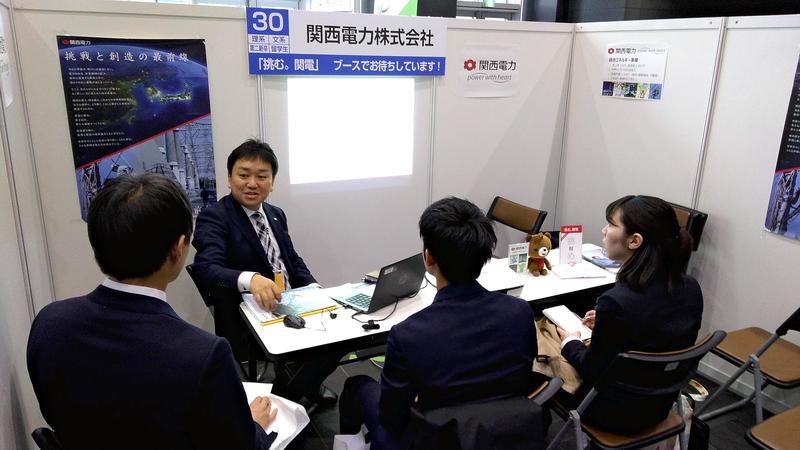
The job-hunting season for university students planning to graduate in 2020 has begun, and an employment seminar featuring nuclear power-related companies was held in Tokyo on March 3. Major power companies set up booths and energetically touted themselves to attendees, but students' interest in major power companies that operate nuclear power plants has been somewhat lacking.
"I want to work for a company that deals with radiation measurement and management," a 21-year-old male student majoring in nuclear power at Tokai University said. "I wasn't considering a major power company."
Factors such as the disaster at the Fukushima No. 1 nuclear power plant and delays in the resumption of nuclear power generation have reduced student interest in nuclear power-related companies. In fiscal 2010, before the Fukushima disaster, over 1,200 students attended the seminar, but the number this year was 213, almost 50 fewer than last year.
The Nuclear Human Resource Development Network, composed of the Japan Atomic Industrial Forum Inc. and other entities, will launch in April a new organization called the "strategic working group to strengthen recruitment and personnel training."
The organization will aim to strengthen links between industry, academia and the government; provide a venue for the exchange of ideas with the government; and promote human resource development strategies.
However, it remains unclear how much benefit can be expected simply from creating a new framework. With the resumption of nuclear power generation delayed, industry representatives face no end of worry about how to assure students of the stability of a career in nuclear power.
Executives of major power companies are unanimous in stating that this year's suspension of the Hitachi project in Britain was a hard blow.
The endeavor, which had been progressing with the support of the British government, was frozen by Hitachi due to uncertainty about its ability to recoup its enormous nuclear power investment.
"We were able to learn about things such as the regulations and attitude of the British government regarding the safety of nuclear power generation," said an executive of Tokyo Electric Power Co., which had dispatched personnel for the project.
However, the loss of this significant opportunity for human resource development has had an undeniable impact on the Japanese nuclear power industry.
Regarding the export of nuclear power generation, a government official involved in the Hitachi project said, "The demand for electric power is increasing in developing countries, but the risks, such as political instability and uncertainty over being able to recoup one's investment through electric power fees, are too high."
Electricity liberalization
As far as nuclear power generation in Japan is concerned, the government has avoided making any clear statement regarding whether it will advocate any new expansion. In its Strategic Energy Plan (see below), which indicates the direction of its energy policy, the government has not changed its approach of considering nuclear power as a main power source. However, many people think that the goal of covering 20 to 22 percent of Japan's power needs with nuclear power in fiscal 2030 may be in jeopardy.
Achieving that goal will require planning to include new facility expansion projects, as well as the rebuilding of deteriorated power plants. Power companies feel that a national support system is essential to finance the huge levels of investment required for nuclear power plant construction, but whether such a system can be realized remains unclear.
Before deregulation in the electricity market, construction and other costs could be recovered through regulated fees. Since deregulation, there has been fierce price competition among newcomers and major power companies. Financial institutions and investors funding the construction of new power plants are increasingly demanding the recovery of their investments in a short time, making it difficult for the private sector to construct nuclear power generation facilities on its own.
Global warming
The reduction of carbon dioxide emissions to curb global warming will require the effective utilization of nuclear power plants, which do not emit carbon dioxide, along with the introduction of more renewable energy. Carbon dioxide emissions for Germany, which despite efforts toward renewable energy is still reliant on coal power, stand at 0.42 kilograms per kilowatt hour (kWh), while for Japan, with its delays in the resumption of nuclear power generation and its reliance on thermal power generation, emissions are 0.49 kilograms per kWh.
In contrast, France, which has a high ratio of nuclear power generation, boasts a low level of just 0.05 kilograms per kWh.
According to The Japan Electrical Manufacturers' Association, the number of personnel in Japan who had been involved in nuclear power plant construction at some point in the past decreased from 5,000 in fiscal 2012 to 4,600 in fiscal 2015. The decline of the worker supply is believed to have continued since then.
The lack of an effective remedy for the graying of the employee population and the decrease in the number of job-seeking students may create obstacles not only for the construction of new facilities, but also for the acquisition of human resources to decommission the Fukushima No. 1 nuclear power plant.
(From The Yomiuri Shimbun, March 13, 2019)
-- Strategic Energy Plan
A basic plan outlining energy policy, decided by the Cabinet last summer. The plan sets a policy of utilizing nuclear power as a mainstay power source while working to develop renewable energy, such as solar and wind power, into additional main power sources. The power supply distribution plan specifies that 22 to 24 percent of Japan's power should come from renewable energy sources in fiscal 2030, exceeding the amount to come from nuclear power.
Read more from The Japan News at https://japannews.yomiuri.co.jp/