Virtual reality (see below) enables you to not only watch an image on the screen in front of you, but to also experience the feeling of entering the world of the image. With all eyes on VR as a next-generation visual presentation, movie production has also begun using this technology. Will it make waves in conventional movie culture and become the next big thing in entertainment?
You find yourself being rocked in a small boat floating on a vast ocean that extends as far as the eye can see. Looking up, the sky and clouds spread out above you. It feels more like you have actually entered this world instead of just watching an animation. Turning to look around at the sudden sound of a steam whistle, you are startled by a passenger ship bearing down on you.
"Age of Sail" is a 12-minute U.S. short movie that depicts the friendship between an old man and a young girl set on a small boat. It screened in the VR category of the Venice International Film Festival, which ran through Sept. 8.
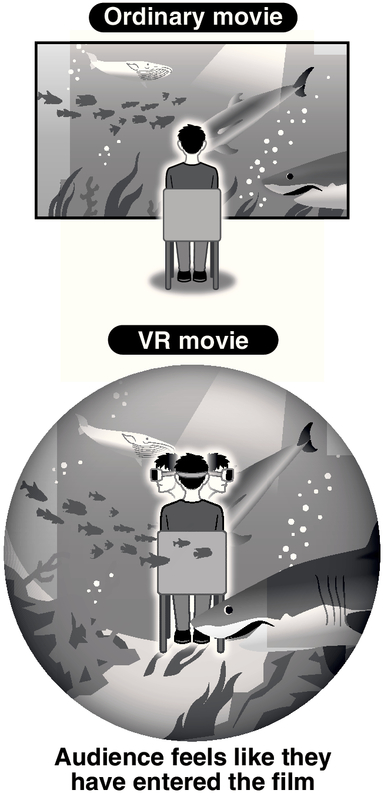
The audience put on special goggles and headphones to watch it in an experience that is different from 3-D movies, where 3-D images unfold before you. Instead, it feels more like you have gone into the screen, and it is fundamentally unlike that of conventional movies and TV.
The category was newly created last year, and a total of 40 works, including 30 entered in the competition, screened at this year's film festival.
In one movie about diving in a submarine, you can enjoy a rich undersea world just by looking up, down and all around. Meanwhile, another work features seats that move along with the images like an amusement park ride, in which you can roam freely around a town in a flying vehicle.
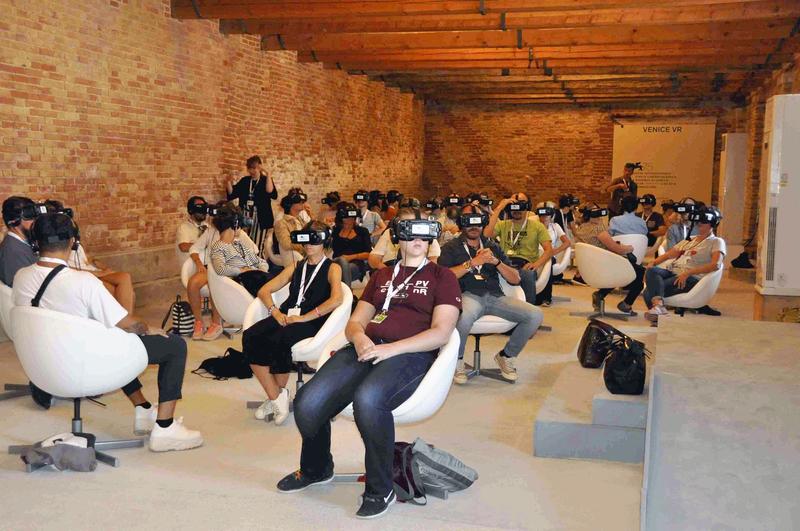
At the venue's "VR theater," dozens of film industry people and general attendees sat in seats wearing goggles. The sight of people turning around in all directions left a strong impression of a futuristic entertainment experience.
One of the prize winners, the French work "Isle of the Dead" (English title), was created based on the world of the painting by Swiss painter Arnold Bocklin.
Hiroo Iwata, a professor at the University of Tsukuba, who is chairman of the Virtual Reality Society of Japan, offered high praise after watching the boat ride to the island in the computer graphics movie. "The high quality images depict the world that serves as a backdrop in minute detail, so it feels just like stepping into the picture," he said.
President of the jury of the category, director Susanne Bier, speculated in her review that with technological advances, longer works will become possible in a few years from now.
Works from Japan
Two works from Japan were screened but not entered in the competition.
"Ghost in the Shell: The Movie Virtual Reality Diver" is based on the popular comics series, and depicts a showdown between terrorists and public security intelligence officers in the near future.
Also based on a comic, "Tale of Wedding Rings VR" progresses like the turning of pages and allows viewers to enjoy the feeling of entering the panels of the comic.
A French movie producer who saw it had high expectations, saying each frame is masterful and hopes to see this used to make live action works, as well as animation.
The release of Sony Corp.'s PlayStation VR in 2016 was considered "the starting year for VR," and awareness of it increased steadily thereafter. In addition to the type in which images are viewed on goggles with built-in screens, there is also a simpler type where a smartphone is fitted into the goggles in place of built-in screens. These are sold for a few thousand yen. Audio in both is usually provided via headphones.
VR images themselves must be paid for and put on a personal computer or smartphone as a general rule, but according to market research firm MM Research Institute, Ltd., the domestic market for goggles and other related hardware will grow from around 5.5 billion yen in fiscal 2016 to 104.6 billion yen in fiscal 2021.
Currently, it is mainly used for games, while other applications are limited to training for construction sites or surgery simulators. For VR movies like those screened in Venice, there is still much work to be done to popularize the technology.
Mikio Gunji, a producer at Production I.G., Inc., which screened "Ghost in the Shell VR," is enthusiastic, saying: "In the future, enjoying videos through VR may become mainstream. To start with, we want to create software to stir up demand."
However, the enormous volume of data for the videos it shows pushes up the cost. There are also age restrictions on using the goggles due to concerns such as nausea that can occur, which is known as "VR sickness."
At present, VR does also not seem well-suited to longer viewing periods, and even at the Venice Film Festival, many of the works were around 15 minutes long.
In the movie industry, there is a movement toward using VR to attract customers to movie theaters, similar to when 3-D movies appeared.
However, if you want to watch it through goggles and headphones, there is no need to go to the trouble of making the trip to a movie theater. To attract customers, added value is necessary.
For this reason, Toei Co., PC manufacturer VAIO Corp. and the production company Craftar Inc. embarked on a joint venture to produce VR movies in December last year, holding a screening at a movie theater in July.
They judged impressive acoustics to be part of the unique appeal of movie theaters, and provided sound directly via the theater's speakers.
It was generally well received by the audience, who commented that "it was far more powerful than watching it at home," and they "were able to immerse themselves in the world of the story." There was also an expectation that they would make the goggles a little lighter.
Toei is currently looking into creating horror and live productions that use this to their advantage. Films can be shown if an internet connection and devices are provided. Toei's director Hidenobu Muramatsu feels there is a business opportunity, saying, "You do not need much investment in equipment."
System without goggles
Meanwhile, Iwata is developing a system that does not require goggles. The system is a projection type that shows images on the floor and walls of a screening venue. While it was originally used for disaster evacuation drills and the like, it can be adapted for movies as well, Iwata said.
"Depending on the position and angle that someone is watching it from, the impression it gives is completely different, even with the same story. How will we use this technology, and what kind of stories will we create? That depends on the ingenuity of creators," Iwata said.
VR has the potential to change movie-making techniques and how people enjoy media, but it is still in development.
Nevertheless, given the amount of attention it is receiving from creators around the world, it is not too late to join the trend.
(From The Yomiuri Shimbun, Sept. 25, 2018)
-- Virtual reality
Technology that uses computers to create a virtual world or reproduce a real place that is far away, giving the sensory impression that things that do not physically exist are actually real. By wearing special goggles and other equipment, it is possible to view a 360-degree image that responds to the direction the viewer is looking in.
Read more from The Japan News at https://japannews.yomiuri.co.jp/