
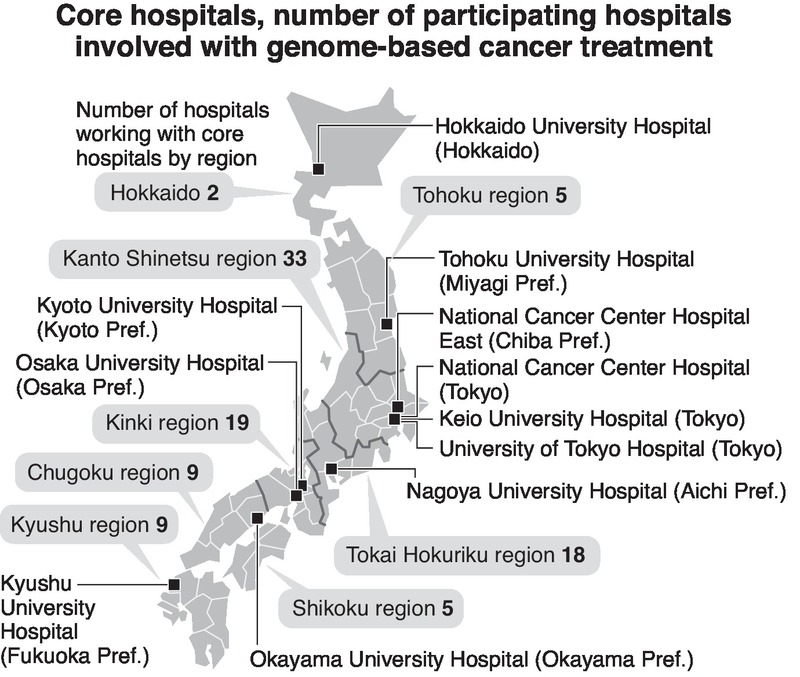
Genome-based cancer treatment (see below) involves examining gene mutations that can cause cancer and exploring the best methods for treating the disease. This spring, the government announced the names of 100 hospitals that will work closely with 11 "core hospitals" to provide cancer treatment based on genome information. The government aims to have the treatment covered by health insurance from April 2019. The National Cancer Center Hospital will expand its clinical research accordingly. However, a number of challenges exist. Genome tests are expensive, and effective drugs for cancer treatment are found in only about 10 percent of cases using the tests.
At a press conference in March, a Health, Labor and Welfare Ministry official in charge of this issue explained the future objectives of the treatment. "We want to establish a system through which patients can receive genome-based cancer treatment in every prefecture across the nation," the official said. In February, the ministry designated 11 core hospitals that will lead the way in genome-based treatment. On the day of the press conference, it announced the names of 100 hospitals that will participate in the program.
Genome-based cancer care involves examining gene mutations that can cause cancer, specifying the medications most likely to be effective, and crafting the best approach for treating the disease. Until now, anticancer agents have basically been chosen depending on the organ where the cancer originated, such as the lungs or breasts. However, the gene responsible for causing cancer can vary, even if it originated in the same place such as the lungs, resulting in difference of effectiveness of medications or the severity of side effects.
If the genetic mutation could be investigated in advance, it would be possible to select drugs more likely to be effective, mitigate side effects and reduce wasteful medical costs. Advances in analytical equipment have recently enabled more than 100 types of cancer-causative genes to be examined at once.
In Japan, these tests have been conducted only at certain hospitals for clinical research or medical treatment not covered by health insurance. The designation of core hospitals and hospitals that will work with them will enable this treatment to be provided across the nation and lay the foundation for its use in medical care covered by health insurance.
Patients eager for treatment
"It would be great if I could undergo this genetic testing nearby," said Hideko Shino, a pharmacist from Inashiki, Ibaraki Prefecture. Shino, 55, suffers from soft tissue sarcoma, an extremely rare type of cancer.
Shino was diagnosed with soft tissue sarcoma about 10 years ago. Although she underwent treatment, including with anticancer agents, her left arm had to be amputated from the shoulder four years later to prevent a relapse and metastasis of the cancer. Shino still works, and every month she drives to the National Cancer Center Hospital in Tokyo.
Anticancer agents are working for Shino at the moment. "But if the drugs I'm taking stop being effective, I want to try that test," she said.
Many patients have high expectations for genome-based cancer treatment. Whenever this issue is reported by newspapers or TV programs, the center is inundated with inquiries. "People ask us if they can receive the treatment," a center official said. Since this spring, when clinical research led by the core hospitals started to take concrete shape using the network of participating hospitals, the center has received more than 300 inquiries.
Govt supports research
In April, the National Cancer Center Hospital started testing that checks 114 types of genes. Although not covered by insurance, this testing has been conducted as an "advanced medical treatment" that, as an exception, has been approved in combination with treatment covered by insurance.
If a patient undergoes testing not covered by insurance together with another treatment that is, it becomes so-called mixed medical care -- the simultaneous use of medical treatment paid for by insurance and treatment that is not. Normally, in such instances, the patient would end up paying the entire bill, including for the insured medical treatment. In this context, the government designated such testing as an advanced medical treatment and has supported the research.
If research progresses under the advanced medical treatment framework and the usefulness of the testing can be verified, it would be a step toward the treatment coming under insurance coverage.
"It is vital to not only find genetic mutations but also to find out just how many patients we can specify a treatment for," said Noboru Yamamoto, chief of the hospital's Department of Experimental Therapeutics. "We want to ascertain the value of this testing."
Elsewhere, the University of Tokyo Hospital is developing a test method that examines more than 400 kinds of causative genes and will begin clinical research as soon as July. Osaka University Hospital and other medical institutions also are developing their own testing methods, so full-fledged research is under way, especially at the core hospitals across the nation.
Insurance coverage won't be easy
The health ministry plans to make genetic testing conducted for genome-based cancer treatment a procedure covered by health insurance, perhaps as soon as next spring.
"We want this treatment covered by insurance, and we're moving this process along faster than normal," a senior ministry official told The Yomiuri Shimbun. The government is pouring resources into this field because genetic testing could open the door to more treatment options for current cancer patients, and it also aims to use data accumulated during this research in the future.
If genetic testing becomes covered by insurance, the financial burden shouldered by patients will fall sharply and the number of people undergoing such tests will surge. Using the wealth of genetic data acquired through these tests would be useful in identifying new genetic mutations connected to cancer and in developing medicines.
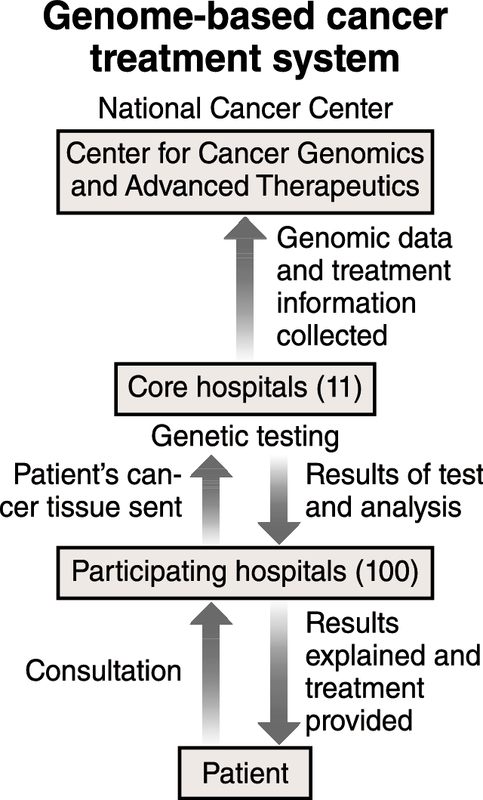
In June, the National Cancer Center will open the Center for Cancer Genomics and Advanced Therapeutics. This center will collect and centrally manage patient data from across Japan. This will make it possible to accurately grasp the location of patients with certain genetic mutations, making it easier for pharmaceutical companies to conduct clinical trials for new drugs.
However, many obstacles remain before the treatment can be covered by health insurance.
At present, only about 10 percent of patients who undergo the treatment end up receiving any therapeutic medication. For the majority of patients, no abnormality is found in their genes, or there are no known drugs that can be used for treatment. The procedure ends up falling short of expectations.
Moreover, testing is expensive. A test conducted as an advanced medical treatment at the National Cancer Center Hospital costs about 670,000 yen. Although this is partly subsidized by research funds, patients are responsible for paying about 470,000 yen themselves. Yasuhiro Fujiwara, deputy-director of the hospital (research), explained the bitter reality for many patients. "As things stand now, about 90 percent pay this money but get little out of it," he said.
The treatment's cost-effectiveness will be an important consideration when deciding whether it will be covered by insurance. "The testing will enable doctors to know in advance which medicines would be effective, which in turn would reduce the administration of unnecessary medication," a health ministry official insisted. Even so, a rational explanation will be essential.
There also will need to be careful discussions about which patients could be covered by insurance and what the real cost of providing such treatment amounts to.
(From The Yomiuri Shimbun, May 17, 2018)
-- Genome-based cancer treatment
Cancer treatment that uses tests to examine the genes responsible for causing cancer. Health insurance covers testing that examines one kind of causative gene for lung and breast cancer to determine in advance if a certain drug will be effective. This system is used widely. The government aims to significantly boost the use of tests that simultaneously check more than 100 genes that could cause cancer in order to find effective drugs.
Read more from The Japan News at https://japannews.yomiuri.co.jp/