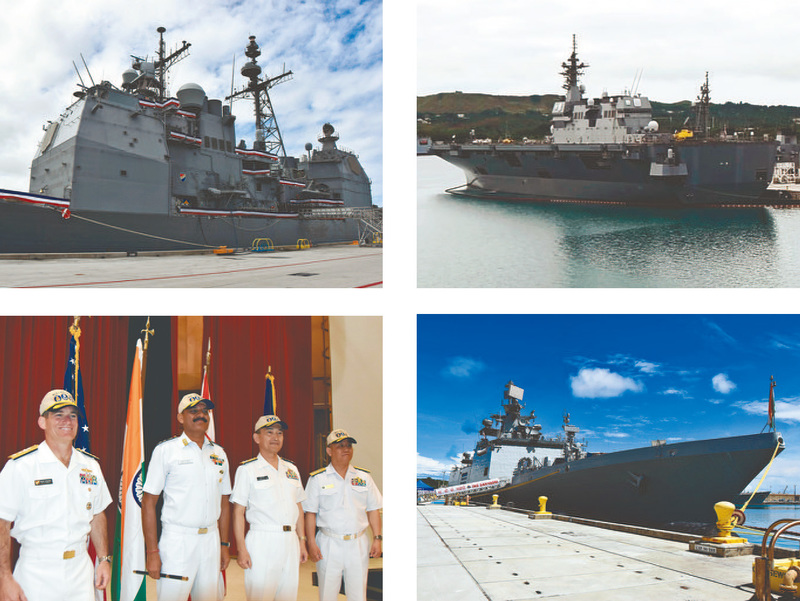
From June 8-16, a joint military exercise called "Malabar" was conducted by the U.S. and Indian navies and the Maritime Self-Defense Force in waters around the U.S. territory of Guam.
Guam is home to both U.S. Air Force and Navy bases, and serves as a forward deployment base in case of an emergency in Taiwan or on the Korean Peninsula, keeping watchful eyes on China and North Korea.
Subs participated in drills
"The three countries of Japan, the United States, and India share [a recognition of] the importance of the Indo-Pacific region. I believe that Malabar shows their commitment to the region and will drive forward the preservation and strengthening of the maritime order in the waters," MSDF Vice Chief of Staff Hiroshi Yamamura stressed at Naval Base Guam on June 8.
Malabar is a joint naval exercise that was launched by the U.S. and Indian navies in 1992. The MSDF first took part in the operation in 2007 and has been participating every year since 2014.
The exercise was upgraded last year to an official joint exercise involving Japan, the United States and India based on an agreement by both Indian and Japanese leaders. This was the first time that the exercise was held in the waters surrounding Guam.
Participating in the exercise were the USS Ronald Reagan, a nuclear-powered aircraft carrier belonging to the U.S. 7th Fleet; the Aegis cruiser USS Antietam; P-8 patrol planes; and a Los Angeles-class nuclear-powered attack submarine, among others from the United States. India was represented by vessels including the Sahyadri frigate warship. The MSDF sent the Ise destroyer, while also sending the Souryu submarine and the latest P-1 patrol planes to participate in the exercise overseas for the first time.
During the joint exercise, drills were conducted based on anti-air, anti-surface and anti-submarine warfare scenarios. It is believed that during the anti-submarine drills, surface vessels and shipboard helicopters searched for submarines with radar and sonar, and then attacked them upon discovery, whereas the submarines tried to evade detection from the surface vessels and approach enemy surface vessels within a torpedo range to attack them.
The anti-submarine drills are significant because the submarines "could become familiar with local waters" and thus be able to exercise their maximum strength in case of an emergency.
Geopolitical value
The value of Guam for the U.S. military lies in its geographical location. Compared to Hawaii, home to the Indo-Pacific Command, Guam is much closer to Taiwan, the Korean Peninsula and Southeast Asia. As the island is also a U.S. territory, it is easy to station forces there and build bases, and is the perfect location from which to deploy forces to the Asia-Pacific region.
This is why those involved with the U.S. military call Guam -- the westernmost point in the Pacific Ocean under U.S. jurisdiction -- "the world's most easy-to-use platform."
The crucial strategic point is the Andersen Air Force Base located in the northern part of the island. Equipped with two 3,500-meter runways, it can deploy B-1, B-2 and B-52 bombers in rotation. The most advanced stealth bomber, the F-22, also uses this base during exercises.
The fact that North Korea threatened the United States in August last year by warning it could attack Guam with medium-range ballistic missiles is a manifestation of Pyongyang's wariness of the war potential of the air base.
I was granted access to the air base. Within its vast grounds, the U.S. Navy's P-8s and the MSDF's P-1s were seen there for the Malabar exercise. A row of four blackish military aircraft that looked like B-52 strategic bombers could be seen in the distance. I was not allowed to photograph them, and I also could not photograph facilities such as runways.
The naval base on the western side of the island is also an important base for the U.S. military. Four Los Angeles-class nuclear-powered attack submarines, submarine rescue ships, and maritime prepositioning ships, which transport weapons and materials, have been deployed there.
There is an enormous ammunition depot on the island, too. Guam also serves as a relay hub for various weapons and goods. In the early 2020s, about 4,000 members of the U.S. Marine Corps stationed in Okinawa Prefecture are due to begin relocating to Guam.
Within missile range
Meanwhile, Japan and the United States are particularly concerned about China's movements. Aiming for "reunification with Taiwan," China continues its military buildup and maritime advances based on the Anti-Access/Area-Denial (A2/AD) strategy, which prevents operations by the U.S. military within the "second island chain" that stretches from the Izu Islands to Guam and also prevents it from entering into the "first island chain" that connects the Nansei Islands to the Philippines.
Compared to Okinawa, Guam has had the military advantage of "not being too close to mainland China." But this state of affairs has changed.
China's Dongfeng-21D (DF-21D) anti-ship ballistic missiles have a range of 1,500 kilometers, enough to cover the first island chain, and the next-generation DF-26 medium-range ballistic missiles are estimated to have a range of 4,000 kilometers, which is far enough to reach Guam.
If Xian-6K (H-6K) strategic bombers, which have a 1,800-kilometer radius of action, are equipped with cruise missiles with a range of 1,500 kilometers, then that will result in an attack range calculated at up to about 3,300 kilometers.
Hiroaki Fukue, former commander of the Air Defense Command of the Air Self-Defense Force, said, "While Guam has become less and less of a safety zone, its importance on a security level for East Asia only increases further."
Japan is required to enhance its collaboration not only with the United States, but also with countries like Australia and India, and to contribute to the stabilization of the Indo-Pacific region.
'Traveling ammo depot'
During my stay in Guam, a submarine of the Ohio class, the largest of the U.S. Navy's undersea vessels, was also in port at the naval base.
While Los Angeles-class nuclear-powered submarines are 110 meters long, Ohio-class subs are even longer at 170 meters.
Atop its hull was a "dry deck shelter" module, from which members of the SEAL special forces are sent to shore and received back. From its outward appearance, this submarine can carry 154 Tomahawk cruise missiles and seems to be a nuclear-powered cruise missile submarine, also known as a "traveling ammunition depot." I was not told the submarine's name.
Last year, an Ohio-class nuclear-powered submarine, the USS Michigan, called at Busan Port in South Korea to keep North Korea in check.
(From The Yomiuri Shimbun, June 27, 2018)
Read more from The Japan News at https://japannews.yomiuri.co.jp/