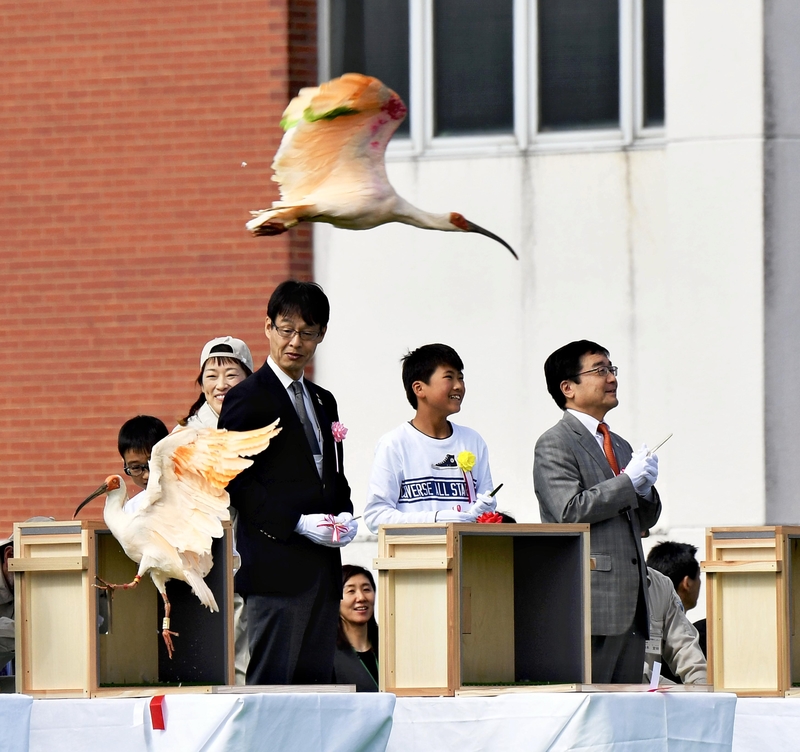
SADO, Niigata -- Ten years have passed since crested ibises (see below) artificially bred from a pair presented by China began to be released on Sado Island in Niigata Prefecture. The wild population of crested ibises has since recovered to about 370 birds, prompting concerns about the possibility of insufficient food and nesting sites on the island in the future.
Steps should be immediately taken to discuss the issue, including the option of releasing birds into the wild in areas outside the island.
Ahead of schedule
"The population in the wild is growing steadily. What we must aim to do next is establish an environment in which the crested ibises can coexist with humans," Environment Minister Yoshiaki Harada said in Sado city on Oct. 14 at a ceremony to mark the 10th anniversary of the beginning of bird releases.
According to Harada, the crested ibis reintegration program is approaching a turning point.
It was in 1999 that Japan first succeeded in artificially breeding crested ibises with a pair from China. Japanese crested ibises born in the wild went extinct in 2003, but their numbers were increased through artificial breeding. In 2008, the first release of 10 birds at once was realized.
As of October this year, birds had been released 19 times. A total of 327 birds have been let loose, and 175 were confirmed to be alive as of Nov. 1. The first chicks produced via natural breeding by a pair of released crested ibises were hatched in 2012. In 2016, chicks were hatched by a pair of crested ibises that had themselves been born in the wild.
The population of "established" birds, ibises confirmed to have survived for more than a year in the wild, currently stands at about 270. The target set by the Environment Ministry in 2016 to establish a population of 220 such crested ibises on Sado Island by around 2020 was achieved two years ahead of schedule in June this year.
Local support
The target was reached early partly due to local residents' efforts to balance restoring the crested ibis habitat with the promotion of agriculture.
The city of Sado used idle farmland to provide a rich biotope with loach and other creatures that crested ibises feed on, and introduced a system for certified rice that reduces the use of pesticides and chemical fertilizers by more than 50 percent. Recognition as a brand-name rice increased its revenue.
Expectations of progress in environmental restoration via subsidies also helped boost these efforts.
In 2011, "Sado's satoyama in harmony with Japanese crested ibises" was designated as a globally important agricultural heritage by the U.N. Food and Agriculture Organization.
However, crested ibises have become commonplace in Sado, with some local people saying they are no longer appreciated as much as before.
With the dwindling number of farmers and an aging population, a sense of stagnation has begun to creep in. For one thing, the certified rice requires significant time and labor to grow and the planting area is reaching its limit.
According to Toru Itagaki, chairman of the Hito-Toki no Kyosei no Shimazukuri Kyogikai, an organization including government officials, universities and citizens' groups and that promotes coexistence with the crested ibises: "If the number of crested ibises continues to grow, damage caused by the birds trampling seedlings in the rice paddies will likely also increase. We've been able to get the community involved so far, but in the future, new challenges will emerge, along with new possibilities to take advantage of the birds."
Tourism resource
Locals have long sought to use the crested ibises as a tourist resource, and the Environment Ministry has begun to change its course from an exclusive focus on conservation to using the birds to vitalize local communities.
In principle, the observation of crested ibises is to be done from inside a vehicle, but a location where observers can leave their vehicles and observe crested ibis was created as an exception in October. Preparations have also begun to establish an observation facility for wild crested ibises, tentatively named "Toki Terrace," with the aim of opening it before next summer.
If the understanding and cooperation of local residents cannot be maintained, the coexistence between crested ibises and humans will break down.
"The true start of coexistence with crested ibises begins here," said Toru Wakamatsu, a senior ranger of Environment Ministry's Sado Ranger Office.
Concern over food, nesting sites
Many experts believe that Sado Island can support a maximum of about 1,000 crested ibises.
Hisashi Nagata, a professor of avian ecology at Niigata University and an expert on the reintegration of the crested ibises, said, "If the population continues to grow at this rate, it is predicted that within 10 years, there will not be sufficient food and places suitable for nesting on Sado Island alone."
Crested ibises born in the wild have a high rate of survival. There are 194 surviving birds, already exceeding the 175 crested ibises released into the wild. The pace of growth in the wild crested ibis population could further accelerate going forward.
Discussions toward setting new targets have already begun at a meeting of experts of the Environment Ministry. At the meeting in October, the prospect of releasing the birds in areas other than Sado was raised. But releasing birds on condition of their reintegration into the wild is no simple matter outside of Sado Island, which has a long history of successful conservation activities.
Unlike Sado, where the entire island is a single municipality, there is a high probability that crested ibises will inhabit areas that straddle multiple local governments on the mainland of Honshu. Gaining the understanding of the residents of all the related municipalities would be a difficult task.
Even the municipalities that are tasked with artificial breeding outside of Sado with the aim of decentralizing rearing sites are unenthusiastic about accepting the role. As a spokesperson of the Nagaoka city government in Niigata Prefecture said: "Many farmers would be affected, so lengthy persuasion is required. The obstacles to implementation are significant."
Budgetary concerns are another major obstacle. Crested ibises take one to two years from hatching until they are ready for release into the wild. The central government spends more than 100 million yen annually on breeding and rearing costs, including the maintenance costs for facilities to adapt the birds to a wild environment.
All of the crested ibises currently living in Japan are the descendants of five birds supplied from China. To maintain genetic diversity, it will be necessary to continue artificial breeding and release using two new birds that arrived from China in October.
Under the current circumstances in which there are programs for the protection and breeding of 63 species of flora and fauna aside from the crested ibises, further increasing the budgets for the crested ibises would be difficult.
In contrast, white storks, which died out in the wild and had their population revived in the same way as crested ibises, require a rearing period of only three to six months before being released.
Releases of the birds began in Toyooka, Hyogo Prefecture, in 2005, and the cities of Noda, Chiba Prefecture, and Echizen, Fukui Prefecture, have also been conducting releases since 2015.
Shingo Miura, a professor of wildlife management at Waseda University, notes: "Under the current circumstances, including gaining the understanding of farmers, there are likely few local governments that would volunteer to be involved in releasing crested ibises. The Environment Ministry needs to pick up the pace in finding potential municipalities."
The national biodiversity strategy established by the government in 2012 includes a passage describing a vision of the country's future in which "people's daily lives are full of living things, with crested ibises and other birds pecking for food and flying gracefully through the sky."
To make this vision a reality, initiatives with a long-term perspective are needed.
(From The Yomiuri Shimbun, Nov. 16, 2018)
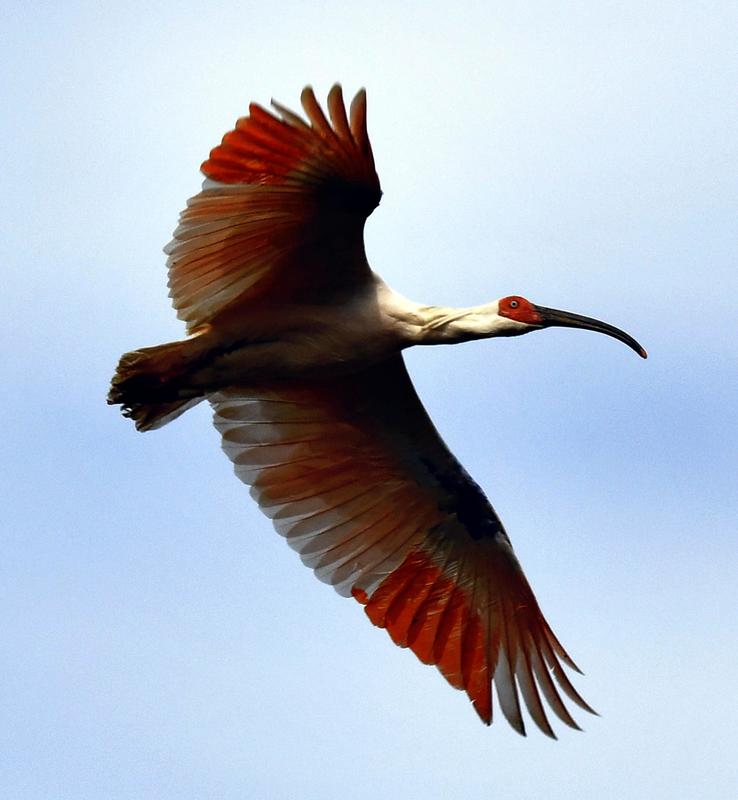
-- Crested ibises
Classified as a member of the ibis family in the Pelicaniformes, its scientific name is Nipponia nippon. Until the early 20th century, it was widely distributed across all of East Asia. Overhunting for their feathers and the loss of prey due to land development and the spraying of pesticides resulted in their disappearance from many areas. In the 1980s, seven wild crested ibises were discovered in China, and the population there had recovered to about 1,800 as of 2016. South Korea is also making efforts for an artificial breeding program to reintegrate these animals to the wild.
Read more from The Japan News at https://japannews.yomiuri.co.jp/