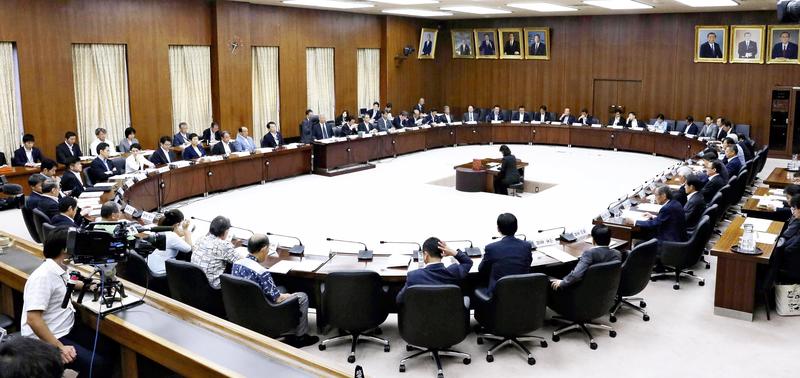
Diet deliberations on amending the Constitution have ground to a halt. What is needed to get these talks moving forward? Some relevant examples from overseas can provide insights on this issue.
Deliberations have stagnated at the commissions on the Constitution in both chambers of the Diet: the House of Representatives and the House of Councillors. During the previous ordinary Diet session, even a bill for amending the National Referendum Law -- which was merely a preliminary step toward talks on revising the Constitution -- could not be passed and ended up being carried over to the next session.
The biggest reason for this situation was growing concern within the Constitutional Democratic Party of Japan, the largest opposition party in the lower house, about attempts led by Prime Minister Shinzo Abe to amend the top law.
With September's presidential election for the ruling Liberal Democratic Party looming, the Constitution is shaping up to be a major point of contention between Abe, former party secretary general Shigeru Ishiba and other potential candidates. But no matter how much this issue is discussed within the party, the prospect of it being debated in the Diet in the coming months is anything but clear.
If constitutional amendment is forcefully initiated in the Diet without a wide-ranging, multiparty agreement, there is a greater risk of such a change being rejected in a national referendum. On the other hand, if too much consideration is given to coordinating views with opposition parties, it will be impossible to take even the first step toward such a proposal.
With this dilemma hanging over him, Abe apparently wants to boost public interest in constitutional amendment by first jump-starting discussions within the LDP.
Inside the LDP, there are whispers of an "emergency option" in which rather than having the commissions draw up a draft of the amendments, the party would recruit lawmakers who support these changes and have them submit such a bill to the Diet.
However, this would be certain to spark a backlash from opposition parties, and there is no guarantee both Diet chambers will fall in line.
Many nations mirror Japan by stipulating strict requirements under which constitutional amendments can be made, rather than just enabling revisions to be implemented through a regular law change. Coordinating among ruling and opposition parties is also a common issue.
Germany, France and Italy appear to be particularly useful as references. They are advanced democracies, just like Japan, and have made significant changes to their constitutions in recent years.
The bar for changing the top law in those three nations is lower than in Japan, because their procedures for constitutional amendment include a path that does not require a national referendum. However, the key point is that most amendments have been crafted under agreements between two major political parties or between ruling and opposition parties.
Compromise key in Germany
Germany has revised its Basic Law, as its Constitution is called, more than 60 times since the end of World War II. Cooperation between Germany's two main parties -- the center-right coalition of the Christian Democratic Union and the Christian Social Union, and the center-left Social Democratic Party -- has become common practice.
Many amendments have dealt with technical reform of administrative bodies such as the allocation of federal and state finances, but changes on issues including rearmament and emergency clauses have involved heated clashes.
Even so, a 1954 revision during the rearmament period was about the only instance in which an amendment was rammed past the main opposition party without cooperation between the two major parties.
In 1993, many people in Germany had divided views on restrictions placed on the acceptance of refugees, but ultimately the two main parties found a compromise. And earlier this century, the two main parties forged an agreement to realize a constitutional amendment to rein in the Bundesrat, or upper house, which was considered too powerful.
"Even on important policy issues such as diplomacy, national security, social security, immigration and refugees, the two main parties adjust their basic stances to conduct politics of agreement," said Masaki Kondo, a political science professor at Kyoto University. "Small political parties and even social groups are sometimes involved in these agreements. Constitutional amendments are made on this foundation."
It is noteworthy that committees have often been organized among senior officials of the two main parties and smaller parties before any constitutional tweaks.
In Japan, the Diet is almost the sole venue for discussions on the top law.
Experts play role in France
In 2008, France rewrote about half of its Constitution in a major overhaul that included limiting the president to two terms in office and strengthening the functions of the Court of Accounts.
A 13-member expert panel -- which included politicians from ruling and opposition parties, lawyers and cultural figures -- compiled a draft of the revisions. A rebellious lawmaker from the Socialist Party, which opposed the amendments, subsequently backed the revisions, and a joint sitting of the two chambers of the French parliament narrowly approved the changes by getting just one more vote than was required with support from 60.2 percent of lawmakers.
"By having many relevant experts deliberate issues of common interest to the public, France was able to avoid falling into partisan discussions," said Kyushu University Associate Professor Takeshi Inoue, an expert on constitutional law.
Italy involves labor unions
Italy provides an intriguing case in terms of national referendums.
In 2001, Italy held a national referendum on constitutional revision to significantly devolve power to local authorities. The government charged ahead with the referendum because it was unable to secure support from at least two-thirds of both parliamentary chambers due to intense confrontation over a general election. However, there was already strong public support for the proposed changes, so the amendments were overwhelmingly passed with support from 64 percent of voters.
By contrast, national referendums in 2006 and 2016 on issues including reforming the two-chamber system overlapped with times when many people were critical of the government. Both referendums were rejected.
These results indicate that even if the government elbows opponents aside and pushes ahead with a national referendum, constitutional amendment could be possible provided there is strong public support for it. However, there is also a high risk of a referendum being rejected if the government misreads public opinion.
Italy's top law reform process involved discussions among a suprapartisan committee from both parliament chambers and hearings attended by economic organizations, labor unions, local government representatives and others.
"I think the LDP should also at least listen to the opinions of groups supporting opposition parties, including labor representatives," said Takeshi Ito, an associate political science professor at the University of Tokyo.
(From the Yomiuri Shimbun, Aug. 2, 2018)
Wisdom, sense of duty needed from parties
The Yomiuri Shimbun
A senior official of one opposition party said it would be "helpful" if the ruling parties steamrolled changes to Article 9 through the Diet.
"That would harden public opposition to the changes, the national referendum would fail, and it could even bring down the Cabinet," the official asserted.
A senior LDP member of the lower house constitution commission said, "It's hard to hold constructive discussions when the opposition is trying to link the issue to political maneuvering."
Constitutional amendment is no longer a taboo topic, and the Diet has a duty to constantly examine the Constitution. Opposition parties should wake up to the fact that they have a responsibility to deal with constitutional issues and rethink their business-as-usual approach. The ruling parties must also devote the necessary wisdom and effort to bring the opposition camp into the process.
Read more from The Japan News at https://japannews.yomiuri.co.jp/