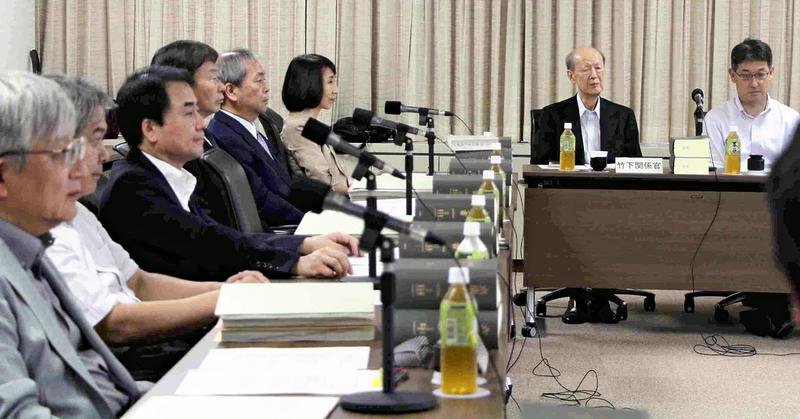
A draft outline of a revision to the Civil Execution Law to crack down on nonpayment of child support and court-ordered damages was compiled on Aug. 31 by the Justice Ministry's Legislative Council, an advisory body to the justice minister.
There is a possibility that the outline could bring changes to the current state of affairs in which the hurdles for compulsory execution are so high that claimants often have no choice but to give up in frustration.
"Even after a divorce, the father still shares responsibility for taking care of the child. But I don't even know where he works, and there's nothing I can do," a 38-year-old woman living in Chiba Prefecture, who has a son attending junior high school, said hopelessly.
When her son was 4 years old, she divorced her husband and was granted custody of their child. Her former husband promised to pay 100,000 yen per month in child support, and a notarized agreement for that purpose was made. However, after he quit his job five years ago, the payments stopped coming.
The woman considered filing a claim to have the money seized from her former husband's bank account. But, under the current system, it is necessary for her to specify the branch name of the bank where the account was created, and provide the information to a court.
Unable to get any information on where her former husband now works or where his account is, she has been forced to bear the situation without having any hope.
The current draft outline is principally intended to help people suffering from such cases involving nonpayment of child support.
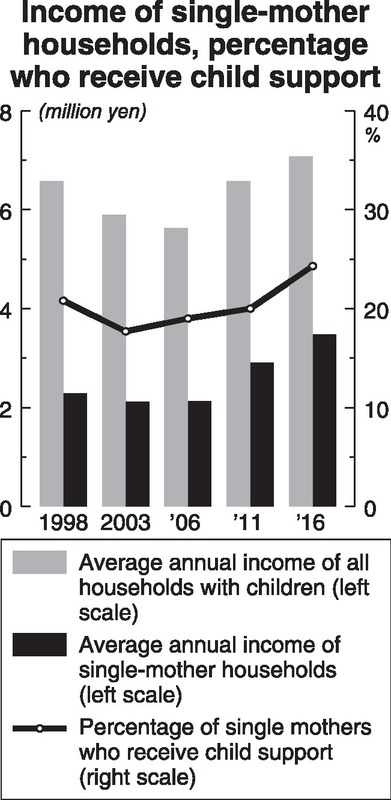
Cases of divorce in which the divorcing couple have at least one child exceed 100,000 every year. However, according to a 2016 survey by the Health, Labor and Welfare Ministry, only 24 percent of fatherless households receive child support payments. In addition, the average yearly income for fatherless households stands at only 3.48 million yen, about half of the average income for all households with children.
However, unless workplaces and bank accounts of those who shirk or feign ignorance of their payment obligations can be determined, it is essentially impossible to file a claim to seize their assets.
To address such situations, the draft outline includes a court-based inquiry system. By providing basic information to a court, such as the full name of a former husband who has failed to make payments, the court would consult with financial institutions and local governments to learn the workplaces and bank accounts of those who fail to pay. As a result, former wives who have not received child support payments as promised will be able to file with the court for seizure of assets based on the information.
Relief for crime victims
According to a 2015 survey by the Japan Federation of Bar Associations, out of 164 cases in which the payment of compensation for damages to a victim of a crime was assured by the court or other process, full compensation was actually paid in only 70 cases.
The new system would also cover people who are responsible for paying compensation for damages due to criminal acts, and thus could influence the current situation surrounding the payment of criminal damages.
Shohei Kodama of Shinjo, Yamagata Prefecture, who lost his second-eldest son, then a first-year junior high school student, in 1993, filed a claim for damages against several former students said to have been involved in the death. In 2005, the Supreme Court ordered the payment of about 57 million yen in damages, but some of the former students, whose places of work and other information could not be determined, did not make payments.
Kodama, 69, said with anger, "It is unbelievable that they can get away with ignoring the court ruling."
"Japan's compulsory execution system is lacking in effectiveness, and there are cases where justice cannot sufficiently function," said Keio University Prof. Koichi Miki, who is familiar with civil execution law.
"This amendment will be a step forward. But in addition to this, it's necessary to consider ways to protect the rights of people who are struggling to get the payment as promised."
Penalties for unintended use
There are also voices pointing out potential issues with the system.
Under the new system, it would also be possible for entities such as consumer financing businesses to gain access to the financial asset details of borrowers who are behind on their payments and use this information to engage in the forced collection of debts.
There is a stipulation under the current law that prohibits the seizure of assets from parties in significant financial distress, but the number of cases using this stipulation remains low.
"Courts should carefully explain to debtors that there is a system in place to prevent the seizure of assets from parties in significant financial distress, and also explain in detail the procedure to make use of that system," said Osamu Mikami, an attorney and secretary general of the Zenkoku Yami-Kinnyu Akushitsu-Kinnyu Taisaku-Kaigi (National committee for the prevention of loan sharking and malicious financing).
Also, there remains a risk that financial details about debtors that are exposed by court action, such as their remaining account balances, could be sold or posted online.
The draft outline contains a new stipulation that penalties would be imposed on such unintended use of debtors' information. However, damages are hard to recover once such information is made open to the public.
It is difficult to trace the path of misused information, and whether the stipulated penalties will be an effective deterrent to malicious sharing of it is as yet unknown.
(From The Yomiuri Shimbun, Sept. 1, 2018)
Overseas govts enforce collection from parents
According to a 2015 National Diet Library survey on child support payments, in the United States, the federal and state governments take measures to find parents who have disappeared without paying child support and collect the money from them.
Parents who fall behind on payments may have their driver's licenses revoked or may even be taken into custody.
In Britain, the government and other entities can withhold child support money from the wages of parents who fail to pay, and there is even a system to take into custody parents who do not pay support.
In South Korea, a special institution on child support payments was established in 2015 to provide support in court proceedings on child support and act as a proxy to collect the money.
Meanwhile, in Japan, the Youikuhi Soudan Shien Center (Child support payment consultation and support center) was established in 2007 by the Health, Labor and Welfare Ministry to support parents struggling to receive child support payments. But the center focuses mainly on explaining legal procedures, and does not accompany clients to court or collect child support money on their behalf.
In fiscal 2016, a project was launched to subsidize local governments that offer lawyer-based legal consulting, but its effectiveness against instances of nonpayment has been low.
"The effectiveness [of this kind of system] cannot be guaranteed unless it comes with administrative support," said Waseda University Prof. Masayuki Tanamura, who specializes in family law. "It's necessary to improve measures against nonpayment of child support to the same level as those in foreign countries."
Read more from The Japan News at https://japannews.yomiuri.co.jp/