Italy's general election on March 4 hammered home the fact that populism remains a potent force in Europe and could very likely have major ramifications for the continent's political and economic stability. Mounting antipathy against the establishment has also been directed squarely at the framework of the European Union itself. How will Italy, the fourth-largest EU economy, deal with the regional bloc? Depending on how coalition negotiations turn out, European unity, which has been reeling since Britain decided to leave the EU, could be shaken even further.
The election results have been taken as "a resurgence of the populist storm" that exceeded almost every prediction. Two political parties caused these powerful winds to blow through Italian politics.
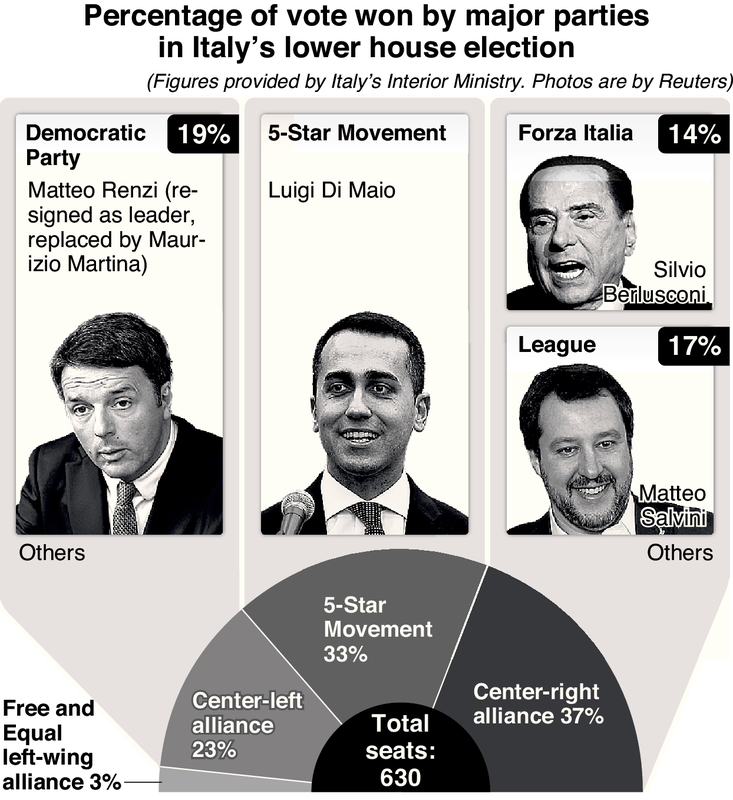
The 5-Star Movement (see below), which has pledged to shatter the establishment, has become the single party with the largest share of the vote in the elections for both houses of parliament. In the Chamber of Deputies (lower house) election, 5-Star scooped up about 33 percent of votes, according to figures released after 99 percent of votes had been counted.
The League, which has trumpeted right-wing, nationalist policies such as cracking down on immigration and dumping the euro, also fared well in the election. The League garnered 17 percent of the vote in the lower house, about five percentage points higher than expected.
Rumors had been swirling that a center-right alliance might gain the upper hand in the election. This alliance includes Forza Italia, a party led by former Italian Prime Minister Silvio Berlusconi, who is seeking to form a fifth administration. Many observers believed Berlusconi would be a pivotal figure in post-election negotiations to form a coalition government.
However, many voters rejected Forza Italia and the ruling Democratic Party. European media, both inside Italy and outside, were stunned by this development. The Financial Times, a British newspaper, said the election "marked the biggest political upheaval in Europe since the Brexit vote in 2016."
Luigi Di Maio, the 31-year-old leader of 5-Star, declared victory after the election. "At last, the republic will be led by Italian citizens," he said.
On the crisis front line
Europe has been buffeted by the 2008 global financial crisis, the euro crisis triggered in 2009 by Greece's debt woes, and problems sparked by an influx of refugees from Africa and Syria since 2015.
The figures in Italy are especially stark. The unemployment rate remains stubbornly high at about 11 percent, and it is said about 620,000 refugees have poured into the country over the past four years.
"Economically and geographically, Italy is on the front line and it has been pounded," said Luigi Scazzieri, a research fellow at the Centre for European Reform. "There was a perception that the European Union couldn't be relied on at that time, and that Italy had been abandoned. That sentiment came to the fore in this election."
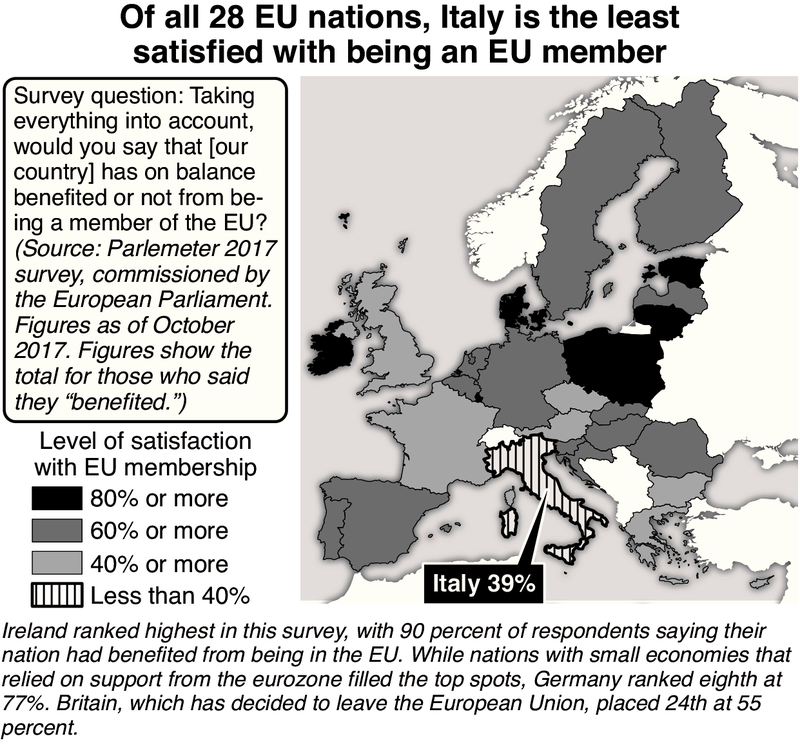
In a survey commissioned by the European Parliament and released in October 2017, only 39 percent of Italians answered "yes" when asked if being a member of the European Union had benefited Italy. This was the lowest percentage given by any of the 28 EU member states.
Ruling parties in retreat
How to handle relations with the European Union has become a major discussion point in national elections being held in EU member states. At times, this issue can even affect the stability of an administration.
Lorenzo De Sio, a political science professor at the LUISS Guido Carli University in Rome, pointed out that Berlusconi resigned as prime minister in 2011 because the "European Union, with Germany front and center, pressured him to step down for failing to restore fiscal health, as he had promised the EU he would, to combat the euro crisis."
In Italy's election, resistance to austerity measures being imposed by the establishment, in this case the European Union, was also evident. The right-wing League widened its support base by calling for Italy to ditch the euro. By contrast, the ruling Democratic Party, which advocated more European integration, lost numerous seats.
The 5-Star Movement also initially supported dropping the euro, but Di Maio's position on this issue has been shifting. "We can govern properly," he said, adding that everybody at EU headquarters in Brussels "need not worry." Nonetheless, many euroskeptics have been in the movement since it was formed, which could be an element of instability.
Both wings flapping
According to Prof. De Sio, the 5-Star is, "strictly speaking, more of an antiestablishment platform than a classic populist party."
All across Europe, populist movements are gathering strength on both ends of the political spectrum. The right-wing populists push nationalist agendas such as anti-immigration policies, while left-wing populists oppose EU austerity measures and are willing to accept ballooning state budgets to attain greater equality in society.
"Populism simplifies problems, stirs up people's anger and then makes promises that are impossible to make a reality," De Sio said. "The anti-immigrant League is an ultra-right populist group that sits close to Germany's anti-refugee Alternative for Germany party and France's National Rally [the National Front]. Yet the 5-Star shows its willingness to hold talks with the European Union. We also need to view it separately from left-wing political parties such as Spain's Podemos."
Two variables
So what factors have spurred the surge of populism in Europe? Scazzieri believes two key variables are at play -- one is how strongly the economy is performing, and the other is the level of concern with cultural change.
"Populism does not easily spread in nations that are economically stable and maintain a strong state identity," Scazzieri said. "We see countries in Central and Eastern Europe where democracies have been new since 1990 and have relatively small economies. Thus populism can easily gain momentum in nations there such as Poland and Hungary. Italy has a large economy, but it has been sluggish for years, and now the nation is facing issues stemming from the influx of immigrants. Both variables have coincided in Italy."
Italy was one of the six founding members of the European Community, which eventually morphed into the European Union. In the past, it also viewed the bloc favorably.
Now the 5-Star Movement, the leading political party in Italy, is in the driving seat for talks to form a ruling coalition. Negotiations will formally start after parliament opens on March 23, but they are expected to be lengthy, and anything but smooth.
If by any chance the 5-Star ends up forging a coalition with the League, which wants to jettison the euro, it would not only destabilize the European Union, but also inevitably have a negative impact on the economy.
For its part, the European Union should not have a rigid preoccupation with austerity policies that are too strict. It should work with the Italian side to find flexible policies that offer the prospect of economic growth.
-- 5-Star Movement
A rising Italian political party calling for vested interests and existing ways of conducting politics to be slashed. Founded in 2009 by popular comedian Beppe Grillo and an entrepreneur, after starting out as an online political movement. It touts policies to help the economically vulnerable and is considered a typical example of a European populist party. The 5-Star has a pro-Russia tilt. The "five stars" refer to the party's five core principles of public water, development, sustainable transportation, a society with access to the internet, and environmentalism.
(From The Yomiuri Shimbun, March 15, 2018)
Read more from The Japan News at https://japannews.yomiuri.co.jp/