Japanese cinema has attracted international attention in recent years as more films have been screened at international film festivals. While the films have become a leading content of the Cool Japan initiative, when it comes to developing human resources, challenges such as aspirants in dire need of production studios remain unresolved.
At the Cannes Film festival last year, "Asako I & II" (original Japanese title: "Netemo Sametemo"), directed by Ryusuke Hamaguchi, was much talked about after it was entered into the competition. The film continues to earn high praise, already named the best picture at the Yokohama Film Festival to be held next month.
Meanwhile, Sho Tsukikawa has directed noteworthy films such as "Hibiki" and "Let Me Eat Your Pancreas" ("Kimi no suizou wo tabetai"), which was nominated for best picture at the 2018 Japan Academy Film Prize.
Hamaguchi and Tsukikawa both studied at the Yokohama-based Graduate School of Film and New Media of the state-funded Tokyo University of the Arts.
People usually start working in film as a director or in other capacities by gaining experience at movie production companies or TV stations, studying at universities or vocational schools, or by producing independent films.
The graduate film school, which was established in 2005, has invited acclaimed directors such as Takeshi Kitano and Kiyoshi Kurosawa as professors, and taught practical production approaches to film and animation. The high quality of the program has won the reputation that studying there is a stepping-stone to becoming a professional. The school has attracted people from various backgrounds, including graduates from other universities and others who have experience in the movie industry. Over the last 10 years or so, other talented directors such as Tetsuya Mariko and Kohei Igarashi have studied at the school.
While the graduate school has accomplished many achievements as a training institution, it has been unable to secure a studio for live-action film production, the very cornerstone of filmmaking, for two years.
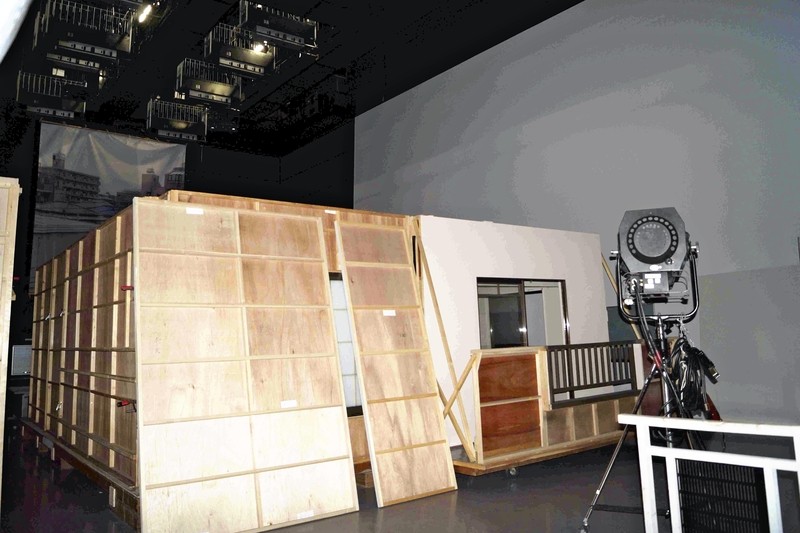
The graduate film school of the Tokyo-based university was located in Yokohama at the behest of the Yokohama city government, which initially renovated a city-owned facility to make large and small studios for live-action films. In 2006, graduate students started working on filmmaking activities. When Hamaguchi enrolled, he participated in a joint production of an adaptation of the Stanislaw Lem sci-fi classic "Solaris," filming on a space station set.
The studios were closed in 2016, however, when a new construction plan was proposed at the seaside area where the studios were set. The university could not afford to build studios on its own. Thus, thoughts of having new studios remain up in the air.
The Yokohama city government has been paying maintenance costs for the graduate school's facilities as well as covering the commissioning fees for education-related projects.
"Amid fiscal difficulties, we have set aside a budget for the film school as a sanctuary," said a city government official, who acknowledged the necessity of having studios, but added, "It would be difficult for us to spend more."
The private Nihon University College of Art, which has also produced a wealth of film industry talent, has multiple studios suitable for producing films or TV dramas, in addition to good-quality equipment. Nevertheless, the private university as well is asking for public support to update equipment for those at the most advanced level.
For vocational schools, their situation is even harsher. According to Toho Gakuen Film Techniques Training College based in Shinjuku Ward, Tokyo, vocational schools receive less public financial support and have no choice but to secure funds for film equipment mainly from tuition. The college seeks to train personnel for their jobs after graduating. However, the college explains that "although we want to teach with the equipment actually used in real filmmaking, in reality, it is difficult for us."
As the Agency for Cultural Affairs has set forth a plan for creating and promoting Japanese films in its planned 2019 fiscal budget, it aims to support the debuts of already accomplished young creators in commercial films. For expanding in overseas markets, it is necessary to create subtitles and conduct promotional activities. These efforts will be subsidized by the Economy, Trade and Industry Ministry and supported by the nonprofit Visual Industry Promotion Organization. Their assistance program, again, will mainly focus on completed works and accomplished filmmakers.
In the current fiscal year, the organization conducted an internship program commissioned by the Agency for Cultural Affairs to give students firsthand experience in filmmaking. But creating an appropriate educational environment is not covered in the program. It falls under the jurisdiction of the Education, Culture, Sports, Science and Technology Ministry, and the ministry urges self-help efforts, arguing that "the simplest and quickest way is securing donations from outside entities such as corporations."
But Tokyo University of the Arts Graduate School of Film and New Media Director Takashi Kiriyama points out, "We have requested donations from outside, but it is not easy."
At arts universities in countries such as China and France, huge studios and the latest equipment are provided. Some countries even allow students to freely use publicly operated studios.
Daisuke Tengan, a director who is also the president of the private Japan Institute of the Moving Image in Kawasaki, insists that more public support is needed.
"The movies and other forms of entertainment are part of culture," he said. "While self-help efforts are required, establishing a world-class environment and public investment are also needed to create new, high-level works."
If the nation seriously envisions a long-term expansion overseas for Japanese films, training filmmakers is essential. Making an effort to build an environment that brings out students' talent will surely contribute to the success of the Cool Japan initiative.
Environment that permits trial and error a necessity
Director Ryusuke Hamaguchi explains his views on why Japan should build infrastructure for discovering more film industry talent.
Filming on a set in a studio and outdoors on location are, so to speak, two wheels of the same cart in filmmaking. They are both necessary filming locations for commercial films, but they are totally different in nature. In a studio, set designers visualize the space of a scene and create the actual set for it. Lightning technicians should plan the light setups thoroughly.
While filming on location requires us not to make mistakes as one mistake could cause trouble to the surrounding area, filming on a set is not the case. Although avoiding a mistake is the basic premise, students should not be afraid of making mistakes. They absolutely need an environment that allows them to make mistakes. In a studio, they do not need to worry too much. Having a place where they can engage in trial and error is extremely important.
To learn the latest techniques and develop their artistic sensibilities, they need facilities where they can exercise their potential. Appropriate support should be given to training for the globally creative in various fields, not only in filmmaking.
(From The Yomiuri Shimbun, Jan. 10, 2019)
Read more from The Japan News at https://japannews.yomiuri.co.jp/