The major blackout that affected 2.95 million households throughout Hokkaido revealed both the fragility of the prefecture's electric power supply system, and the difficulty of balancing the promotion of competition through deregulation while maintaining stable electric power supply. In addition to investigating the causes, the government must also debate the proper course of mid-to-long term policy.
On Sept. 21, the government began a probe into the reasons that led to the Hokkaido blackout.
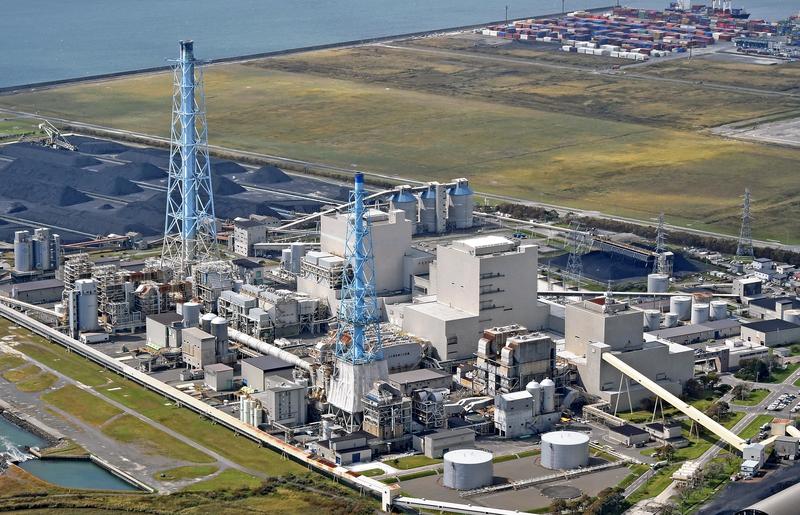
When the earthquake struck, Hokkaido Electric Power Co.'s (HEPCO) Tomato-Atsuma thermal power plant, with an output of 1.65 million kilowatts, was supplying roughly half of the prefecture's electric power. This main power source shut down within 10 to 20 minutes, disrupting the balance between supply and demand of electricity. Power was cut off throughout the region.
HEPCO's response at the time of the earthquake must be uncovered in detail.
However, that alone will not solve the structural problems Hokkaido's electric power supply system faces.
Dependence on Tomato-Atsuma
There is a reason HEPCO depends on a single thermal power station for the majority of its supply. It is the push by the government to deregulate electric power.
Since 2000, deregulation of the retail sale of electric power has progressed sequentially, starting with major consumers such as large corporations and factories. In 2016, it was completely deregulated, including sales to households, generating competition between the major power companies, as well as with companies that had newly entered the market.
Before then, major power companies -- protected by regulations -- were reliably able to recover their expenses on power generation and capital investment through its fees. The business environment has changed significantly, since.
HEPCO's Tomato-Atsuma power plant uses coal, which has a low cost for power generation, as fuel. The decision to raise the ratio of the operation of large, efficient power plants to increase profitability is logical from a business management perspective.
Furthermore, power companies are "moving to decommission, or shut down, inefficient oil-burning thermal power plants and obsolete thermal power plants," according to one senior official at a major power company. Restarting nuclear power plants, with their low cost of energy production, should spur on this trend.
HEPCO also uses coal-fired thermal plants as its main power stations, and has decided to decommission or shut down its old and inefficient power plant in Onbetsu, which has an output of 148,000 kilowatts, and the one in Naie, which has an output of 350,000 kilowatts.
Decentralizing power generation and having a backup power station at the ready are effective means of preparing for a large-scale natural disaster, but there are limits to what power companies can do as private corporations.
Poor efficiency
HEPCO supplies electricity over a vast area. It provides service to 51 customers per square kilometer, roughly a fifth of the average for other power companies, and the length of power lines per customer is double the average for other companies, resulting in poor efficiency.
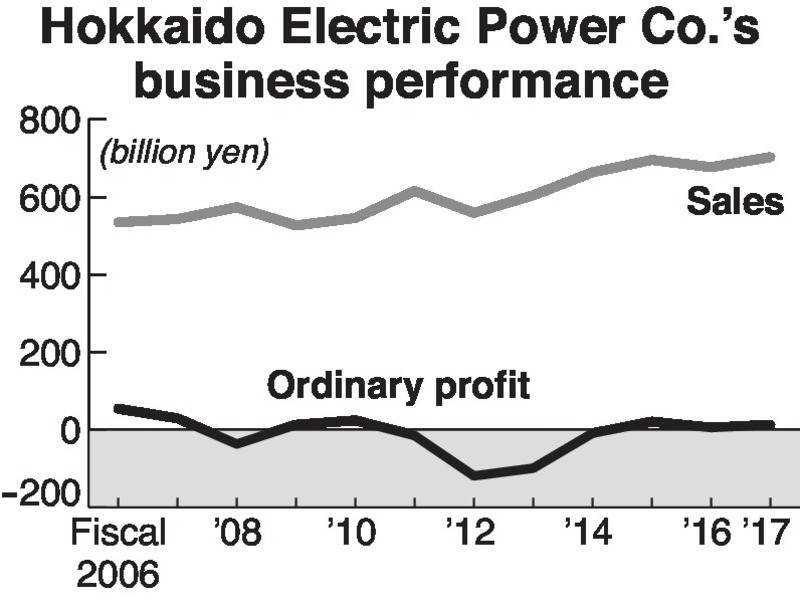
As a result of deregulation, the market share of new entrants known as PPSs (power producers and suppliers) and others is high, accounting for 16.5% of Hokkaido's power usage, and customers continue to leave HEPCO. This was the result of two rounds of price hikes intended to help the company escape operating losses after it shut down its Tomari nuclear power plant in the wake of the Great East Japan Earthquake. HEPCO's capital to asset ratio, which represents its financial soundness, is 11%, the lowest among the nine major power companies.
If Hokkaido's population falls, the cost of maintaining power plants and the power grid will rise. "Sooner or later, they will end up in the same situation as Hokkaido Railway Co., which is struggling to maintain its rail network," a government source said.
HEPCO had been hurriedly working on supply-stabilizing measures such as bolstering its interconnection lines between Hokkaido and Honshu, building new thermal power plants, but they were not able to complete in time.
At the same time, HEPCO has been forced to invest well over 200 billion yen to construct seawalls and other safety measures for the Tomari nuclear power plant, which has been shut down since 2012.
It is highly probable that if this earthquake had occurred in winter -- when the usage for electricity is greater -- it would have taken even longer to recover from the blackout.
An official at a major power company pointed out that if a large cold front were to spread over both Hokkaido and Honshu and drive up electricity usage, there would be difficulty transmitting power over the interconnection lines as well. The Hokkaido blackout demonstrates that major power companies alone cannot maintain adequate, stable supply.
Balancing against cost
The Organization for Cross-regional Coordination of Transmission Operators serves to secure a stable nationwide power supply, and has investigated measures to ensure supply capacity during a large-scale disaster.
They assert that oil-burning thermal power plants, which can be easily restarted, are effective when power supply capacity is lost due to a major disaster. Yet nothing has been made concrete on who should cover the costs for such measures.
The government is planning to set up a new system to encourage the power companies to maintain their thermal power plants while building new ones, to forestall the trend toward decommissioning inefficient ones. However, this will take significant time to implement, and there are some aspects of which the effectiveness is uncertain.
The deregulation of electric power lowered prices and increased consumers' choice. Nevertheless, there is no denying that guaranteeing stable supply has not been a priority.
How will we resolve such conflicts in deregulation? The blackout has brought this serious issue to the fore.
(From The Yomiuri Shimbun September 22, 2018)
Read more from The Japan News at https://japannews.yomiuri.co.jp/