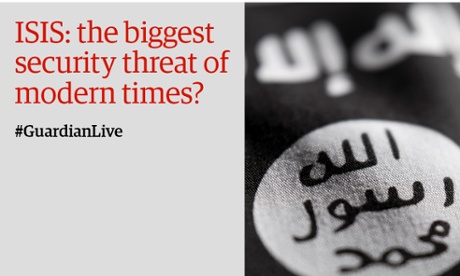
Here’s a snapshot of what our panel thought:
Professor of international relations at the London School of Economics
Isis is a manifestation of the spreading sectarian wars in Syria and Iraq; a new cold war that’s raging in the heart of the Middle East between Shia-dominated Iran and Sunni-dominated Saudi Arabia. Isis has been able to manipulate this sectarian divide and to portray itself as the vanguard against the Shia-based regimes in Iraq and Syria.
The conflict in Syria has been pivotal in providing Isis with money, training and fighters, as well as allowing it to expand its social base. When the Americans left Iraq in 2011, Isis was not Isis in Iraq; it was al-Qaida and numbered 4-500 fighters. Now we’re talking about between 18,000 and 32,000.
What we need now is a bottom-up strategy. We need to dislodge Isis, we need to deny Isis its social base of support. Once this killing machine is dismantled, there are no ideas, nothing will remain except, from what I dread, the deep collective scars on the imagination.
Syria is the nerve centre of Isis. More than two-thirds of its fighters are there. It has given Isis the inspiration and the social capital to build this particular base. But there is no strategy in Syria and I don’t think there is a solution in the near term. We are talking about a 10-year war.
Ex-radical, chairman of the Quilliam Foundation and Liberal Democrat parliamentary candidate
What we need to ask ourselves is why we have up to 1,000 young British-born and raised Muslims who, by Home Office estimates, have gone to join Isis, and why do they seem to be on the more extreme end of the the recruits who have come from the rest of Europe? Those from the UK are more educated and more brutal. We are now unfortunately acutely aware of this thanks to the infamous character known to us as Jihadi John, the executioner.
I think there are four factors we need to consider. Firstly the notion of grievance, whether real or perceived. There is also an acute identity crisis; we are still settling those questions of what it means to be British in the modern age and what it means to be European. The third factor is the role played by charismatic recruiters to plug the void created by those grievances and to provide a sense of belonging to an alternative identity. The fourth and final factor is ideology - in this case the Islamist ideology - which I define as a desire to impose any given interpretation of the religion of Islam over society. This can manifest in non-violent Islamism, working within the system, or it can manifest in the most brutal forms of violence as we see in Isis. To challenge it we have to look at all four factors.
I think we missed a key opportunity when Assad was accused of using chemical weapons on his population to go in very surgically, not putting boots on the ground, but to go in and weaken his ability to kill his own population. And it’s at that moment we failed. It’s at that moment the pendulum swung in favour of factions such as Isis. We let the people down and we’ve never been able to recover from it.
Head of the Egyptian Revolutionary Council and associate fellow at Chatham House (speaking in a personal capacity)
I think the implications of this radicalisation are very much connected to what happened in Egypt and elsewhere in the region in terms of the Arab Spring and its failure so far. The Arab Spring undermined the threat coming from al-Qaida at the time. It was really the most serious response that came from the grassroots in the region, saying that there is an alternative to radicalisation, there is an alternative to violence and that change can be brought about.
Egypt witnessed for the first time post-2011 and the fall of Mubarak the beginnings of a democratic process. While the military was still very much part of the political environment, there were free and fair elections, Egypt had its first freely elected parliament, and the Islamist parties, particularly the Muslim Brotherhood, came to the fore and were willing to play largely by the rules of the game.
All that was upset through a military coup about a year and half ago, and now the political space that was opened up to moderate Islamists has been brutally shut down. By doing that the appeal of groups like Isis and others who promote the idea that armed struggle or violence is the only alternative given the failure of the democratic experiment has only grown, and that is a very dangerous development in our region.
Political refugee from Saddam Hussein’s regime and lecturer in sociology at London Metropolitan University
I don’t think Western inaction is the problem. Western action is the major problem with the rise of Isis. Isis does pose a mortal danger in the area, and when I say Isis it’s short not just for this organisation but a combination of many terrorist groups and political organisations like Saddam’s Ba’ath party in Iraq. They have all combined to produce quite a dangerous situation in the Middle East.
I think the biggest security threat to the British people has been the British government blindly following United States-led wars in the region. These wars have produced catastrophic results. They were fought under the umbrella of humanitarian intervention, of setting in motion democratic change, but if you look around you have the destruction of Afghanistan in 2001, the destruction of Iraq in 2003, the destruction of Libya in 2011, then the destruction of Syria. These are states and societies that have been brought to their knees and within the climate of the destruction of state institutions, these states collapsed.
For Britain and the British people, the sooner our government disengages from blindly following US policies in the region the more secure the British people will be.
The panelists were speaking at a Guardian Live event at the Royal Institute of British Architects in London. Find out about more upcoming events and debates and how to sign up as a member.