May 2014
An email arrives from the English Baroque Soloists’ fixer asking about a huge patch of work at the Royal Opera House in Autumn 2015. An opera by Gluck, a composer with whom I am not overly familiar. But no matter. I don’t even look to see if I am free. Anything in the diary can be cleared. The English Baroque Soloists, Monteverdi Choir, the Royal Opera House, Hofesh Shechter Company, Juan Diego Flórez, Lucy Crowe and of course, John Eliot Gardiner … it’s going in the book IMMEDIATELY!
January 2015
An updated list of dates comes through and it’s confirmed that not only do we have eight performances of Orphée et Eurydice at the Opera House, but further concert performances in Versailles and Hamburg with tenor Michele Angelini. I’ve played at Versailles under John Eliot before: the prospect of the opulent splendour of the palace is an extremely exciting one.
August 2015
We get the final players’ schedule and I am slightly envious of the three trombones – it’s indicated that they will not only be performing on stage from memory but that they have to attend several sessions at an earlier call time to accommodate time for “costumes/wigs/make-up”.
31 August 2015
The first day of orchestra rehearsals. I fail to follow the directions to the rehearsal room given to me by the receptionist and end up totally lost in the lighting rig above the main stage of the Royal Opera House. Being up there is a strangely nice way to start the project, seeing the level of equipment involved in staging an opera at this sort of venue. A kind technician takes pity on me and confesses that, although he’s worked at the ROH for 15 years, he isn’t entirely sure how to find the room I’m looking for. The place is a labyrinth worthy of Greek mythology. After visiting what I imagine must be most of the rehearsal rooms in the building we finally happen upon the Clore Studio.
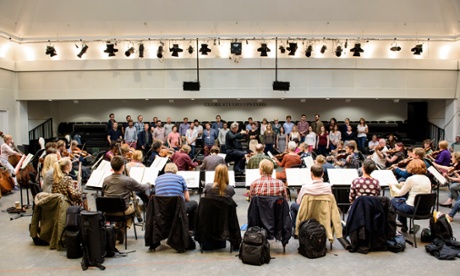
Up to this point my main interaction with the project has been via pictures on social media of the choir and dancers in rehearsal. This is finally the orchestra’s time to find out a little more about the opera and to get to know the music that will be in our lives for the next five weeks. JEG begins by talking to us a little about Gluck, and about the fantastic work done so far by the dancers, the choir and the soloists. He warns those of us with a fear of heights that we will be on a moving platform on stage, which will go up and down to reflect the journey into the Underworld. I am very glad that I am sat on the inside of our desk as I have a history of failing to deal well with being high up. Happily, my desk partner has no such issues.
JEG’s enthusiasm for the collaborative nature of the project is infectious and together we settle to read through the dances that round off the opera.
One of the first things that we notice is a distracting buzz coming from somewhere in the hall. JEG is unhappy about this and a technician is called. A procession of different technicians arrive and look stumped. Eventually, as the orchestra takes its tea break, four technicians (including one on a ladder probing the speakers in the ceiling) discover the source to be a tuning machine which has switched itself on in the leader’s violin case. She offers to buy beers for all of the technicians. JEG sees the funny side and after the break everyone is a little happier for the quiet in between playing.
Discussion is had over the interpretation of the wavy lines over strings of notes, and it is eventually decided that string players should produce a two-fingered vibrato movement alongside bow vibrato in the right hand. The effect is a stuttered sobbing sound, reflecting Orphée’s grief. It’s effective, and although it’s an unusual technique on period instruments it is decided it’s of great benefit. Seeing the words “Russian vibrato” pencilled into a viola part doesn’t tend to happen in works written as early as this one! It’s a very vivid sound world. As viola players we are sometimes doubling the cellos, joining the horns in soaring above the orchestra, or playing nimble flashes of notes as if we were third violins.
For us it’s very different writing to that of the operas produced by Handel for example, where our role is less fluid, mellifluous though his writing can be. Among the members of the orchestra little glances are exchanged through joy at beautiful chord progressions that we are hearing for the first time, chuckles over runs of notes that happen so quickly that we can’t get to them quite in time at first sight, and exasperation over the occasional missed accidental in the edition, or a missed key signature at a new line. In the first three hours it feels like we’ve covered a lot of ground. JEG has been clear about how he will beat each section, including bars which will not be indicated at all where the singers are on their own and we wait to catch them. The bare bones for these movements are now in place.
1 September 2015
We arrive at the Opera House to a tremendous queue at the stage door as the 34 members of the Monteverdi Choir and 55 members of the English Baroque Soloists all sign in at a little window one at a time. These are two very sociable groups of musicians and so it takes a while to get through the area with all the happy greetings being exchanged. By 3pm we are all seated and begin with Act 1 Scene 1 and a Tombeau for Eurydice’s death. JEG asks the choir to sing it unaccompanied so we can catch the nuances in their phrasing and shaping, asking them to shape it in an exaggerated manner so that we can match them as well as possible with the shape of every bow stroke or breath. Hearing them sing unaccompanied is a huge privilege. They sing as if they are one instrument, capable of making a huge array of colours and textures. From shockingly bold and bright, to seductively quiet and everything in between, the Monteverdi Choir show us, in various sections, how to blend our sounds to theirs, and several sections are worked through with this depth of care and attention. They have been working on this piece for a week or so now, and it shows with their unified, polished approach.
After the break we settle down, the choir now gone, to the Overture. It’s a real romp from start to finish with majestic horns and brilliant violins, earthed by celli, basses and timpani with the motor running in the viola section. We only play this once before going back over some shaping and wrangling over awkward bowing in other movements where the phrasing of the texts kicks against the bowing that would come most naturally to us. In the final 20 minutes our Eurydice and Amour join us to run a couple of items. Lucy Crowe as Eurydice is breathtaking. Everything about her voice is extraordinary. We run some awkward corners, full of tempo changes and swift interjections which need to be completely unanimous. Then Amanda Forsythe sings a section from her part as Amour, with the orchestra only just managing to keep up through a maze of changes in tempo and affect. Bold, strong bow strokes turn in the blink of an eye to the quietest, sweetest long notes. We finish for the day with a feeling that something has been secured which was previously likely to topple down at any moment.
2 September 2015
Six hours of rehearsal time have been allocated to the orchestra today, with all three soloists joining us towards the end of the day. Cadogan Hall is full of the scent of coffee at 10am as we take our seats and tune before starting on a sequence from the Underworld at the beginning of Act 2. We work more on the two-fingered vibrato technique in the strings, making the sound even more shrill and intense. Leader Kati Debretzeni says that we are out of the high baroque language of Rameau, but not yet into the properly classical performance practices of Kreutzer and Rode. Gluck had a vivid imagination, his style is on the cusp, reminiscent somewhat of CPE Bach’s Empfindsammer-stil (“The affected style”) in its affectionate quirkiness, but also previewing the proper Sturm und Drang Mozartian dramas. We decide that the techniques which we’re using are legitimate within the context of historical performance practice, and give the notes on the page the “oomph” that they need to fulfil what we assume to be the composer’s intention. We are using a mixture of bows in the orchestra, from baroque, to transitional, to classical. As this opera is not too far from the end of the baroque era there would probably have been a mixture like this in the original orchestra, and so as players we have had the freedom to choose what suits us all best.
JEG concedes that the awkwardness of the words against the bow strokes might be an indication that Gluck simply wasn’t very good at French. We find a solution which seems to fit, before turning our attention to the powerfully dramatic Act of the Furies which closes Act 2 Scene 1. The horns are extremely prominent here, cutting through the orchestra with dissonant calls of warning. I later mention to principal horn Anneke Scott that I think they sound incredible. She tells me, smiling, that sometimes she does think that it must be “weird to play one of those instruments that no-one can hear”. I like this very much. For my part I can’t quite imagine playing an instrument that has the capacity to completely change the sound of an orchestra in the way that a horn can.
Moving on to Scene 2, flautist Rachel Beckett takes the limelight for the Ballet des Ombres Heureuses. We experiment in the middle section with muted strings, reduced strings, and muted, reduced strings before settling on the latter to ensure that Rachel’s beautifully clear tone can be heard. It looks from the schedule as if she will play this on the stage from memory. It’s a captivating moment, and a wonderfully calm contrast to the furious terror that closes Scene 1.
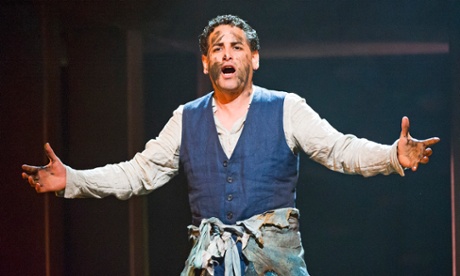
In the afternoon we are joined by Juan Diego Flórez and get to hear our Orphée for the first time. He is marking some of the higher and louder sections for today, no doubt saving his voice for the long run of shows ahead, but the dark intensity of his singing is very much in evidence even here. Tomorrow we are rehearsing in situ for the first time on the main stage at the Royal Opera House.
3 September
This is a musical, not a technical, rehearsal and we play through to check that everything is together and musically coherent. Flórez is singing his items with full voice today and it sounds electrifying. We are seated, as warned, in a sort of fenced-off enclosure in the middle of the stage, so that there will be the possibility of the plot unfolding upstage and downstage of us. For the rehearsal today everyone is behind us, but as there is nothing to watch so far we don’t feel that we are missing out on the action.
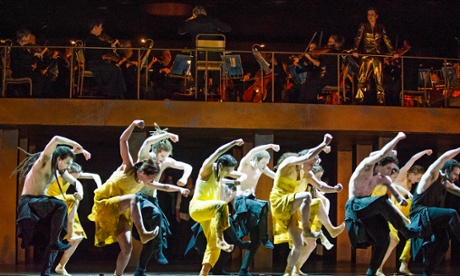
We are introduced to the co-director and choreographer, Hofesh Shechter, the dancers rehearse the Act of the Furies from the end of Act 2. A troupe of male dancers are in front of us as we play, and several of us are completely distracted by what they are doing. They dance with a very low centre of gravity, and move quickly across the stage, like light and agile animals.
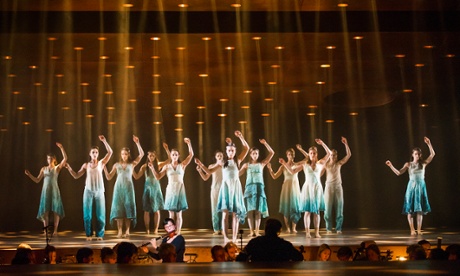
There is something primitive and beautiful about it, and it works well with the dramatic music in the orchestra. We then move to Act 3, set in Elysium. Female dancers stand behind the orchestra platform and move slowly, in perfect unison, with their arms unfolding as if they are trees, branches occasionally ruffled by a breeze. All the dancers seem happy afterwards that their movements sit well with the music, and nothing is rehearsed further.
Monday 7 September
Back at the Opera House after a weekend off for the orchestra, although the choir and soloists have been rehearsing on stage with the piano. This is the first of the technical rehearsals which make up the next few days, with a full dress rehearsal planned for Friday night. Dancers and singers are now in costume backstage and the orchestra have been asked to attend wearing black so that the overall visual impact of the show can be fully studied by the co-directors and their team. We begin in total darkness with a very long pause in which the lights are brought up a little, and it becomes apparent that JEG is waiting for the lights to fully come on before he gives us our upbeat, but that the lighting team are waiting for his upbeat as their cue to bring up our lights.
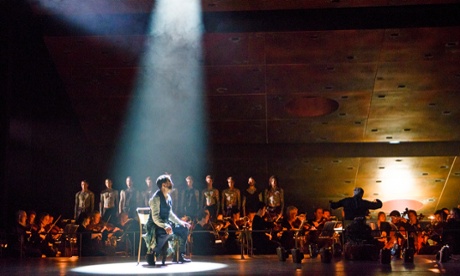
On our music stands we’ve been given a sheet of paper detailing all the moments when the orchestral platform will move up and down, mirroring Orphée’s journey into the Underworld and on to Elysium. Towards the end of the Overture I realise that the ceiling is substantially closer than it was at the start. A worried glance to my left confirms that we are about 10 feet higher than we were at the beginning of the session and, were it not for the platform wobbling with the movement of the choir and dancers beneath, I would have had no idea that we’d moved at all so smooth is the operating mechanism. Having no head for heights I resolve to concentrate even harder on the notes in front of me and JEG’s baton in the distance.
It soon becomes apparent that the screens that relay JEG’s beat to the onstage performers are running fractionally slower than real time, leading him to urge the onstage harpist in Act 2 to “watch me, not that bloke on the screen, he’s late”. Fortunately she has a clear line of sight to where he is on our platform and after a couple of runs the ensemble between her and the small group of string players accompanying her is watertight. This moment comes at a crucial point in the opera where Orphée sings and accompanies himself on the lyre, impressing the guardians of the Underworld sufficiently to be granted access. We in the viola section do wonder if his success would have been the same had he been a viola player. We suspect that the first movement of the Telemann Viola Concerto might not have yielded the same reaction.
There is an awkward moment towards the end of the rehearsal where Flórez makes his way through the orchestra during an aria and begins to sing the words “I can’t get through” as I realise, to my shame, that my chair is impeding his progress and he is trapped in the viola section – although he is extremely nice about it.
Wednesday 9 September
The focus for the next couple of days is Act 3. There is a lot of accompanied recitative which requires minute detail from every player and so there are passages which we attend to repeatedly until we know them inside out. This intense working atmosphere is broken Flórez corpsing – as he struggles to light a match with which to set himself on fire, when Orphée believes his mission to be unsuccessful. The repetitions of this section only seem to intensify his laughter and it’s not long before he is entirely unable to sing.
Friday 11 September
We take our places on stage behind the curtain at the Royal Opera House. JEG has warned us that in the recitatives we should stick with his beat and avoid playing with what we hear from the singers so that we have a unanimous approach, whether or not it fits precisely with the text. The approach to the arias is to be different: here we are to aim for flexibility based on what we are hearing from the team of soloists. We can hear the sounds of the crowd in the auditorium from where we are and it sounds like there is a huge number of people in attendance for the dress rehearsal. Even so, nothing quite prepares us for the moment when the curtain is raised and we have our first packed house. Instantly the atmosphere is different from the rehearsals and the air of anticipation is palpable across the orchestra as we go into the Overture following our cue of three onstage clicks of a cigarette lighter from Flórez on a very dark stage. Performing the work for the first time gives us a sense of the dramatic flow and the structure falls into place. The energy is suddenly completely different and with an audience in attendance the pacing is slightly altered where we pause to receive applause in places, or move straight through between different sections to maintain momentum within the drama.
This opera has an unusual structure. Once the story has concluded we have a suite of dances lasting approximately 15 minutes where Eurydice’s return is triumphantly celebrated. These are extremely demanding for all the players and the focus musically is completely on the band. We’ve been playing for around two hours at this point and the physicality of this is definitely taking its toll, but there is a sense that every player is overcoming this physical and mental exhaustion individually to engage with the huge amount of collective energy being generated.
Before the house lights come up JEG tells us he’s happy with how it has gone. The platform is lowered and he leaves to take his bow. There is a collective sense of a job well done, and many of the players and singers end up in the pub opposite the stage door to have a well-deserved drink or three. Everyone is in high spirits from the adrenaline of the show, and there is a feeling that we have managed to put together something that will doubtless evolve as we go through the run, but the preparation period is finished. We are ready to open in three days’ time.
Monday 14 September (after the first performance)
The opening night was an electrifying and unforgettable experience. From the depths of grief in the shadows to the sunny and triumphant dances at the end everyone on stage was fully engaged and committed. It was a hugely exciting and satisfying way to start the run, made even better by the enthusiastic audience, and I’m proud and delighted to be a part of it.
-
Orphée et Eurydice is at the Royal Opera House, London on 23, 26, 28 and 30 September and 3 October.