Christopher Nolan’s The Odyssey has brought Homer’s epic tale back to the big screen. The film is the latest retelling of a story that is almost 3,000 years old. But why do these ancient Greek stories continue to captivate new generations?
Nolan aside, Stephen Fry’s accessible retelling of Greek myths in 2017 and Disney’s Hercules (1997) film, for example, are part of a much longer tradition of repackaging the ancient world for contemporary audiences.
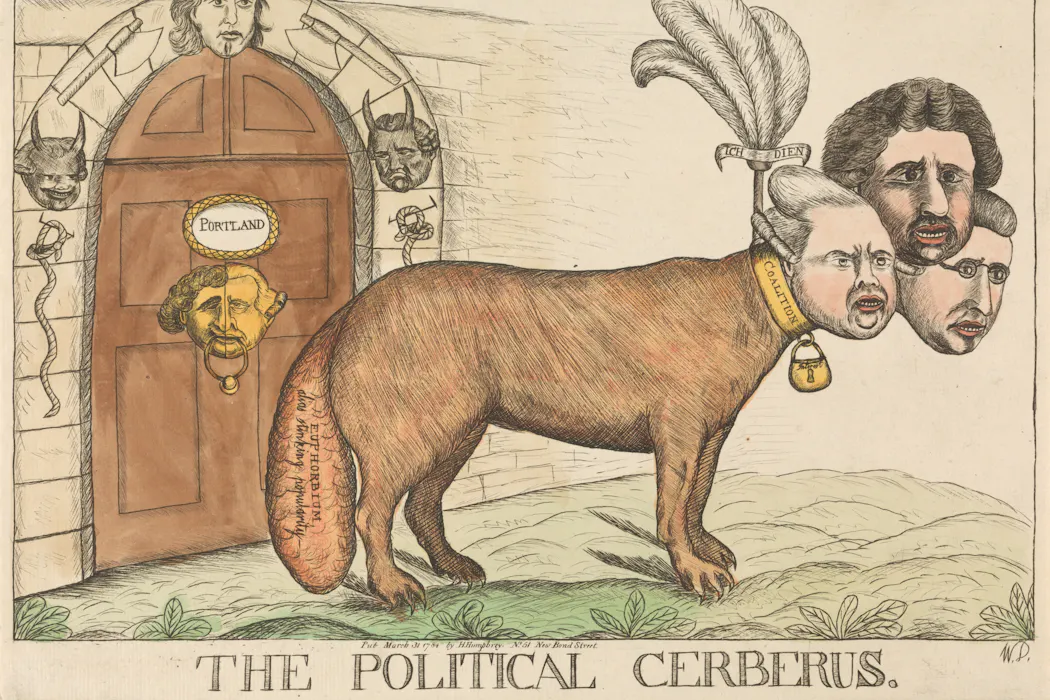
In the 18th century, political caricaturists were doing much the same thing, turning Greek mythology into popular entertainment, and using it to mock the politicians of the day.
Unlike many stories, Greek myths have never had one definitive version. They’ve always existed in multiple tellings, allowing each generation to reshape them for its own concerns.
In the 18th century, satirists used them to attack politicians. Neoclassicism was a cultural movement that revived the art and ideas of ancient Greece and Rome, and it was influential among the educated elite. Knowledge of Greek mythology was part of a classical education, but caricaturists helped turn that knowledge into something a much wider audience could understand and enjoy.
James Gillray and Thomas Rowlandson were among the most accomplished of these artists, while others, such as William Dent, produced cruder and more straightforward political jokes. Their caricatures were commercial products as well as political weapons: single-sheet prints, often hand-coloured, designed to be sold, displayed and discussed.
Greek mythology was particularly useful because its characters came with ready-made meanings. Hercules suggested strength, whereas King Midas suggested greed. The monstrous Hydra suggested a problem that seemed impossible to defeat. Caricaturists could borrow those associations and attach them to politicians.
Politicians as Greek heroes and villains
The politicians Charles James Fox, William Pitt and Richard Brinsley Sheridan were recurring characters in this visual soap opera. Their personalities became familiar through years of caricature. Fox was portrayed as the socialite, gambler and womaniser. Pitt as serious, reclusive and stiff. And Sheridan as a failing, bankrupt politician with a fondness for drink.
The artists could then place these recognisable figures inside equally familiar myths. In The Infant Hercules drawing, Thomas Rowlandson depicts the young Pitt as Hercules, fighting off two serpents representing politicians Fox and Lord North.
At first glance, Pitt is the hero. But the joke is more complicated. By portraying him as an infant, Rowlandson also mocks his youth and inexperience. Pitt became prime minister in 1783 at the age of just 24. His shield hints at the protection afforded by his father’s political legacy – William Pitt the Elder had also been prime minister.
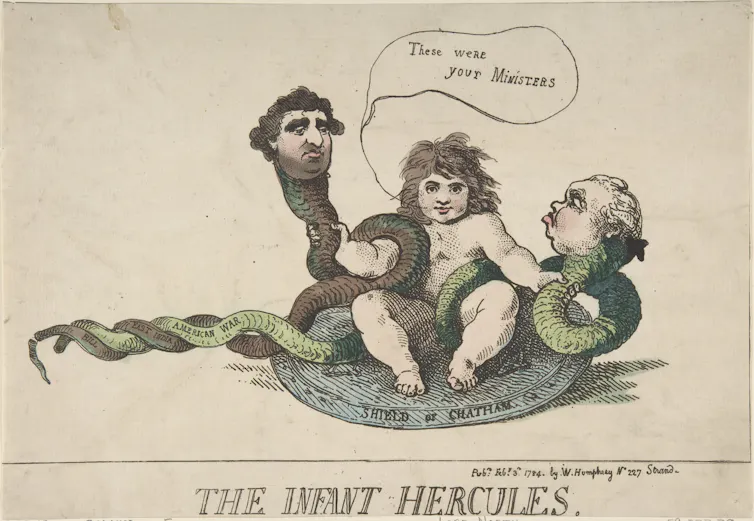
The myth therefore gives the caricature two layers. Even someone with little knowledge of Greek mythology could see the joke, while a more knowledgeable viewer could appreciate the references to Hercules, Pitt’s youth and his political inheritance.
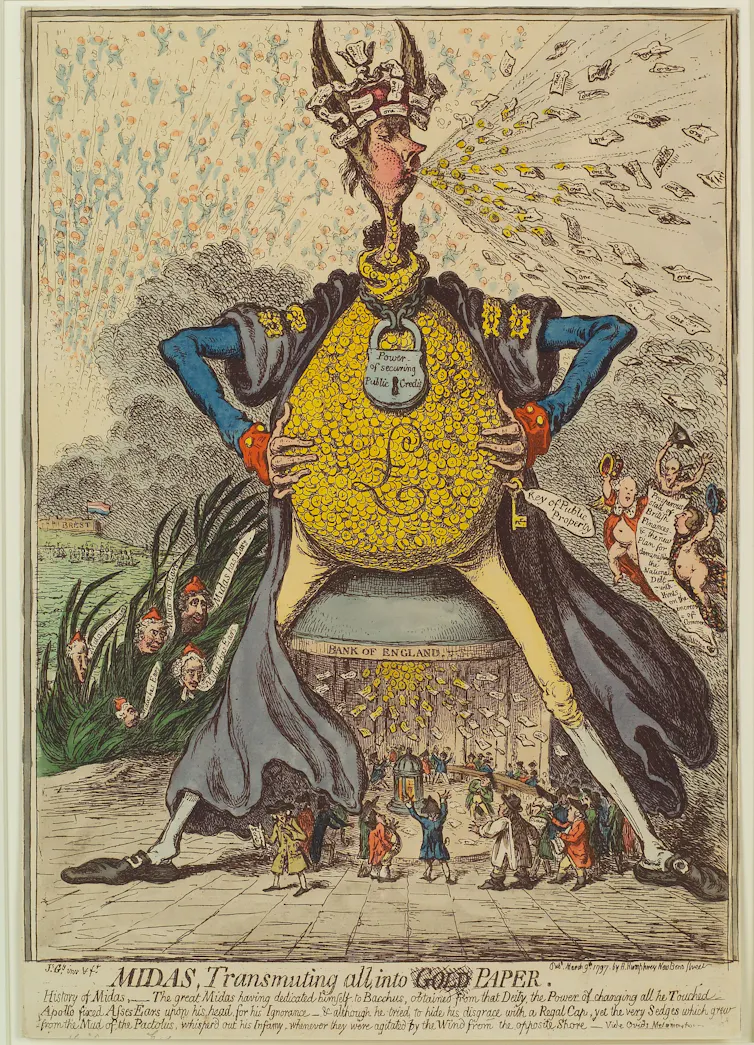
James Gillray used a different Greek myth to attack Pitt’s policies. In Greek mythology, King Midas was granted the ability to turn everything he touched into gold. The gift quickly became a curse.
In Gillray’s Midas (1797), Pitt becomes Midas, turning everything he touches into banknotes. The image attacks Pitt’s taxation policies and portrays him as greedy and self-serving. Gillray also gives Pitt the donkey’s ears associated with Midas, a visual shorthand for shame and foolishness.
The myth makes the political criticism instantly legible. Pitt doesn’t need to be explained at length because the audience already knows what Midas represents. Greek mythology could also be used to attack politicians on a much more personal level.
In Homer’s Odyssey, the nymph Calypso keeps Odysseus trapped on her island. Charles Williams reworked this story in The Modern Calypso, depicting Richard Brinsley Sheridan as Mentor, the friend of Odysseus, in Calypso’s company. Sheridan is shown surrounded by wine, a joke about Sheridan’s alcoholism. The mythology provided the framework, but the target was firmly contemporary.
A joke everyone could understand
This was one of the great strengths of caricature. A political print could operate on more than one level. For someone with little knowledge of classical mythology, the visual joke could be immediate: Pitt as a baby, or a politician with the ears of a donkey. The image could be enjoyed as cheap entertainment, discussed in the street or in coffee houses and displayed in the windows of print shops.
For those with greater knowledge, the same image carried another layer of meaning. Understanding the original myth made the joke richer and gave the political attack greater force.
This helps explain why Greek mythology proved so useful to 18th-century caricaturists. They didn’t need to explain every detail. The stories already provided a shared cultural language.
And that language was not entirely confined to the educated elite. Greek mythology itself had always been a product of retelling. Before the stories were written down, they were passed on orally by performers who could adapt them for different audiences.
Read more: When satire could destroy a career: the scandals of Georgian politician Charles James Fox
The caricaturists of the 18th century were doing something remarkably similar. They changed the medium and the details, but kept the underlying stories recognisable.
Christopher Nolan is doing the same thing today. His Odyssey may have been shown on gigantic Imax screens rather than as a hand-coloured print in a London shop window, but the principle is familiar.
Every generation rewrites Greek myth because every generation sees itself in these stories. The myths survive not because they remain unchanged, but because they can change with us.
This article was originally published on The Conversation. Read the original article.