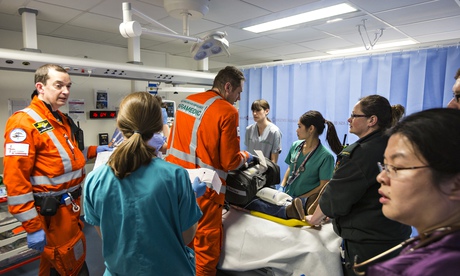
Huge numbers of hospital beds filled with patients “trapped” there despite being fit to leave are adding to the deepening chaos in A&E and forcing operations to be cancelled, a survey of NHS bosses has revealed.
Half of hospitals reported that at least 10% of beds are taken up by “bedblockers”, 50 chief executives and chairs of NHS trusts across England have told a survey for the Guardian.
Two in five also say that as many as one in five beds cannot be used for newly arrived patients who need medical care, according to the research by NHS Providers.At Addenbrooke’s hospital in Cambridge, one of the largest hospitals in England, 87 of 1,000 beds are filled with such patients. One has been there for 70 days after she was declared fit to leave, and another for 59 days, the hospital said.
On Wednesday night, Addenbrooke’s declared it was in the throes of a major incident, meaning it was rationing less urgent care to cope with demand. But the hospital complained that 21 patients have been theoretically fit to go for at least three weeks, 11 for between two and three weeks and 22 for between seven and 13 days. But the hospital is lacking care facilities to allow them to be moved home or to a care home.
Dr Keith McNeil, the hospital’s chief executive, said the situation had forced the hospital to cancel planned operations such as hernia repairs but said it was costing it vital income.
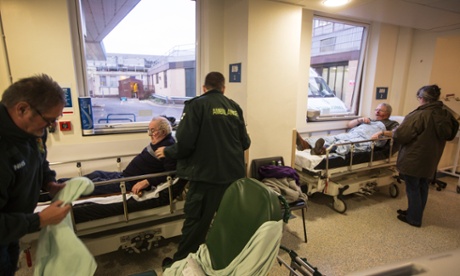
Royal Bolton, which declared a major incident on Tuesday, said freeing up beds and finding places for patients who no longer needed hospital care was its main issue. The Royal Bournemouth and Christchurch hospitals had over 35 such patients and Peterborough hospital, which has declared a major incident for the fourth time since the beginning of December, told the Guardian it had 38 on Tuesday. Yeovil hospital also had over 30 while West Hertfordshire hospitals had 37 on Monday.
Inadequate social care support – a lack of care home beds and a shortage of support to keep people healthy at home – means their occupants, despite being ready to go, are unable to be safely discharged. NHS figures for November last year, the latest available, show that the number of patients in English hospitals who were medically ready to leave but had no arrangements for care afterwards stood at 5,026. Two-thirds were in acute hospitals, the highest number since records began in August 2010. Two-thirds of all bed days lost were down to the NHS, just over a quarter to social care organisations, with the rest attributable to both sectors.
A majority (55%) of the NHS trust bosses questioned said the problem was worse now than a year ago, with many blaming cuts to social care budgetsRespondents said that the growing problem is also:
• Leading to patients having to be put on wards that are inappropriate for their needs, such as a surgical ward for a medical patient.
• Forcing hospitals to open extra wards, known as “contingency” or “escalation” areas, because of the number of bedblockers.
• Making it harder to meet NHS waiting times for planned surgery because the hospital being full is leading to scheduled operations being postponed.
• Wasting vital NHS resources on patients who no longer need them.
• Reducing the chances of elderly patients being successfully rehabilitated.
• Lengthening patients’ stay, which the NHS has been trying for years to shorten.
The charity Age UK criticised cuts to social care under the coalition for creating a system where vital NHS resources are wasted and patients suffer.
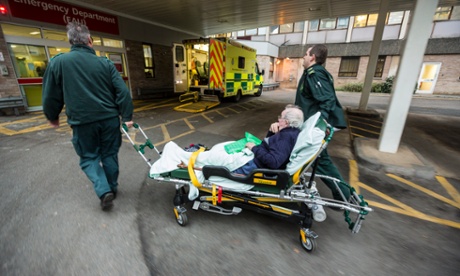
“We know that social care spending has fallen dramatically and that without social care older people are more likely to end up in A&E because of a health crisis. It is also clear that without the proper social care to support them on discharge, whether that be at home or in a care home, stays in hospital are often longer than they need to be for medical reasons,” said Caroline Abrahams, the charity’s director.
“Waiting in hospital for care to be organised not only undermines an older person’s chances of recovery, it is also profoundly upsetting for them and their families. It is madness to waste expensive NHS resources in this way, when it would be much more cost effective and better for older people to ensure good social care is available for them instead.
David Cameron has blamed demand for the problems, saying an ageing population increased the pressure on A&E when they should be treated elsewhere. But the figures suggest that systematic problems are contributing to the strain on hospitals. The non-emergency NHS 111 helpline has also come under scrutiny for the increasing number of people it has been referring to hospitals.
Claims last year by Bruce Keogh, medical director of NHS England, that 40% of patients at A&E do not need urgent treatment, were afterwards disputed by the College of Emergency Medicine, which commissioned research suggesting only 15% could have been seen by a GP in the community.
Kevin Reynard, the college’s vice-president, said: “The issue isn’t, on the whole, getting healthy patients out of hospital. It’s people who have got clinical illnesses and clinical dependencies who need to go into some intermediate care or [are] waiting for social care or other community-based care.”

Unblocking beds was not a cure-all but it would help. However Reynard said it was being made more difficult by cuts to social care. “The squeeze in getting these services provided in a timely way makes it harder for us.”
David Pearson, president of the Association of Directors of Adult Social Services, said the number of older people with multiple long-term health conditions had increased exponentially even as social services budgets had been cut by 26% over the last four years. “That doesn’t make any sense at all from our perspective. We have had to reduce the number of people receiving services by something in the order of 500,000.
“We have about 1.3 million people served by 1.5 million people in social care. This shows the level of need we are dealing with. There needs to be significant investment in community-based health and social care in order to care for more people at home.”
A Better Care Fund set up by the government to spur improvements in this area, and due to begin operating next year, would have no new money, he said.
British Medical Association chair Mark Porter said: “It’s incredible, one in three people who were receiving state-funded care are not receiving it today and that sort of thing ripples back.”
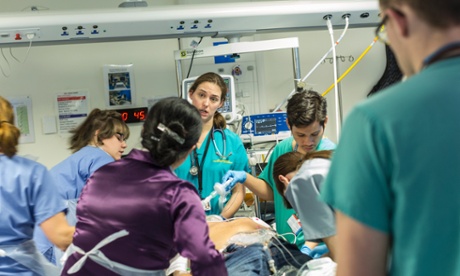
Chris Ham, chief executive of the Kings’ Fund thinktank, said the system was “fundamentally broken” and there was no obvious cure. “We know some of it is due to increasingly constrained social care services but we also know most of the cases are within the NHS, because of a lack of coordination within the NHS itself, for example between hospital and community nursing staff.”
However, Care England, which represents care homes, said the problems lay with poor NHS management. Martin Green OBE, its chief executive, said: “For a number of years, independent care home providers have been offering the NHS increased capacity, in order to deal with the pressures that the health service faces over the winter months.
“These offers have been repeatedly ignored and it is no surprise that A&Es once again find themselves overstretched.
“A broken payment model, in which money flows into the acute sector at the expense of the rest of the health and social care system, has allowed the needs of individuals with complex conditions to escalate to the point at which they have no choice but to present at A&E.”
There were also warnings that the crisis might see an increase in patients taking legal action. Inez Brown, medical negligence lawyer at Medical Accident Group, said: “Many hospitals simply can’t cope with the demand on their services, and now we’re about to enter the flu season when hospitals historically see a spike in patient numbers, the situation could get a lot worse.
“With so many hospitals declaring major incidents at the same time mistakes will be made.”