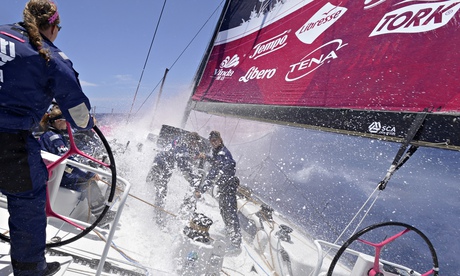
If you were at Alicante port on Saturday, you might have wondered why everyone appeared to be wearing pink. And not a quiet pink either, but magenta. It’s the official colour of Team SCA, the first all-female crew to tackle the Volvo round the world yacht race in 10 years. Walking around the port before the race begins it’s clear which team has the most support. You can’t move for magenta.
The Volvo Ocean Race (VOR) takes place over nine months and covers nearly 40,000 nautical miles. It’s seen as the toughest race in professional sailing and it’s dominated by men. In the race’s 41-year history there have only been four female teams and none of those have had the funding or training necessary to make them serious contenders. But two years ago global hygiene and forests products company SCA decided it wanted to create a team that wouldn’t just take part, but would actually be a threat to the boys.
More than 400 women applied for the 14 spots available on the team and 18 months ago training began in earnest. This early commitment to the project and the amount of time it gave the women together is, according to skipper Sam Davies, the team’s biggest advantage. Significantly less experienced than their rivals, just two of the women have competed in the VOR before, they knew they needed as much practice as they could get.
Coming together early on in the process has given them a chance to bond, something which is going to be vitally important given that they’re spending weeks at a time in just 65 feet of space. It’s also given them time to learn about themselves.
“For me personally, I’ve had to learn how to move from doing everything single-handedly to working in a team,” says Davies. “That means thinking about how we communicate and not trying to do everything myself. This [whole experience] has been a big lesson for all of us, we’ve all had to grow as a team”.
The tiny living space and three extra crew members (the only concession, a nod to the fact that even after 18 months of training they’re just not as physically strong as the men) means that conditions are cramped. Crew member Annie Lush admits it can be difficult but explains that a mix of remembering that everyone is doing the best they can and trying to be upbeat when it’s required is what gets them through.
Early on in training their original coach, Magnus Olsson, suffered a stroke and died. For Lush, trying to bring a bit of Olsson’s spirit onboard for the trip is important.
“He was really loud and always laughing. To him that was one of the most important things. I try to imagine what Magnus would do in those situations [when it’s particularly tough] and try to take on a bit of his character … I sailed with him and it was great to just be with him and learn how he was and how we handled things. He even made me sneak some wine onboard”.
As well as battling through conditions that range from squalls to so little wind that in one early blogpost the team actually felt they were going backwards, the women will have to deal with the sheer length of the race. Finishing in June 2015, they’ll be away from friends and family for nearly nine months, with only the occasional dockside meeting to tide them over. For Lush, these long periods at sea come with additional challenges, just how do you stay positive and upbeat when for days at a time it seems as though you’re losing?
“I’m from a racing and performance background, I find it hard to switch off as I’m always worrying about the extra 2%. In a race like this there are moments where you can lose miles, and some of it is due to your navigation and your choices but some of it is just down to luck. You could lose a hundred miles without doing anything wrong. If you’re losing miles you can claw it back, but it might take days.”
So can they win it? The team behind them certainly believe they’re going to be in with a fighting chance. Both SCA CEO Jan Johansson and the team’s managing director, Richard Brisius, are keen to emphasise that this is the best-trained female team the race has ever seen. For SCA, the sponsor relationship went beyond just putting their name on the boat and instead became about creating a floating vehicle for female empowerment. The women have received physical training, nutritional advice and worked with some of the best coaches in the sailing world. They’ve also taken a different approach to forming a team than the traditional male crewed boats.
Davies is a first-time skipper and, in fact, that’s not even her title. Typically, a boat taking part in the VOR would first appoint a skipper and then the skipper would put the team together. SCA all trained as a team to begin with, before appointing Davies as “the person in charge”. She’s more reticent when talking about the team’s chances: “It’s the team that progresses the most during the race that has the most potential to be on the podium at the end,” she says. “That’s our mentality going into the race – to learn and to improve.”
Atypically, Davies is also open about the support she’s going to be seeking from her crew. Sat in the middle of the other six, male, skippers at an early morning press conference she is the only one to admit any sort of fear or worry about her own performance. In a line of studied macho insouciance, her authenticity is refreshing.
“I had doubts about whether I’d be good enough to do it [skipper the yacht]. I knew I had work to do but within Team SCA I have huge support both onboard and onshore. The team know I’m a beginner so they know I can make mistakes and they support me and help me to make sure we do as well as we can”.
So far, that seems to be pretty well. First over the start line on Saturday, they were, at the time of writing, leading the pack. But it’s early days and for now the team are still finding their sea legs and coming to terms with the fact that what was once an impossible dream is actually happening.
How do the guys see them? “Honestly, I think the guys just see us as another competitor now,” says Lush. “Has that changed? Yeah, probably. I mean, we’re these girls on this magenta boat but we have a really strong shore crew and this is a new class. We’ve been in the boat since the beginning and we’ve been the ones asking the questions, and the guys know that. Also, we’re a massive team. SCA have done a good job of painting Alicante magenta, there’s no doubt that we’re here”.
She’s right, there’s no missing them. And if they can keep going as they started, the boys might have to get used to sailing in their wake.
Six facts about Team SCA
1. In the first 10 months of training each crew member lifted the equivalent of 1m kilos each.
2. The onboard mascot is a cuddly toy version of Barney the purple dinosaur.
3. Annie Lush gained her spot in the boat after refusing to wait for an invite to interview and instead flying to Stockholm, telling selectors that since she was going to be there they had to meet with her.
4. Every time the boat is tacked the crew has to move up to three tonnes of kit below deck from one side to the other. This includes sails, food and other equipment.
5. In order to keep weight down on the boat packing is limited to one bag for each leg. Australian Sophie Ciszek is taking just four pairs of socks for the first leg from Alicante to Cape Town.
6. The team’s official song is Wake Me Up by Avicii. The Swedish producer gave them his blessing to use the song and even allowed them to cover it.