Last Friday night, I was watching Alien in a bar on the Khao San Road, when Leonardo DiCaprio walked past. He paused for a few seconds and then walked on. Then a woman came into the cafe and sprayed me with water. A few minutes later, DiCaprio came past again, and then again. Eventually, he went away, and everyone got up and went for "lunch". It was a quarter past midnight.
Lest you think the heat is affecting my mind, let me explain: I was employed for the night as an extra on The Beach, the film of Alex Garland's cult book, currently being shot in Thailand. The Khao San Road is the heart of Bangkok's backpackers' enclave, but this non-encounter took place in Krabi, a small town 1,000km southwest of the capital. One of the world's most eligible males was a few metres behind me, but I wasn't allowed to look round - I saw only his reflection on the bar's TV screen. We were being sprayed with water, because time had jumped forward to the Thai New Year in April, when everybody celebrates with a big water fight.
The film is being made by the same team - producer Andrew Macdonald, director Danny Boyle and scriptwriter John Hodge - who shot Trainspotting and Shallow Grave. Unlike those films, The Beach is a Hollywood A-list affair, funded by Twentieth Century Fox, with a $40- million budget and a star whose image papers the walls of pre-pubescent girls the world over. And, unlike its predecessors, this movie, which is now halfway through shooting, is already notorious as the focus of passionate opposition and legal moves to stop filming. Pre-production was halted for two weeks for an environmental report last November, and a court case against the makers and the authorities who allowed filming to go ahead is pending.
The Beach is the story of Richard, a young traveller (British in the book yet American in the movie, funnily enough), who opts out of the Lonely Planet-led, trans-Asian amble favoured by the backpacking fraternity, and joins a secret community of beach-dwelling Utopia-seekers. It ends in bitterness and carnage and, while events surrounding the filming have not been quite that dramatic, it hasn't all been fun either.
Macdonald and Boyle decided to film the beach scenes on Koh Phi Phi Leh, a stunning rocky island in the Andaman Sea, which is uninhabited and part of a national marine park. Its highlight is Maya Cove, a semi-enclosed lagoon whose white beach is circled by tall cliffs. But Maya Cove is a popular destination for snorkellers and daytrippers, and is not as unspoilt as it first appears. As the Rough Guide warns, "Unfortunately, the discarded lunch boxes and water bottles of daytrippers now threaten the health of the marine life." Most of the coral in the cove is dead, because the tourist boats anchor in it.
Thailand's Forestry Department gave Macdonald and Boyle permission to film on Phi Phi Leh on payment of four million baht (£66,500), plus a five-million baht bond which will be returned once the island is restored to its natural state. Then they set about preparing for January's two-week shoot. The only thing Maya Cove lacked, the film-makers felt, was coconut palms, to make it look like paradise. The Forestry Department agreed to the planting of 60 trees, on condition that they were removed after filming. The plants that were uprooted to make way for them were stored in a nursery on the island, to be replanted. However, this is a national park, even if it is damaged: people have been fined for taking shells from Maya Cove. Local environmentalists began to protest at what they saw as Hollywood buying a licence to mess around with nature.
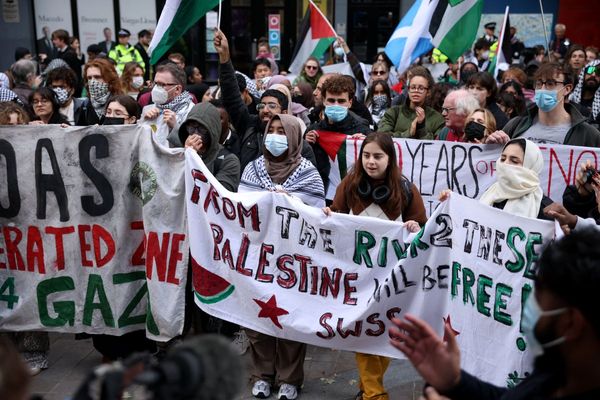
Protesters camped on the beach, carrying banners reading "Change your script, not our beach" and "What a Titanic mistake". Some wore DiCaprio masks. The press, inevitably, began to get excited. The facts became less important.
For example, the ripping up of the beach was interpreted as part of a grand plan to turn the island into "Phi Phi Leo", a tourist attraction like the nearby Khao Ping Gan, Scaramanga's hideaway in the Man With The Golden Gun, which is now a horrible shrine to Bond tat. Phi Phi Leo is supposedly also going to involve the building of a hotel and casinos and the introduction of sex tourism.
So what are the facts? The two Phi Phi islands form one of Thailand's most popular tourist destinations. Phi Phi Don has a tacky seafront that is home to many a massage stall, tour operator and western bar. I ate the worst food I've had in Thailand before moving on to snorkel at Phi Phi Leh, which, though uninhabited, is far from deserted. The Viking Cave is a centre for the wildly lucrative bird-nesting industry, while round the corner, Maya was full of tourists' boats, every one of which was anchored in dead coral.
The facts are that the film-makers did not anchor at all in the bay, and round the other side of the island, every anchor was buried in sand, and no ropes touched any coral. Before they did anything else, the crew removed three tonnes of rubbish. They built boardwalks so there would be minimal impact on the land. Last week, there was no sign of the 60 coconut palms (filming there finished on January 30), though the Forestry Department was rumoured to want to keep them. The sand dunes were being remade. Beach and water were spotless and spectacular.
Anne Miller and Robert Cogen, of Reef Check, a UN-endorsed organisation that monitors coral reefs worldwide, visited during the shoot, horrified by the stories. "No coral appeared to have been damaged in any way," they wrote in the Bangkok Post last week. "In fact, the coral looked a bit healthier than it had. The construction was exemplary by any standard."
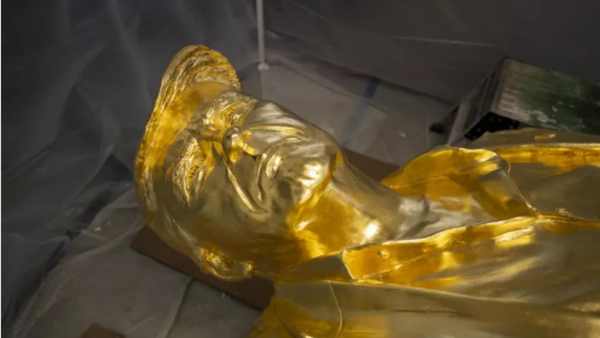
Although the liberal's instinct is to side with nature against Rupert Murdoch, in this instance it isn't fair. In Krabi last week, there was no sign of any opposition. Indeed, a sign near the Post Office was reassuring: "Only Krabi, they choose, so everybody supports you, The Beach". The town, which is a departure point for Phi Phi Leh, had been gearing up for its three nights as Bangkok for some time. When I arrived, I was struck by the enormous golden reclining Buddha in the town centre. It was the most beautiful Buddha I had seen. Days later, I discovered it had been made out of polystyrene, and escorted on a lorry from Phuket with its head and feet covered to avoid offending passers-by. Then came the shops. Notices started to appear on the pseudo-Khao San Road explaining that nothing was for sale: "Just for the filming." Others responded with signs proclaiming that their stock, on the other hand, was real: "Not for the film." It became difficult to remember what was an illusion. Even members of the film crew were rumoured to have attempted to purchase their own props.
The atmosphere on set was astonishingly relaxed, considering the trials of the past few months - even with the addition of 100 backpackers. The selected extras who gathered outside the cinema at 5pm were largely clean and presentable - the crazy elements of the Khao San Road were missing, but hey, this is Hollywood.
I was told to sit at a brightly-lit table at the top of the road, on the opposite corner to the one rounded by Leonardo's tuk-tuk, so almost certainly out of shot. We were able to sit back, drink bad coffee from the van, and watch. Tilda Swinton, who co-stars, was shooting a home movie. The real camera was on a scaffolding tower in front of the cinema, with All Night Dancing written behind it. Leading away, the Khao San Road, like its population, was considerably more salubrious than the real thing, though it gained authenticity when machines began pumping out steam for the polluted effect. Traffic roared past and the tuk-tuk rounded the corner, time and time again, containing Leo's stand-in, a Dutch traveller who is mistaken for DiCaprio not only by children, but also, sometimes, by paparazzi.
Would the real DiCaprio look as good? There was an attempt at studied nonchalance when a dark-windowed Land Cruiser pulled up and he stepped out. A mumble spread as everyone was obliged to inform the nearest person of their initial impression. "He doesn't do it for me," muttered my friend Anna. The first few takes of Richard strolling up the Khao San Road, being drenched in the New Year shenanigans, were ruined by passers-by turning to have a good look.
As he walked, he was offered (with, I feel, some knowing irony on the part of the makers) a trip to Koh Phi Phi. He was also offered a drink of snake's blood. "I was never offered snake's blood on Khao San Road," I ventured to the producer. "This is a movie," he said.
And so the night passed, with surges of energy and troughs of exhaustion. People gave up running to the van for coffee and started heading to the Seven Eleven for energy drinks instead. The all-night pharmacy sold out of diet pills. A Dutch girl at the next table in the diner fell asleep. Some people drifted off, causing continuity headaches (they weren't paying us until the end, to make sure we stayed).
I sat at a table in the deep background of a shot with an irritating Canadian girl, unable to summon the energy to get away from her strident opinions on everything. Nearby, another extra leapt up and photographed DiCaprio. The bodyguards were on to him in a second. "Leo's working," they said. "What does he expect, being so famous?" asked the annoying girl. "He should be able to work," I contended. "We are his colleagues, after all."
"That's true," she said.
"Colleagues."
We had a quiet moment of risible self-appreciation. It was 4.30am. These things happen.
As I watched him walk up the road again and again, I realised that Leonardo DiCaprio is just a bloke with a funny job. Children in the Mekong Delta wear washed out T-shirts bearing his picture. Yet, if he weren't so recognisable, you wouldn't give him more than a second glance on the street. At one point, an extra was reading a copy of Cosmopolitan, turned to a Leo picture, and did an exaggerated double take as he passed. Somehow I think it's a moment that won't make it into the movie.
As it began to get light, things took on some urgency. Paul, Anna and I were walking across the front of the cinema, beneath the All Night Dancing sign. Leo's tuk-tuk rounded the corner (Anna and I are, in fact, sitting at a table drinking coffee and walking past the cinema at the same time in that sequence) and the engine didn't appear to be working properly. The black sky became dark blue. The few clouds became first visible, and then pink. We assumed our starting positions time and time again, and every time we walked as far as the phone box, having an animated conversation, and ducked under the plastic cordon.
Again and again we walked, and the sky became ever lighter. Monks in bright orange robes began to walk across the set between takes, because it was 6am and the day was beginning. Then we had to race to the other end of the set to where we were for the previous shot (looking at Thai cassettes, since you ask), but a cameraman fell over, his camera following him, and shooting stopped for the night.
Krabi was getting back to normal, the Khao San Road was about to be dismantled, and the movie was moving to Phuket. The gold polystyrene Buddha, however, remains in place at the request of the monks of the Wat Keow Gowaram. The protesters have left the set, but the fight goes on in court. A case brought by environmentalists against the forestry chief, the Agricultural Ministry, the film's Thai agent, and Twentieth Century Fox is due on March 26, shortly before the end of filming.
There are many environmental outrages in Thailand - Reef Check cite the bombing of coral reefs in the Similians and the nets that cover the shallow reefs there as examples; half the country's trees have been cut down since 1961 - and the mobilisation of environmental protesters inspired by The Beach may prove to be an entirely positive development. Right cause, wrong (though sexy) focus.