It’s just over a year since unarmed Michael Brown was shot dead by Ferguson county police officer Darren Wilson, sparking mass public outrage throughout the US and much soul searching at the way in which a predominantly white police force applies the law in areas with majority black populations. This week in the same St Louis suburb the situation is little improved, with a state of emergency having been announced as an attempt to stem the continuing violence between the public and the police. To many, especially young males in majority black areas, the presence of an apparently hostile increasingly militarised police force feels less like a public service and more like an army of occupation.
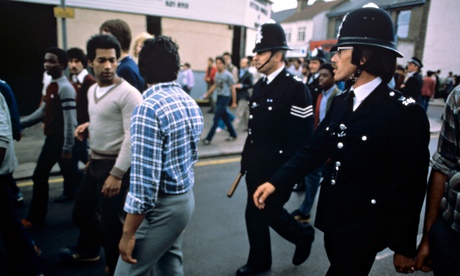
Inevitably then, as I walk up to Brixton police station in London for my Friday night “ride along” with Chief Inspector Roy Smith, I can’t help but wonder how our police force shapes up in comparison. The Brixton riots of 1981 had something of the Ferguson situation about them. But most of the police now stationed here weren’t even born back then. Outside the station a little memorial continues to be maintained for Sean Rigg, a black musician with a history of mental health issues who died in custody here nine years ago next week. I wait in reception – where in April a group of protesters chanting “No justice. No peace. Fuck the police” tried to storm the station only to be driven back with tear gas. No, these issues are not ancient history.
The evening shift begins at 2pm. The chief inspector gives his briefing, things to watch out for, a quick slide show of the faces of bad guys, who come from all sections of society, to find. And then it’s out into Lambeth. Sitting in the police van, the chief inspector boots up his on-board screen with its link to the station. This is where the jobs come in, from stolen bikes to gang murders. But the technology is old and painstakingly slow. It would be so much quicker on his own smartphone, he laments. Years of underinvestment are a major police gripe. And I understand why.
But the biggest thing that makes catching criminals and keeping the peace more difficult is community relations. Two black guys are having a fight outside a kebab shop. One has the other in a headlock. Smith pulls over to intervene. It turns out that they are cousins, play-fighting. As he questions them, others start coming out of the kebab shop to accuse him of racism. A small crowd gathers. In the end, the chief inspector withdraws. At another incident two teenage girls are arrested for shoplifting on Streatham high street. They resist arrest and a number of officers are needed to handcuff them. I can see how it is safer for all concerned to do it with overwhelming force but it certainly looks bad. A crowd gathers. Again the police are accused of racism. I sat next to Doreen Laurence the other day and she was telling me how many times her other son Stuart has been subject to stop and search. It’s a familiar experience for young black men in this part of London and contributes to the common perception that the police specifically target them.
Well, nothing I saw on that shift came close to racism. Nothing. What I saw was good people struggling to do a hard and important job with dwindling resources and getting little but abuse in return. But what I also saw was a public deeply suspicious of them and, in turn, a force suspicious of the public. And the problem was clear. It’s long been a basic principle of our policing that, as Peel put it: “the police are the public and the public are the police.” Yet of the 60 or so Brixton officers out on the streets on that shift, I think only one was black. Just one. And that was the problem in Ferguson too. When Michael Brown was shot, four out of the 53 Ferguson Police Department were black, in an area where 66% were African American. It’s obvious: in order to achieve policing by consent, at the very least the police must look like the public they serve. OK, inner-city clergy don’t always look like their congregations (I don’t). But crucially, we don’t travel in from the suburbs. We live in the places we serve. And that wouldn’t be a bad idea for the police either. For policing has to be of the community, by the community and for the community.