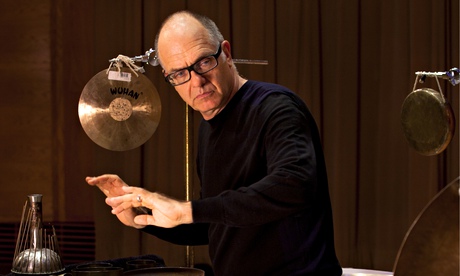
Music by this year’s composer-in-residence, James Dillon, dominated the second weekend of the Huddersfield Contemporary Music festival. Before a final day devoted to performances of all seven of his string quartets, there was a visit by the BBC Scottish Symphony Orchestra, conducted by long-time Dillon collaborator Steven Schick, which included two substantial pieces, one of them being heard for the first time.
That premiere, though, was of a work completed eight years ago. Physis was originally one of a series of commissions by the Orchestre de Paris to celebrate the Berlioz bicentenary, but the orchestra never performed it. It was planned as a diptych, but for this concert Dillon had decided that only the second part should be performed, still substantial enough as a 23-minute single movement. He says that it’s a study in the relationship between musical repetition and musical change, between mechanics and spontaneity; what emerges in performance are passages of extremely refined harmonic and rhythmic stasis, which are interrupted by music that is much more convulsive and unpredictable, until finally it all achieves a kind of resolution in a series of gradually decelerating hammered-out unisons.
It was paired here with another Dillon work from the same period – the piano concerto Andromeda, which was first performed at the 2006 Proms with Noriko Kawai as soloist; she played it again here, as dauntless and indefatigable as ever. Harmonically, the two works share a family likeness, but where Physis is predominantly slow moving and monolithic, Andromeda is much more discursive and diverse – like a series of dialogues with the whole tradition of piano-concerto writing since Beethoven. There are solo passages of impacted Brahms-like intensity, others that are more flamboyant and confrontational, and moments of quiet ethereal beauty. As ever with Dillon’s music, the past constantly haunts the present in an original way.
To be broadcast on Radio 3’s Hear and Now on 24 January.