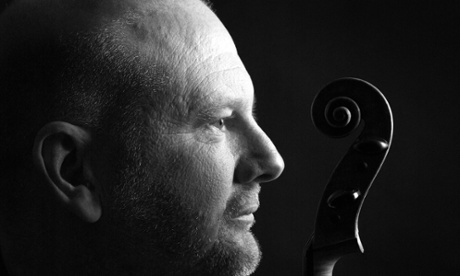
Composers usually await their premieres sitting in the audience, looking stressed and trying to avoid eye contact – especially at the venues that seem to think it’s funny to sit them among the critics. Brett Dean, however, spent the first half of this concert on stage where, as a former member of the Berlin Philharmonic, he was a useful addition to the viola section of the BBCSO in Beethoven’s Eighth Symphony. And the performance, under John Storgårds, was one in which he could have let some of that pre-premiere tension go: big-boned, a little heavy on its feet, but persuasive in the forceful crescendos of the first movement and the bristling energy of the finale.
Dean took his expected seat in the audience for the UK premiere of The Last Days of Socrates, written to a text by Graeme William Ellis and first performed by the Berliners under Simon Rattle in 2013. Its length, classical subject and ritualistic rhythmic drive recall Stravinsky’s Oedipus Rex, but the noises Dean conjures are all his own.
At full tilt, which they often are, orchestra and chorus form a wall of sound that, in the Barbican, was ear-splitting. Elsewhere, Dean drops in vivid spots of colour that can be hard to place: an electric guitar; off-stage violins; a windchime-like jangling from toy bells and house keys being shaken. The latter accompanies Socrates’ description of the swan singing before its death. Dean trips up when a small off-stage chorus “oooohs” at the mention of Hades – it sounds like children playing ghosts. But Socrates’ own swansong, after the hemlock has audibly dripped down his throat, is tinglingly evocative, with the orchestra slipping and sliding out of focus.
The orchestra and the BBC Symphony Chorus were brilliantly committed, and the sonic exuberance of Dean’s music fascinates. Yet even in that swansong, Socrates’ words can sound hectoring, despite the characteristic intensity John Tomlinson lent them here. Nobody expected a happy ending, but this is a strikingly severe 50 minutes.
• On BBC iPlayer until 15 March.