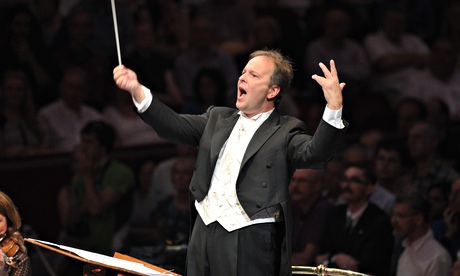
The Inextinguishable, the name Carl Nielsen gave his Fourth Symphony, gives performers a lot to live up to. It’s not a religious work, not even a humanist one – that much was clear in the almost mechanical edge some passages had in this performance by the BBSCO and Sakari Oramo, the latest instalment in their Nielsen cycle. Rather, it evokes the life force that makes nature indestructible: green shoots breaking through concrete.
This was a thrillingly affirmative performance. Oramo powered through the teeming opening section; melodic fragments emerged raw-edged and brazen from within the melee. It seemed artless, and it was meant to: everything was about impulse and propulsion, and any noticeable lingering would have lessened the sense of the elemental. How would the gently perky woodwind tune of the second movement fit with all this? In the event, it took on a beautiful and single-minded inevitability, as if we zoomed in for a few minutes from our soaring overview of nature to a single spider weaving its web.
This is turning out to be an enormously rewarding series, not only for the Nielsen symphonies but for the contemporaneous works with which each is programmed. Here, we were in the turbulent 1910s. Sibelius’s The Oceanides started off with prominent, glassy harp before tumbling into billowing sea-spray music that evoked Debussy’s La Mer – more than usually so in this, a little-known earlier version of the score.
In Zemlinsky’s Six Maeterlinck Songs, the heady orchestra at times nearly overwhelmed Anne Sofie von Otter’s honeyed, crystalline tone, but nothing dulled the confiding expressiveness of her delivery. And Ravel’s Tombeau de Couperin was a rich orchestral showcase that exemplified some of the musical contradictions of the decade: four dances, each dedicated to a friend killed in the war, each infused with longing for a far-off age, yet each pulsing with a zest for life that could be called – yes - inextinguishable.
• On BBC iPlayer until 20 March.