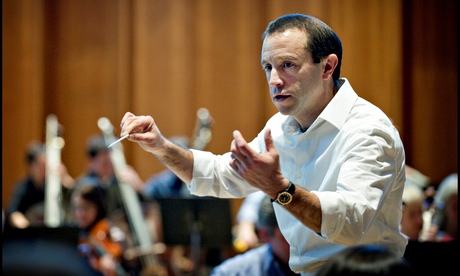
If there are stages in his career that in retrospect appear significant, 2014 may become another for Mark Wigglesworth. His credentials as an interpreter of Wagner were evident when he conducted the BBC National Orchestra of Wales playing Elgar’s First Symphony, influenced by the German, at this year’s Proms. So this performance of The Dream of Gerontius at St David’s Hall, with the same forces and with its debt to Parsifal, was eagerly anticipated. It did not disappoint.
From the opening prelude, Wigglesworth created the mystic aura that surrounds the dying Gerontius, his frailty and his doubts, as though dipping in and out of consciousness. In the process, Wigglesworth established the basis of a colour palette – almost Turneresque in its balance of clarity and haze, and implicitly connected to Elgar’s harmonic language – that he then deployed with masterly control over the whole span of the work. The misty sheen of the BBC NOW strings was notable throughout.
Tenor Peter Hoare appeared to have thought himself into the role of Gerontius, his stance drooping and vulnerable, yet he projected the words of Cardinal Newman’s poem with such precision as to wring out every scintilla of meaning and, even if occasionally under pressure against the loudest orchestral passages, he carried the lyrical expanses of Elgar’s phrasing with conviction. In the role of the Angel, contralto Anna Larsson, a vision in red and gold with voice blazing and burnished, eloquently reinforced the Wagnerian parallels, while Peter Rose was the authoritative bass as both the Priest and the Angel of the Agony.
The BBC National Chorus of Wales, joined by members of the Bristol Choral Society, could have been a bit more demonic, but as the angelic host, their massed choral weight ensured that Praise to the Holiest in the Height, was Elgar at his most glorious.
• Available on BBC iPlayer