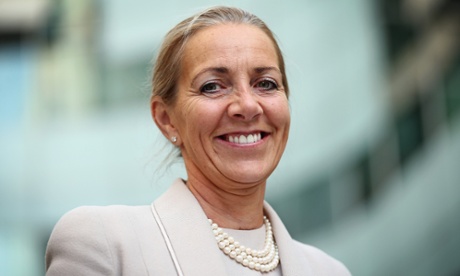
Last week saw Rona Fairhead, the new chair of the BBC Trust, give her first major public speech. It’s a rite of passage for all newcomers as it was for chairmen of the now-defunct BBC governors. All arrive as outsiders and often, in broadcasting terms, unknown quantities. As such all have the capacity to put the wind up the BBC and especially its top management. I remember watching Sir Christopher Bland, newly arrived as BBC chairman with a reputation for being his own man, make one of his first speeches in the mid-90s. Senior executives became visibly more relaxed as he complimented the BBC and its then strategy. By the end they were beaming like Cheshire cats. The chairman had been captured.
This was a bit unfair as Bland remained an independent presence throughout his time at the BBC. But insiders could be heard similarly purring as Fairhead paid tribute to the organisation. She namechecked programmes, talked up the BBC as a space for national culture and moments of togetherness, and made a strong case for its independence from politicians and government, which she undertook to defend at all costs. The BBC, she said, did not belong to the government or the state but to its licence fee payers; and they, not just some political/chattering class “elite”, should decide its future in the forthcoming charter review process. Oh, and a smaller BBC would not be a BBC able to deliver all those goodies we so love.
So far so good, and all stuff to warm the cockles of BBC hearts. But what was missing was any coherent sense of how the body she chairs – much criticised as it has been – is functioning. In terms of representing the licence fee payers’ interests, things have shown some signs of going awry. Take the management’s plan to take BBC3 off-air to go online-only, announced by Tony Hall in March 2014: no plan delivered to the trust until mid-November and the trust’s public value test only launched the week before last. In the meantime BBC3’s controller has left for Sky, the budgets and commissioning arrangements have been rejigged and a new head has been appointed with exciting plans for his new online digital offering. In other words, the trust is left in the ludicrous position of more or less having to agree to the plan since it has already almost happened.
Something similar appears to be happening with Hall’s biggest idea yet – his “compete or compare” efficiency strategy and the associated spinning-off of large parts of BBC production into a new company allowed to compete in the outside market. It was announced in July but no plan has yet been lodged with the trust.
Both these cases point to a fundamental difficulty of the trust system as currently set up and legislated for in the BBC charter. If the trust gets too close to the management – especially to management decisions and strategies, for example signing them off in advance as the board of a public company might do – then the question raised is, is it “independent” enough of managers to hold them to account? If the trust stays too far away (as it was perceived to have done over the executive pay-offs and DMI fiascos) then what’s the point of it? Either way the licence fee payer appears to get let down. It was telling that the research published by the trust to accompany Fairhead’s speech, and used to buttress her arguments for the BBC’s independence, clearly shows significant public demand for the trust’s functions to be carried out by a body acting independently on licence fee payers’ behalf.
All this at a time when the BBC Trust and management will need to be able to speak with one voice to articulate their vision of the corporation’s size, scope and public purpose. At some point Fairhead – who arrived as very much an agnostic on the question – is going to have to tell us whether the trust she chairs can really be made fit for purpose.
Steve Hewlett presents BBC Radio 4’s The Media Show