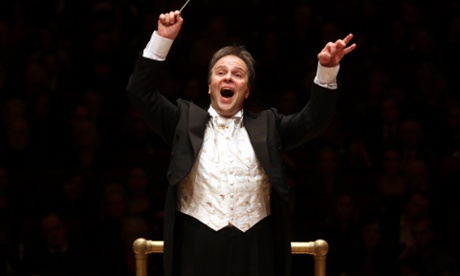
It was left to Sakari Oramo and the BBC Symphony Orchestra to round out the 150th-anniversary tribute to Sibelius at the Proms, which they had launched on the opening night. Oramo opted to go back to where Sibelius’s career as an orchestral composer began, pairing En Saga and Kullervo. The two works, completed in 1892 (the former a tone poem and the latter a symphonic suite), were the starting point for what proved to be one of the most remarkable orchestral journeys since Beethoven.
As Oramo’s urgent performances showed, what is remarkable about both En Saga and Kullervo is that, however much they reveal the 19th-century composers who were Sibelius’s starting point, they also point unambiguously to the future, and to the intensely personal language that he would create for himself within barely a decade. En Saga in particular could not have been written by anyone else. The way in which the tone poem picks up speed as it hurtles inescapably towards its end, looks forward to the way in which the first movement of the Fifth Symphony would transform itself into a scherzo a quarter of a century later. It is a reminder that, musically at least for Sibelius, the line between tone poem and symphony was always a narrow one.
With its uneasy mix of the descriptive, the operatic, and the symphonic, Kullervo is a much more problematic piece. The outer movements are magnificent, the central duet between Kullervo and his sister-lover totally unlike anything else Sibelius wrote, but the two decorative movements that flank it are late-Romantic routine. Oramo made no apologies for its weaknesses, and his totally coherent account sometimes suggested that Tchaikovsky’s Manfred – whose central character is just as flawed as the haunted Kullervo – was one of Sibelius’s models. The male voices of the Polytech Choir from Helsinki and the BBC Symphony Chorus supplied the baleful, runic narration; in the central movement the role of Kullervo was sung with operatic panache by Waltteri Torikka while as the sister, Johanna Rusanen-Kartano showed that, even in the Royal Albert Hall, it’s still possible for a soprano to make every word distinct.
- Available on BBC iPlayer until 28 September. The Proms continue until 12 September.