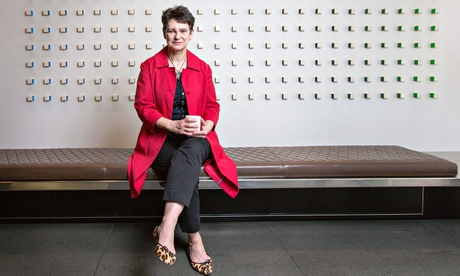
When economist Diane Coyle joined the BBC in 2007 as one of its first trustees, the corporation was emerging from the aftermath of the Hutton inquiry with a new charter and a new governance model designed to protect its independence from political interference and subject it to greater scrutiny.
Eight and a half years later, as Coyle departs having risen to become BBC Trust vice chair, the BBC goes into negotiations for a new charter and licence fee facing questions about the future of its governance and potentially – if the headlines are to be believed – some of the same threats to its independence.
But Coyle, with her background not only at the BBC but as economics editor of the Independent and a former adviser to the Treasury, says she does not think the Tory majority “makes a lot of difference in practice”.
She explains: “In the Conservative party there are more people who are ideological about the BBC and would want to pare it back”, but “I think the government and [new culture secretary] John Whittingdale are actually quite pragmatic and recognise among the people who vote for them that the BBC has great popularity.
“If politicians really stop to think about it they recognise independent scrutiny from the BBC, although it can be uncomfortable, serves them better than anything else. All the research I’ve ever seen says that people, on the whole, like the BBC and want it to carry on and don’t want it interfered with…I think grown-up politicians will not be daft enough to ignore what people think about it.” And she thinks that, “Whittingdale, despite the headlines, is actually a good choice. He’s really well-informed. He’s a pragmatic, sensible man. He knows people in the independent sector and around the country.”
However Coyle believes another “shotgun” licence fee settlement of the kind the BBC went through in 2010 would be “scandalous”. “I think making sure that the audience voice is heard and there’s a proper and transparent process is really important because…the 2010 licence fee settlement was highly unsatisfactory and I don’t think it’s acceptable to have anything like that again.”
The Conservatives have previously indicated they want to scrap the trust, and its chair Rona Fairhead has suggested there should be a “transfer [of] the trust’s responsibilities for regulation and accountability to an external regulator”.
Coyle thinks there should be a debate about different models but says: “In any governance change guaranteeing independence is pretty fundamental. There are two sides to it, one is accountability of the BBC to the people, and the other is the independence from political interference. By an accumulation of small changes over time that has been eroded.”
Those changes range from more examinations by the National Audit Office to being included in overall government accounting. “We have to find a balance between proper accountability to parliament and not going [before select committees] every three weeks because there’s been something in the headlines,” says Coyle. “I think there have been occasions when parliament has strayed into editorial territory when it shouldn’t have.”
The way to stop the corporation’s independence from being encroached upon is “by having a discussion, by having a debate about it” and including the BBC’s commercial rivals, who she says do understand the mixed creative ecology and that “being able to operate under the British cultural halo the BBC helps create really helps.”
Coyle is in many ways an embodiment of the BBC, having listened to and learnt from it as a child growing up in , where she attended Bury Grammar School, and she says in the past it gave her a window on the world
Lancashire. She also had a “worm’s eye view” of the corporation through her husband, BBC technology correspondent Rory Cellan-Jones.
So it was no surprise that she would want to go for the top job of chair after she stood in as acting chair last year when Chris Patten had to step down due to heart surgery. What was a shock was that she was not even shortlisted. “I was surprised and disappointed,” she admits.
Was she given any explanation for the decision?
“No. But that’s water well under the bridge now,” she says.
Those who chose not to shortlist her might have been having second thoughts when Fairhead hit the headlines earlier this year in the aftermath of the tax avoidance scandal at HSBC, where she has been a long-serving non-executive director. Public accounts committee chair Margaret Hodge said Fairhead had “lost my trust”.
Did the publicity damage the BBC Trust? “No. It’s a temporary storm I think. Rona’s made it very clear the trust is her top priority.”
When asked if Fairhead’s HSBC role matters, Coyle answers: “It’s hard to know for sure what would have happened if I’d been in that position. There would’ve been something. I think the role attracts attack.”
However she says it is an “overstatement” to call it a poisoned chalice: “It’s an incredibly rewarding and important public service role but it does attract a very high profile and that’s the character of public life now.”
She says if she had got the job, there “would’ve been something to do with my economics, I don’t know. There’d have been something”.
However nothing adverse has emerged during her
time at the Trust (“Maybe I’m just too boring!” she jokes) and she has a reputation for being a hard-working, safe pair of hands.
As befits a true economist – her books include The Economics of Enough – when she flew back from her family holiday in Australia to take over from Patten, after he stepped down due to heart surgery, she flew economy.
She also paid towards her own leaving party, which was attended by all the previous trust chairs, including Patten. If she had become chair what would she have done?
“I don’t think I would have done anything different from what Rona has done. I think she’s proving an excellent chair,” Coyle says.
She reckons the BBC Trust is “actually a pretty good model” and with some improvements could do the job as well as any alternative.
“It’s a lot more settled as time has gone by. When we first started everything was new so there were practical teething problems, and then over time we’ve had periodic reviews of how we’ve operated with the aim of clarifying things. Given things that have occurred such as DMI [the axed £100m Digital Media Initiative] and [senior executives’] severance pay, getting more clarity around the responsibilities for operational matters has come into focus.”
“Service reviews, public value tests, the editorial complaints process have all worked well in holding the BBC to account in a way it never was before, and in making sure there’s a structure to take account of the views of audiences whether it’s the research and formal consultations.”
An undoubted low for the BBC Trust, though, was the Jimmy Savile scandal and its fallout, which led to the departure of director general George Entwistle in 2012. “Savile was certainly the most depressing because of the character of the revelations,” Coyle acknowledges. “Once we got past the crisis and George leaving and so on, the internal maelstrom, I think the organisation has responded strongly to what was revealed in terms of BBC procedures and policies, and also thinking about what it says about giving a voice to people who weren’t listened to at the time. That’s important.”
Her highlights have included meeting “all the people who make the BBC tick” around the country. Plus visiting the BBC’s transmitter in Droitwich “because I’m a bit of an anorak and just going and seeing how it worked was amazing. There’s a cage around the electricity generator and the kit, and if you put your ear to the fence you can hear The Archers because of the amount of power going through it.”
She thinks the BBC is in good shape creatively, citing favourite shows such as Call the Midwife, Strictly Come Dancing and the drama Hinterland, and says that it is improving diversity, though that could happen a bit faster.
Post-BBC she is planning a new economics book about social welfare, teaching at Manchester University and giving “some TLC” to her economics consultancy. Plus, “I’ll have a holiday” because taking over as acting chair meant: “I didn’t have one last summer.”
Curriculum vitae
Age 54
Education BA, Brasenose College, Oxford (PPE); MA, PhD, Harvard (economics)
Career 1985 senior economic assistant, HM Treasury 1986 senior economist, DRI Europe 1988 internship, the Economist 1989 European editor, Investors Chronicle 1993 economics editor, the Independent 2001 member of Competition Commission 2006 BBC trustee 2007 joins migration advisory committee 2009 Independent Review of Higher Education Funding 2011 vice chair, BBC Trust 2014 acting chair 2015 professor of economics, University of Manchester